Nguyen Ngoc Phung Kieu from Quy Nhon, a first-time traveler, is planning a trip to Tokyo in march with a group of 5 friends to see cherry blossoms. She is seeking clarification on items prohibited from entering Japan.
Visitors to Japan are strictly prohibited from bringing fruits, vegetables, meat, and meat products into the country, as it is illegal. This guidance comes from the Japan National Tourism Organization (JNTO) and Maff.go.jp, the official website of Japan's Ministry of Agriculture, Forestry and Fisheries.
"Japanese law strictly prohibits bringing in fruits, vegetables, meat, meat products, and many other items," according to Maff.go.jp.
Violators who intentionally bring prohibited items into Japan may face severe penalties: up to three years in prison or a fine of up to 3,000,000 JPY. If customs officials suspect malicious intent, they will report the individual to the police.
Beyond these items, certain plants, such as seedlings, seeds, grains, and legumes, though not entirely banned, require a phytosanitary certificate issued by the exporting country's government agency. Soil and live insects are also prohibited. Even fresh fruits and vegetables found in airplane meals are not allowed; passengers should consume these on board and avoid carrying any leftovers off the plane.
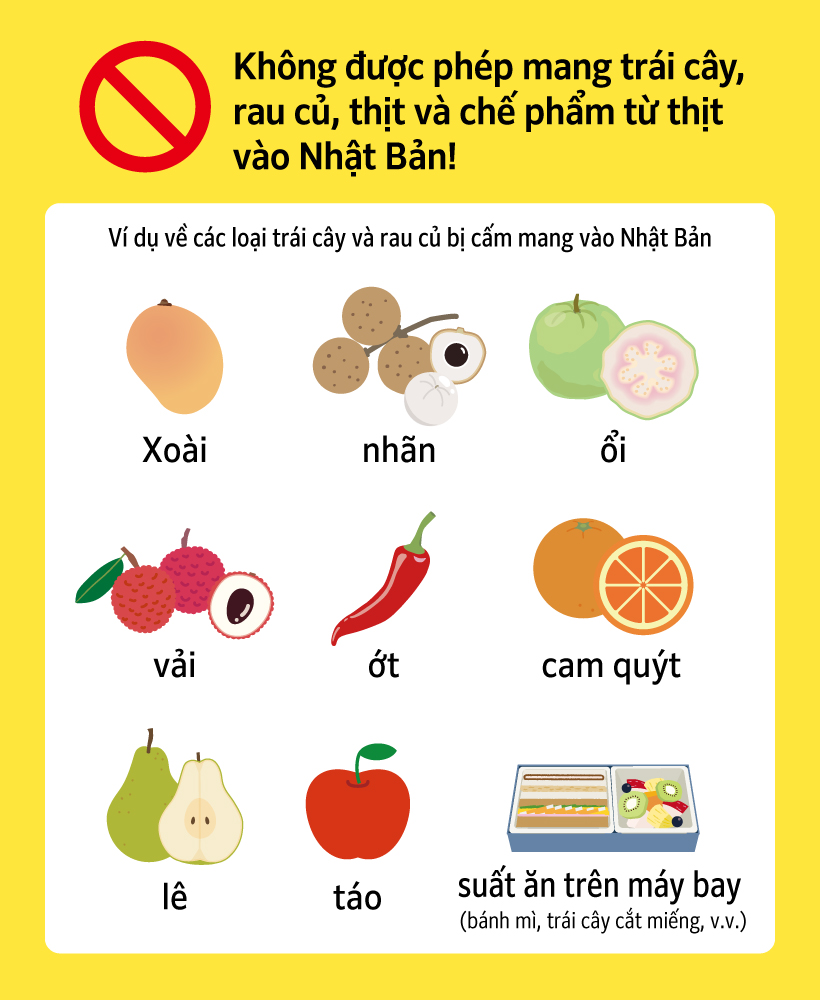 |
Examples of prohibited fruits and vegetables in Japan include: mangoes, longans, guavas, lychees, chili peppers, citrus fruits, pears, apples, and cut fruit in airplane meals. Photo: Maff |
Examples of prohibited fruits and vegetables in Japan include: mangoes, longans, guavas, lychees, chili peppers, citrus fruits, pears, apples, and cut fruit in airplane meals. Photo: Maff
The prohibition on meat and meat products extends beyond primary meat items like fresh ham, sausages, cured sausages, bacon, and dried meat. It also includes products containing even small amounts of meat, such as: meat-filled dumplings, gyoza, meat buns, ham sandwiches, and gimbap.
There are no exceptions for products that are vacuum-packed, cooked, sold at airport duty-free shops, or labeled in Japanese. Furthermore, visitors are not permitted to send these prohibited products to anyone in Japan via international mail.
**Reason for the restrictions**
According to Maff.go.jp, the Japanese government implements these strict regulations to prevent the introduction of foreign plant pests and animal infectious diseases. Many countries worldwide experience outbreaks of diseases and pests that cause significant damage to crops, such as fruit flies and blight. These diseases and pests pose a risk of adhering to fruits and vegetables, potentially entering Japan and leading to the bans.
Additionally, several animal infectious diseases not present in Japan, such as foot-and-mouth disease and African swine fever (ASF), are currently occurring overseas. These diseases are known to be transmitted through meat and meat products, and there have been numerous reports of animal infectious diseases spreading to distant countries via contaminated meat. Therefore, bringing meat and meat products into Japan is strictly prohibited.
Contact with livestock or stepping on cultivated soil can transfer animal pathogens to a visitor's clothing or shoes, potentially introducing them to Japan. To mitigate this risk, visitors should avoid entering livestock facilities or live animal markets before traveling to Japan. If contact with livestock or entry into such facilities occurred prior to arrival, visitors must report to the animal quarantine counter upon entering Japan to have their shoes and clothing disinfected.
**Inspection upon arrival in Japan**
Upon arrival at airports and seaports, quarantine officers from the Plant Quarantine Station or Animal Quarantine Station will inspect luggage and parcels. They ensure no prohibited items are brought into Japan. These officers will inquire about the presence of banned items and utilize sniffer dogs trained to detect prohibited plants and animal products.
Visitors may be asked to open their luggage or parcels for inspection, and active cooperation is appreciated. The inspection process may take time, as passport and boarding pass information might be recorded during the check.
Minh (According to Maff, JNTO)