"I cannot come to your location, you need to walk to where I am parked," Katie Williams, an Australian tourist, received this message just seconds after her Grab driver accepted a ride in the Canggu area. Despite Katie explaining that her parents were elderly, the driver refused to enter the hotel, citing it as "too dangerous".
After two cancelled trips, Katie's family had to accept paying double the price for a local car service. Her hotel was located in an unofficial "no-go zone" for ride-hailing applications on the island.
This situation stems from a territory dispute between ride-hailing companies and the authority of the *banjar*, or village community councils. In Bali, these self-governing units have the power to set taxi fares for drivers operating within their jurisdiction.
Local drivers impose non-negotiable fares and always charge for two-way trips. Nyoman, a local driver, stated that he retains 70% of the revenue from each trip, with the remainder contributed to the *banjar*'s charity fund. He described ride-hailing applications as a "threat" that lowers market prices without contributing to the community.
"In Bali, we protect our traditions and land," he said.
Typically, a ride from Denpasar International Airport to Singaraja costs between 800,000 to 1,000,000 rupiah (45-56 USD). However, if tourists use a ride-hailing application, they would pay only two-thirds of that amount.
 |
Tourists stroll on a beach in Bali. Photo: Tempo English |
This price disparity has led to fierce competition and incidents of violence. In January 2023, a ride-hailing driver was assaulted for picking up a passenger outside a restaurant. Late last year, Canggu police arrested a local driver for blocking a vehicle and extorting 150,000 rupiah (about 10 USD) from tourists on their way to the airport.
"Violence is not a good solution, I don't like it," Nyoman remarked, even though he acknowledged it is often unavoidable and continues to occur.
On social media forums, many tourists have expressed frustration, labeling the situation a "taxi mafia". Some reported being threatened with violence by intoxicated drivers if they refused their services.
In response to these issues, the Bali island government in 2024 had to issue a warning advising international tourists to thoroughly research the "internal regulations" of their accommodations and recommended that hotels be transparent about transportation services to prevent conflicts.
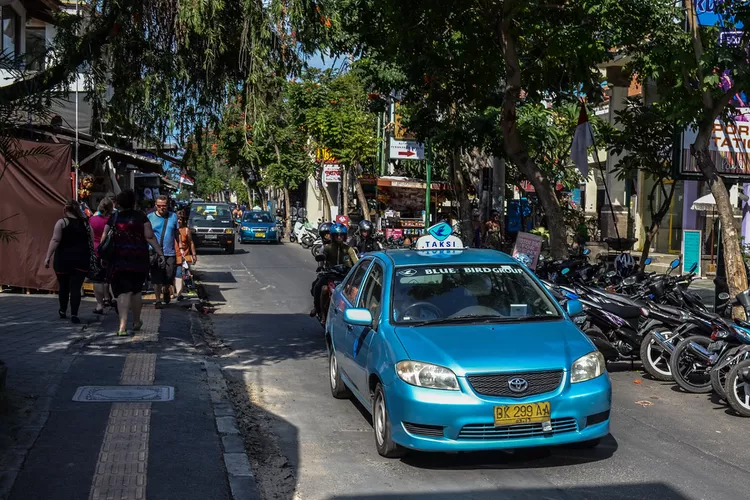 |
Taxis move on a road in Kuta, Bali. Photo: e Guide Travel |
In the first three months of this year, the number of international visitors to Bali decreased by approximately 800 daily, according to Bali Governor Wayan Koster. However, this decline was largely attributed to the Middle East conflict, which resulted in reduced flight schedules.
For Bali's hospitality sector, this unofficial competition has become a burden, negatively impacting business operations.
According to Wayan Kariasa, manager of The Ariras resort in Candidasa, eastern Bali, ride-hailing applications are largely inactive there, with local drivers dominating the market. To reach the main beach in the area, tourists need to travel an additional 8 km. They find it difficult to call ride-hailing taxis and often must use local drivers' services. Kariasa noted that his guests are "not very happy about the prices of the drivers".
A Grab ride from Kariasa's resort to Virgin beach is estimated at around 30,000 rupiah (2 USD). Local drivers charge 10 times that amount, or sometimes up to 500,000 rupiah (28 USD) if they perceive they can extort more from tourists.
However, Kariasa cannot complain. Local authorities control the roads outside the resort gates, and maintaining a good relationship with local drivers is something he must protect as carefully as any TripAdvisor review.
Similar predicaments occur in Sanur, parts of Ubud, Uluwatu, and Canggu, forcing tourists to weigh their options between ride-hailing apps, local prices, and walking.
Despite this, adapting to the situation is not a solution. The restricted zones on the island persist, and many believe the Bali taxi conflict is "far from over".