If you frequently travel by air, especially on international flights, understanding power bank regulations is essential. By late January 2026, many major airlines worldwide had tightened rules for power banks to minimize fire and explosion risks.
This does not mean power banks are banned from airplanes, but the method of carrying, their capacity, and usage are now under stricter control. If you are preparing for a flight in 2026, travelers should note the following guidelines from Mr. Huynh Manh of Bucketravel Tourism Company, TP HCM, to avoid baggage delays, refusal of transport, or issues at the airport.
Why power banks are regulated
Most power banks today use high-energy lithium-ion or lithium-polymer batteries. While this allows for compact devices, it also poses a fire or explosion risk if damaged or overheated. According to the International Civil Aviation Organization (ICAO) aviation safety report, lithium batteries are categorized as high-risk items for fire hazards within aircraft cabins.
In recent years, several incidents involving power banks have occurred, such as smoke in the cabin or devices overheating in luggage, leading to emergency landings for some flights.
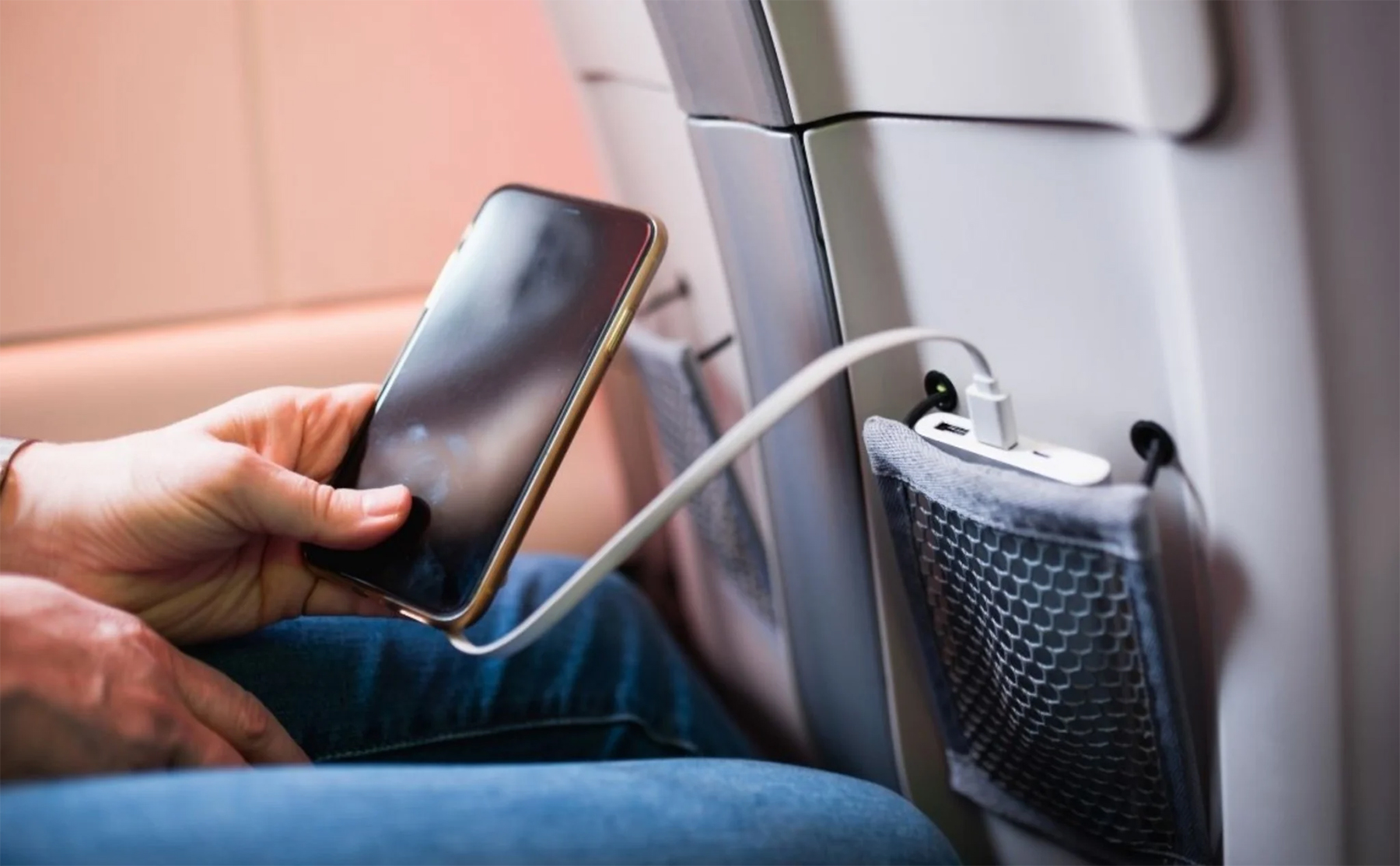 |
Do not use power banks on the plane. Photo: Hoang Anh
Power bank capacity regulations
Battery capacity is a key factor when bringing a power bank on a plane. Global airlines now apply regulations based on safety standards from the International Air Transport Association (IATA) and ICAO. Typically, battery capacity is listed on the device in mAh (milliampere-hour). In aviation, the limit is calculated in Wh (watt-hour).
When checking your power bank, passengers should convert the capacity to determine if the device is permitted on board. The formula is: Wh = (mAh ÷ 1000) × V. For example: 10,000 mAh × 3.7V = 37 Wh. Most power banks on the market fall between 30-80 Wh, making them permissible on airplanes.
Power banks are divided into three main groups, each with different regulations:
Batteries under 100 Wh (approximately under 20,000 mAh)
This is the most common group of batteries carried by passengers. These power banks typically have capacities of 10,000 mAh, 15,000 mAh, or 20,000 mAh. They are generally used to charge phones, tablets, wireless headphones, or other personal electronic devices.
Under current aviation safety regulations, power banks under 100 Wh are considered safe. Specific rules are:
- Permitted in carry-on luggage; absolutely prohibited in checked baggage.
- No prior approval from the airline is needed.
- Each passenger may carry a maximum of 10 such batteries.
Power banks of 10,000 mAh or 20,000 mAh rarely encounter issues at security checkpoints, provided the device has a clear capacity label and is properly stored. Keep them in an easily accessible location for security personnel to inspect if needed.
Batteries between 100 Wh - 160 Wh (approximately 20,000 ~ 32,000 mAh)
This group includes larger capacity batteries, often used for specialized equipment requiring more power, such as professional video cameras, high-performance laptops, editing equipment, or certain personal medical devices. Due to their higher capacity, these batteries pose an increased risk of heat generation if an incident occurs. Therefore, airlines require strict control. Specific rules are:
- Prior approval from the airline is required.
- A maximum of two batteries per passenger is allowed.
- Must be placed in carry-on luggage, not checked baggage.
In many cases, check-in staff may ask for a declaration of battery capacity or inspect information printed on the device before allowing it on the plane.
Batteries over 160 Wh (over 32,000 mAh)
This type of battery is not permitted on board under any circumstances. Batteries with capacities exceeding 160 Wh are classified as hazardous for air transport. This rule applies to loose batteries, extremely large capacity power banks, or devices containing lithium batteries that exceed the permissible power limit.
If these types of batteries need to be transported, passengers must arrange for specialized cargo transport, following specific packaging and control procedures as per aviation regulations.
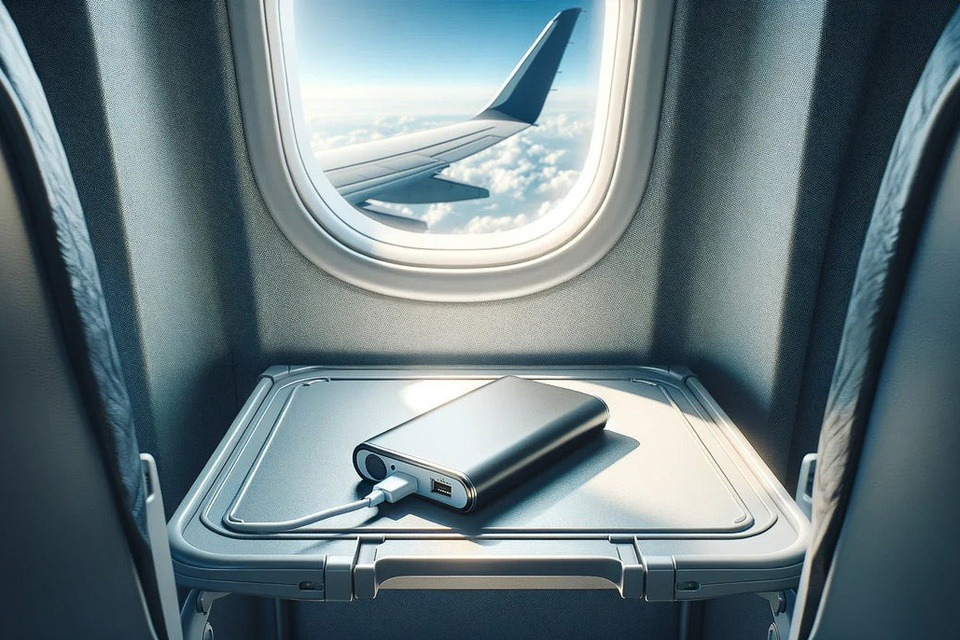 |
Power banks must be placed in an easily visible spot. Photo: THTourist
Important notes when carrying power banks
Power banks are only allowed in carry-on luggage; they must never be placed in checked baggage, even if turned off. The reason is that checked baggage compartments are difficult to monitor, making it hard for the crew to detect a battery fire or smoke quickly. In the cabin, incidents can be addressed immediately.
Regardless of the battery's capacity group, passengers must adhere to general rules:
- The battery must clearly state its capacity on the device body.
- Do not carry unverified or unlabeled batteries.
- Cover the terminals or place the battery in a protective case to prevent short circuits.
- Always place the battery in an easily accessible position, not in the overhead locker.
- Report any unusual signs. If a battery is hot, swollen, or emitting smoke, notify a flight attendant immediately. Cabin crew are trained to handle such situations.
Many airlines now prohibit the use of power banks throughout the flight. This means you are not permitted to:
- Charge a phone with a power bank.
- Recharge the power bank on the plane.
- Plug a charger into the seat's USB port.
- The USB ports on airplanes should only be used for phones and tablets, not for charging power banks.
At least 13 major international airlines have adopted new lithium battery regulations, including: Singapore Airlines, EVA Air, Thai Airways, Emirates, AirAsia, Air Busan, China Airlines, Korean Air, Hong Kong Airlines, Cathay Pacific, Tigerair, Starlux Airlines, and Asiana Airlines. Many of these airlines operate routes to Vietnam, directly affecting Vietnamese international or transit passengers.
In Vietnam, airlines such as Vietnam Airlines, Pacific Airlines, Vasco, and VietJet Air permit passengers to carry compliant power banks, provided they adhere to regulations:
- Not in checked baggage; must be in carry-on luggage.
- Placed in an easily visible location.
- Not to be used during the flight.
In some cases, ground staff may provide specialized battery protection bags to prevent short circuits.
Tam Anh