"Since the start of the peak tourism season, my tours have been fully booked every month," said Nguyen Manh Hai, an international tour guide in Vietnam. Hai noted that while Italian visitors were not numerous previously, their numbers have surged from late 2025 to early this year, with many travel companies consistently requesting his services. According to data released by the General Statistics Office in January, Italy was among the markets with strong growth in January, increasing 1,7 times compared to the previous month.
The group of 11 Italian tourists led by Hai on a 7-day trip to Ho Chi Minh City represents a potential segment for Vietnamese tourism. In 2026, the tourism sector aims to welcome 25 million visitors, a 20% increase from 2025.
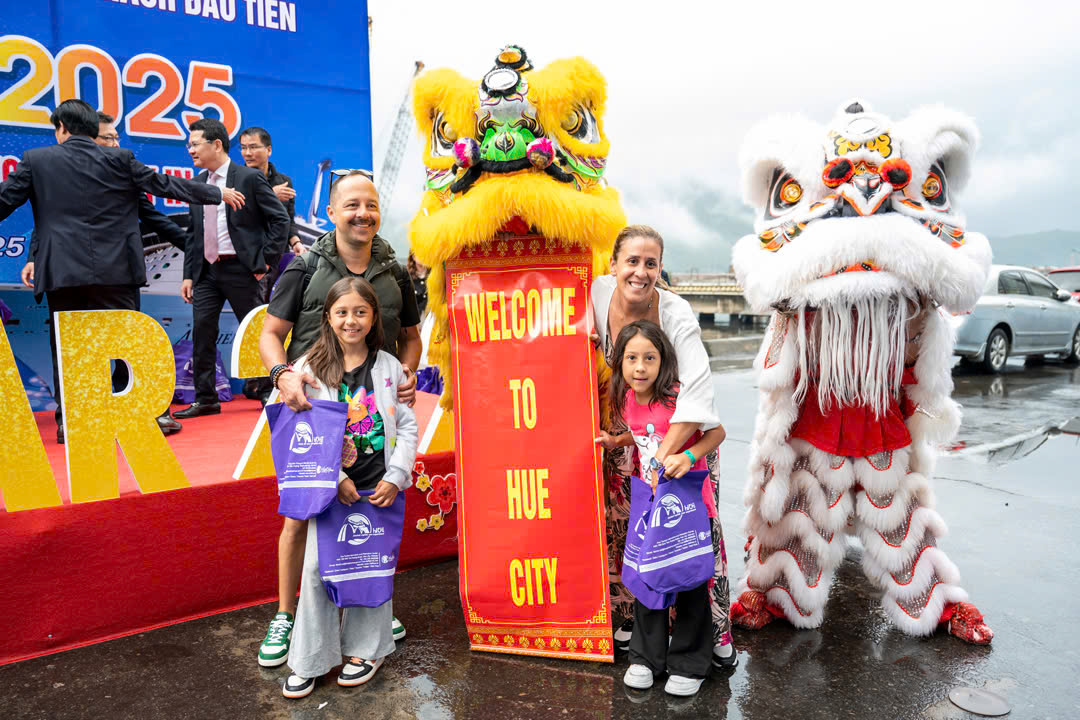 |
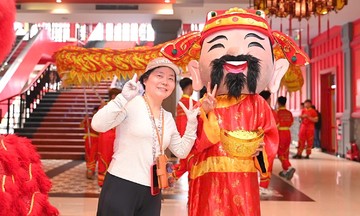
International visitors take photos with a lion dance troupe upon arriving in Hue. Photo: Vo Thanh
To achieve the target of 25 million visitors in 2026, the tourism sector is implementing various synchronized solutions, from refining policies to enhancing product and service quality, to meet diverse market demands.
Pham Hai Quynh, Director of the Institute for Asian Development, likened this goal to a "difficult problem" that requires the entire industry to make a strong breakthrough. However, Quynh believes this number is achievable, as it is based on last year's record growth momentum.
Pham Ha, CEO of LuxGroup, echoed this view, describing 25 million visitors as an "ambitious figure" that reflects Vietnam's growing confidence on the global tourism map.
The Vietnam National Authority of Tourism notes that the international market is entering a fiercely competitive phase, with many countries constantly repositioning their brands and launching large-scale promotional campaigns to gain market share.
Tourist preferences are shifting, with a trend towards safe, unique, and well-promoted destinations. Consumers now search for information online, prefer short video content, and often make destination choices based on immediate emotional appeal.
The development of digital technology, artificial intelligence, and social media platforms means the race for market share is not only happening at destinations but also intensely in the online environment. This reality compels countries to invest strategically to maintain their position on the international tourism map.
The Vietnam National Authority of Tourism announced that this year it will consolidate promotional information from localities and businesses to develop a common advertising plan. This will help units proactively manage resources, develop distinct products for each region, and avoid event overlaps.
These efforts aim to sustain the growth of international visitors while enhancing Vietnam's brand recognition in the global race for market share. To realize this goal, the tourism sector will focus on key markets with fast growth rates, high spending levels, and longer stays.
Targeted visitor segments include traditional destinations with direct, large-scale flights (Northeast Asia), nearby markets (ASEAN), and long-haul but high-spending markets (Western Europe, North America, Northern Europe).
Additionally, Vietnam is also targeting distant and growing markets like Australia, Russia, Southern Europe, and Eastern Europe. The Middle Eastern market (UAE, Gulf countries) is also becoming a strategically targeted segment for Vietnam's tourism industry, as these are high-end visitors seeking luxury experiences and expensive retreats.
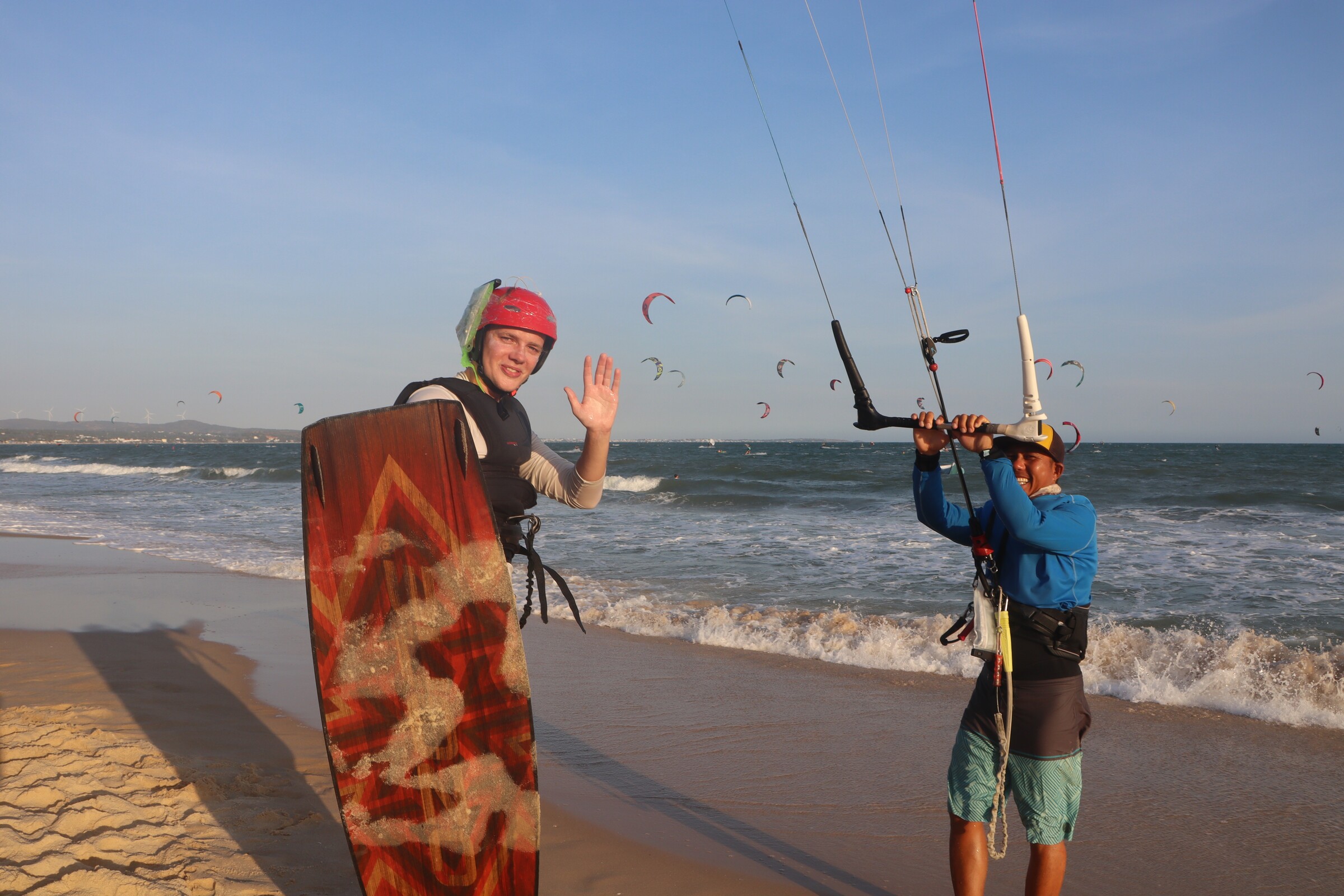 |
Tourists kitesurfing on Mui Ne beach in December 2025. Photo: Viet Quoc
A more crucial next step, according to many tourism experts, is for Vietnam to develop "pillar products" to attract visitors.
At the announcement ceremony for the 2026 tourism promotion programs, Nguyen Trung Khanh, Director General of the Vietnam National Authority of Tourism, stated that Vietnam has four pillar products to attract international visitors and encourage them to "spend more, stay longer": island tourism, golf, MICE, and culinary experiences.
To conquer key markets such as Europe, North America, Australia, or the luxury segment from India and China, Vietnam needs unique and personalized products. Developing secluded resorts, focusing on spa, meditation, yoga experiences, and healthy cuisine are product lines that "retain" guests the longest and account for the most significant portion of tourist budgets, according to Pham Hai Quynh.
Golf and MICE tourism also represent customer segments with spending levels three to four times higher than regular tourists. Hosting international golf tournaments and major economic events will become a magnet for the elite. Instead of merely passing through destinations, the tourism sector needs deep experiential tours, such as exploring heritage by luxury train, culinary tours featuring Michelin chefs, or unique indigenous cultural experiences in heritage regions like Hoi An, Hue, and Ha Giang.
High-spending visitors are currently very concerned about the environment. Therefore, tourism products that promote plastic waste reduction and nature conservation will be a significant advantage, encouraging them to choose Vietnam over neighboring countries, according to Quynh of the Institute for Asian Development.
The flexibility of the e-visa policy, extended temporary stay durations, and increasingly convenient air connectivity are practical levers to realize the 25 million target.
However, instead of focusing solely on the 25 million figure, the tourism sector is aiming for a deeper goal: total tourism revenue, which indicates that Vietnam is not just pursuing quantity but focusing on high-spending markets.
To further enhance its promotion, market orientation, and pillar product creation, the tourism sector is also upgrading infrastructure and facilitating convenient transportation for visitors by closely coordinating with airlines. Data released in January by the General Statistics Office showed that in 2025, Vietnam welcomed nearly 21,2 million visitors, with over 17,8 million arriving by air, accounting for nearly 84% of total arrivals. Boeing forecasts that Vietnam will become Southeast Asia's fastest-growing aviation market by 2030, with an average annual growth rate of over 8%.
Nguyen Quang Trung, Deputy General Director of Vietnam Airlines, stated that this year, the airline is prepared for 140 tourism promotion and advertising programs under the theme "Soaring Vietnamese Aspirations," aiming to bring an increasing number of international visitors.
Currently, Vietnam has over 70 air routes to destinations on four continents. This year, the airline will increase the number of routes to over 80 by opening new direct flights to Amsterdam, Netherlands – a destination attracting high-spending, long-stay visitors – as well as Da Nang-Osaka, Da Nang-Narita, and routes to India.
Air routes already familiar to international visitors are also seeing increased flight frequencies by Vietnamese airlines to accommodate more guests, such as Hanoi-Sydney and Hanoi-Melbourne. With increased frequency and new routes, the tourism sector gains further momentum to attract international visitors.
"Through connecting destinations, we hope to contribute to elevating Vietnam's position on the world tourism map," Trung said.
However, Quynh believes the industry must also confront existing bottlenecks. Post-pandemic, the quality of tourism personnel remains inconsistent. It is crucial to upgrade professional skills, especially foreign language proficiency and a professional service mindset for high-end clients. Issues such as soliciting customers, price gouging, and waste management in key tourist areas remain "blemishes" that detract from the visitor experience.
 |
Tourists visit Hoi An ancient town, 1/11/2025. Photo: Nguyen Dong
"Currently, visitors to Vietnam still complain that they don't know where to go at night," Quynh noted.
Pham Ha, CEO of LuxGroup, believes that the biggest bottleneck in Vietnamese tourism today is not infrastructure, but human resources. According to the Vietnam National Authority of Tourism, the industry needs about 40.000 workers annually but can only meet half of that demand. Among these, the number of well-trained or advanced personnel accounts for less than half.
"High-end tourism cannot operate with a cheap labor mindset. If we want to welcome 5-star guests, we must invest in 5-star personnel, from skills and service culture to professional pride," Ha added.
Vietnam possesses the advantage of a thousand-year-old culture, friendly and hospitable people, rich cuisine, and a gifted nature with a coastline stretching over 3.000 km. However, these advantages can only be transformed into true value when communicated effectively by the tourism sector.
According to Ha, high-spending guests do not seek ostentatious resorts. They seek subtlety in identity: a truly good cup of coffee, a heritage story told with emotion, a timely and sincere smile.
"Future tourism is not measured by the number of people who visit, but by the number of people who want to return. When we achieve that, money will naturally flow to the tourism sector – in a sustainable way," Ha concluded.