On 5/2, Mariola and her husband fulfilled their wish to visit a cemetery in Vietnam. Several months prior, they watched a documentary on Vietnamese tourism by Mai Thi Nguyen-Kim, a doctor of chemistry and a famous Vietnamese-German television presenter. In the documentary, Mai Thi Nguyen-Kim visited and introduced An Bang cemetery in Hue. She described it as "an endless area with brightly decorated structures resembling pagodas and palaces – a miniature wonderland for the deceased".
Upon arriving in Da Nang from Bangkok on 29/1, Mariola planned to visit An Bang cemetery. According to the German tourist, standing before An Bang cemetery, she found it even more vibrant than the video she had seen. While strolling, she encountered diligent workers decorating and repairing graves.
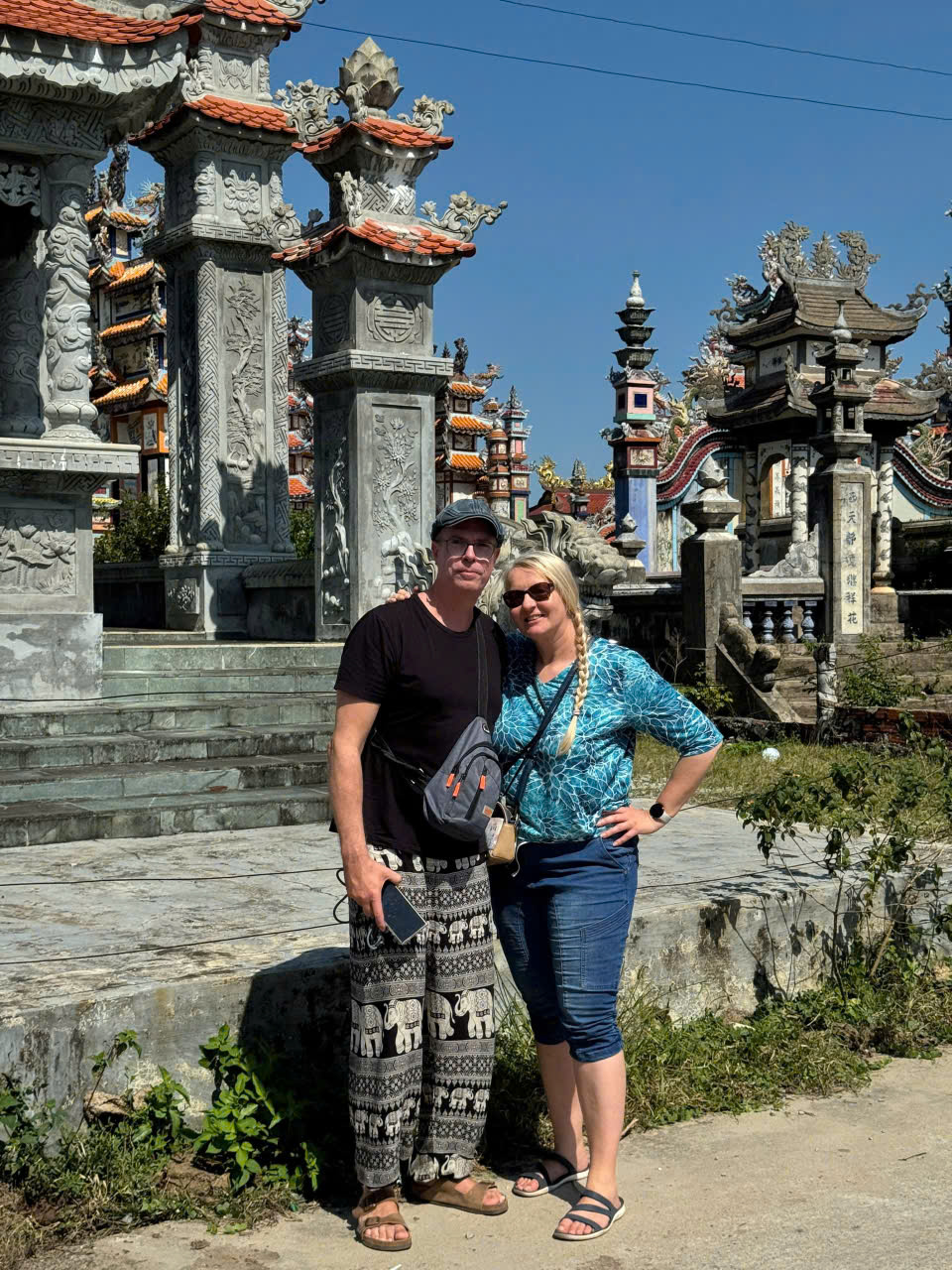 |
Mariola and her husband at An Bang cemetery on the morning of 5/2. *Photo: NVCC*
Annually, Mariola and her husband dedicate five to six weeks to travel. In the last four years, they have primarily traveled to Asia to gain a deeper understanding of cultural differences. Before their trips, they thoroughly researched destinations via YouTube videos or television programs. Videos about traditional Vietnamese rituals particularly captivated Mariola, especially funeral ceremonies.
Mariola stated that in major European cities, cremation is increasingly common due to limited land for cemeteries. In smaller towns or rural areas, the deceased are typically interred in coffins with graves sized for adults; married couples are prepared for double graves.
After cremation, ashes are placed in urns and buried in a family plot, or in smaller graves, or in columbarium niches inscribed with the deceased's name. Mariola shared that her father had been interred a few days prior near her paternal grandparents' grave. Later, when her mother passes away, her ashes will also be placed there.
"I thought of my father while standing at An Bang cemetery", she said, adding that her father had been seriously ill and his passing felt like "a release after a long time". Seeing the colorful graves there, the female tourist thought it would be wonderful if her father also had such a resting place.
According to Mariola, European cemeteries feature various types of graves, but generally do not use many colors. This marks a significant difference from cemeteries in Vietnam. Cemeteries in Germany are typically clearly planned, making it easy to locate graves, whereas Vietnamese cemeteries are vibrant and appear more complex.
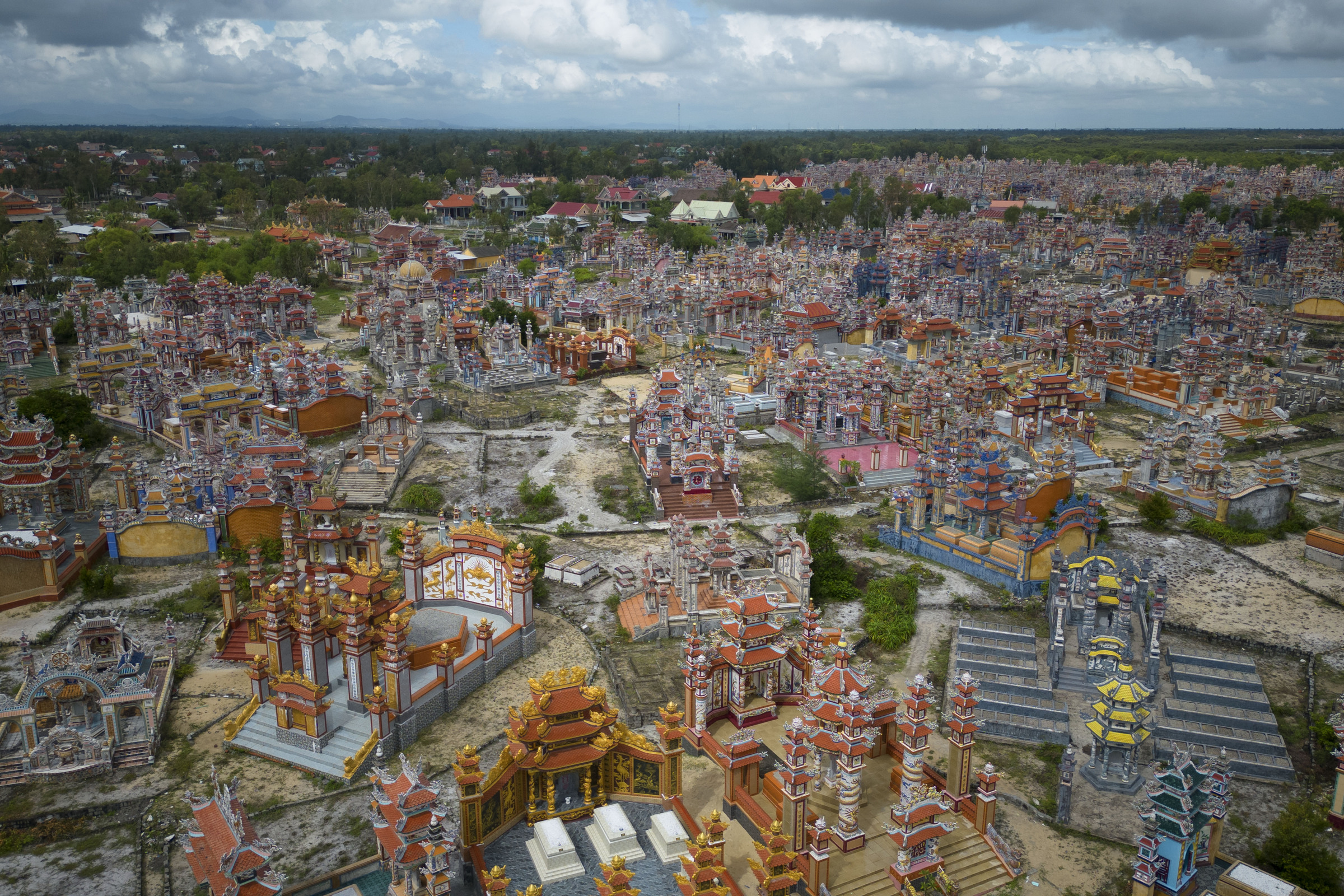 |
An Bang cemetery in 2022. *Photo: Vo Thanh*
The female tourist shared that she and her husband hold contrasting views on grave aesthetics. While she preferred bright colors like those at An Bang cemetery, her husband leaned towards more somber tones.
Learning that many graves here cost up to billions of dong (hundreds of thousands of USD), the tourist was surprised by the investment made by Vietnamese people. In Europe, a marble grave can cost several thousand euros. However, the general trend is to use urns in smaller plots or place them in columbarium walls due to increasingly limited land.
The female tourist had previously not cared where she would be buried after death, but this visit changed her perspective.
"Having a place to remember the deceased is also a way to educate the living", she said, adding that in some European countries like Poland, funeral rites are also more solemn and grand than in Germany. On 1/1, people visit to remember the deceased with flowers and lit candles, similar to Vietnam.
The female tourist wanted to visit other cemeteries in Vietnam but lacked time as she had to fly to Kuala Lumpur on 8/2. Mariola stated that expanding her understanding and the experience of visiting a cemetery in Vietnam was "wonderful". In just about one hour, the female tourist could envision how important visiting ancestral graves is to Vietnamese people.
"I have no children to visit my grave later. I will be cremated and my ashes placed in a columbarium wall", she said, adding that the idea of large, meticulously cared-for graves was also very interesting.
An Bang cemetery is approximately 35 km east of Hue city center and covers an area of about 250 hectares with over 3,000 graves of various sizes. It is considered one of Vietnam's most opulent and renowned cemeteries, often referred to as the "city of the dead". The tombs there feature diverse architecture, blending various cultural and religious elements such as Buddhism, Catholicism, and Taoism, with elaborate, colorful, and large-scale designs.
Video about An Bang cemetery on German television. *Video: Zdf*
Tu Nguyen