Images published by the US military specialized website War Zone on 15/5 revealed an F/A-18F Super Hornet carrying an AIM-260 JATM air-to-air missile. The missile was mounted on a pylon next to the right engine air intake as the jet departed Eglin Air Force Base in Florida. This pylon typically accommodates AIM-120 AMRAAM air-to-air missiles or targeting pods.
The F/A-18F also carried an FPU-13/A auxiliary fuel tank equipped with an infrared search and track (irst) system on a centerline pylon, flanked by two conventional auxiliary fuel tanks, and flight data collection equipment on both wingtips. The insignia on the vertical stabilizer indicated the aircraft belonged to Air Test and Evaluation Squadron 31 of the US Navy.
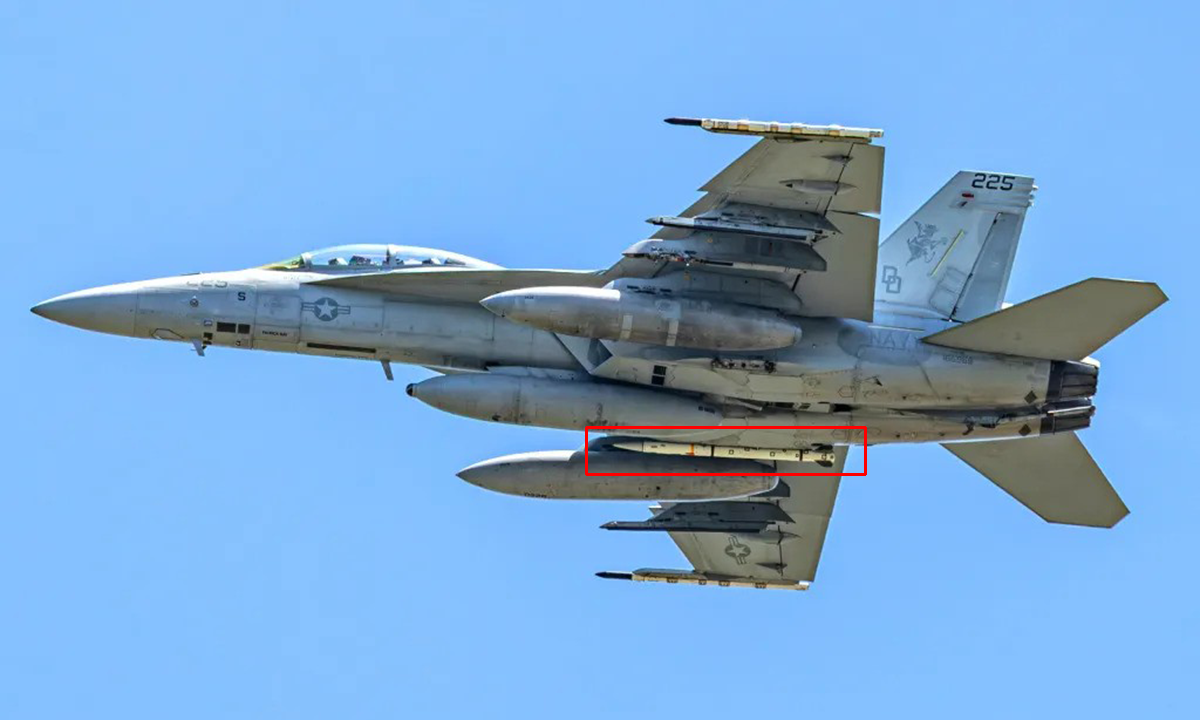 |
The AIM-260 air-to-air missile (circled in red) on an F/A-18F fighter jet taking off from Eglin Air Force Base on 13/5. *Photo: War Zone* |
This marks the first public appearance of images showing the air-to-air missile, described as highly classified, despite air testing activities having begun many years ago. The AIM-260 missile was initially planned for parallel use with the AIM-120 series before its complete replacement.
The AIM-260 missile in the photos features a minimalist design, with a streamlined body and only four tailfins. Unlike the AIM-120 series, it lacks mid-body lifting surfaces and strakes along its sides. According to War Zone editor Joseph Trevithick, this design aims to minimize drag, thereby increasing the missile's speed and range.
"Overall, the AIM-260 missile in the photos perfectly matches what was previously shown in official JATM drawings, both in design and markings," Trevithick commented.
The AIM-260 is being jointly developed by the US Navy and Air Force. US officials stated that the increasing range of Chinese air-to-air missiles, specifically the PL-15 series, was the primary motivation for the United States to launch the JATM program. Consequently, maximizing range is a central requirement for the project.
The AIM-260 is believed capable of hitting targets at a distance of at least 200 km, potentially even further. In contrast, the AIM-120 series has a maximum range of 160 km for its most modern variant. China's domestic PL-15 missile, for comparison, boasts a range of up to 300 km.
 |
Simulated image of an AIM-260 missile being launched from an F-22 fighter jet. *Graphic: USAF* |
Another requirement for the AIM-260 is a size similar to the AIM-120, ensuring easy deployment on existing aircraft and fitting into the internal weapon bays of the F-22 and F-35. Detailed information about the AIM-260 series remains limited.
The F/A-18E/F combat aircraft and F-22 fighter jets are expected to be the first aircraft equipped with the AIM-260 missile for operational deployment. This weapon will likely also be integrated into other aircraft, including the F-47 stealth fighter and the US Navy's sixth-generation combat aircraft.
The exact timeline for the AIM-260's entry into US military service remains unclear. When the AIM-260 program was made public in 2019, US officials aimed for deployment by 2022. Late last year, reports suggested the project faced a three-month delay due to funding issues, but this information was denied.
According to Trevithick, the appearance of the first images of the AIM-260 indicates progress in efforts to equip the US Navy and Air Force with this missile.
Pham Giang (via War Zone, Aviationist)