West Broadway marks the dividing line between an affluent area, where the median household income exceeds 250,000 USD, and a neighborhood where that figure is just 60,000 USD. On one side of the road stand the glittering high-rises of the Seaport district, while immediately across are rows of three-story brick houses.
John Meier, a South Boston resident, clearly observes this deep socio-economic divide. Young professionals are willing to pay high fees for food delivery services from the Whole Foods supermarket chain. Just a few blocks away, residents rely on free food distribution points to feed their families.
A decade ago, Meier, 43 years old, understood the depth of this divide when he learned one of his high school students lived in the nearby social housing. When he mentioned that they were neighbors, the student chuckled and replied, "You're not my neighbor."
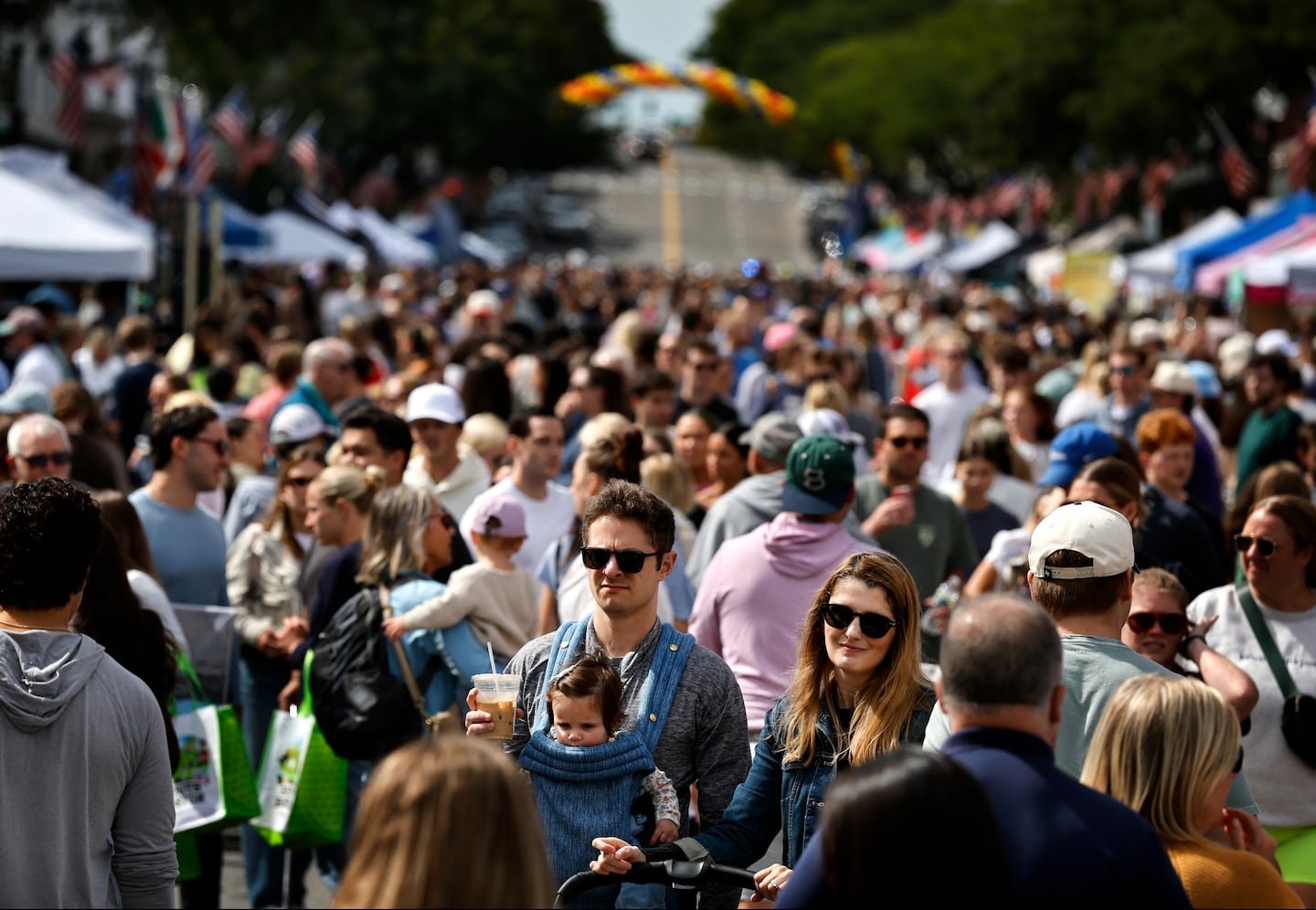 |
Crowded East Broadway during a street festival. *Photo: Boston Globe*
According to new research from the MassINC Center, this is one of the starkest contrasts in Greater Boston, an urban area with one of the highest levels of income disparity nationwide, and which has seen a sharp increase in income polarization in recent years. Since 2020, this polarization in Massachusetts has increased more rapidly than in any other state.
This trend means a diminishing number of neighborhoods with diverse income levels. Instead, the wealthy tend to live alongside the wealthy, while the poor live with the poor.
The report indicates that this separation can limit access to relationships and resources that help improve economic status, thereby perpetuating inequality across generations.
"The more inequality the economy creates, the more people tend to segregate themselves into distinct groups," said Ben Forman, MassINC Director.
Leon, 51 years old, deeply values gifts such as diapers and Christmas presents from wealthier residents, but she is also acutely aware that they belong to an entirely different world.
"There's always a line," she said. "They can help, but we know our place."
South Boston was once predominantly a working-class area when social housing was constructed there in the 1930s and 1940s. However, the bayfront area began to transform in the early 2000s.
Typically, luxury condominium projects are required to allocate about 10-20% of units for affordable sale or rent to low-income individuals. Yet, the city government allowed developers to pay a fee into a general housing fund instead of providing these affordable units. The result was the formation of a "wealthy white bayfront area," according to Donna Brown, Executive Director of the South Boston Resident Development Corporation, who has lived there since 1989.
Gentrification spread as young college graduates flocked to purchase apartments near beaches and subway stations, driving up rents and making it unaffordable for working families to remain in the area.
 |
Quinn Fraser, 6 years old, with family visiting the South Boston Street Festival. *Photo: Boston Globe*
This profound income disparity is not confined to urban centers. Several affluent suburbs, including Wellesley, Lexington, and Sudbury, also significantly contribute to the region's income disparity. According to data from MassINC, in one census tract in Natick, the median household income was 209,000 USD; meanwhile, in a neighboring area of Framingham, this figure was only 49,000 USD.
Steven Durlauf, Director of the Stone Center for Research on Inequality and Wealth Mobility at the University of Chicago, observes that the segregation stemming from inequality also perpetuates inequality. The environment where children grow up can determine the schools they attend, the resources they access, the crime they witness, and the role models they encounter.
The living environment also profoundly impacts life expectancy. In 2023, the Boston Public Health Commission reported a 23-year difference in life expectancy between an area in Roxbury, where the median household income was approximately 60,000 USD, and a section of Back Bay, where that figure exceeded 250,000 USD.