Sometimes, Rachel Negro-Henderson encountered awkward run-ins with acquaintances.
"People would often avoid explaining why they were there, as if it were just a coincidence," shared Negro-Henderson, an administrative manager at a medical facility. "They would pretend to have just stopped by because they urgently needed a tomato."
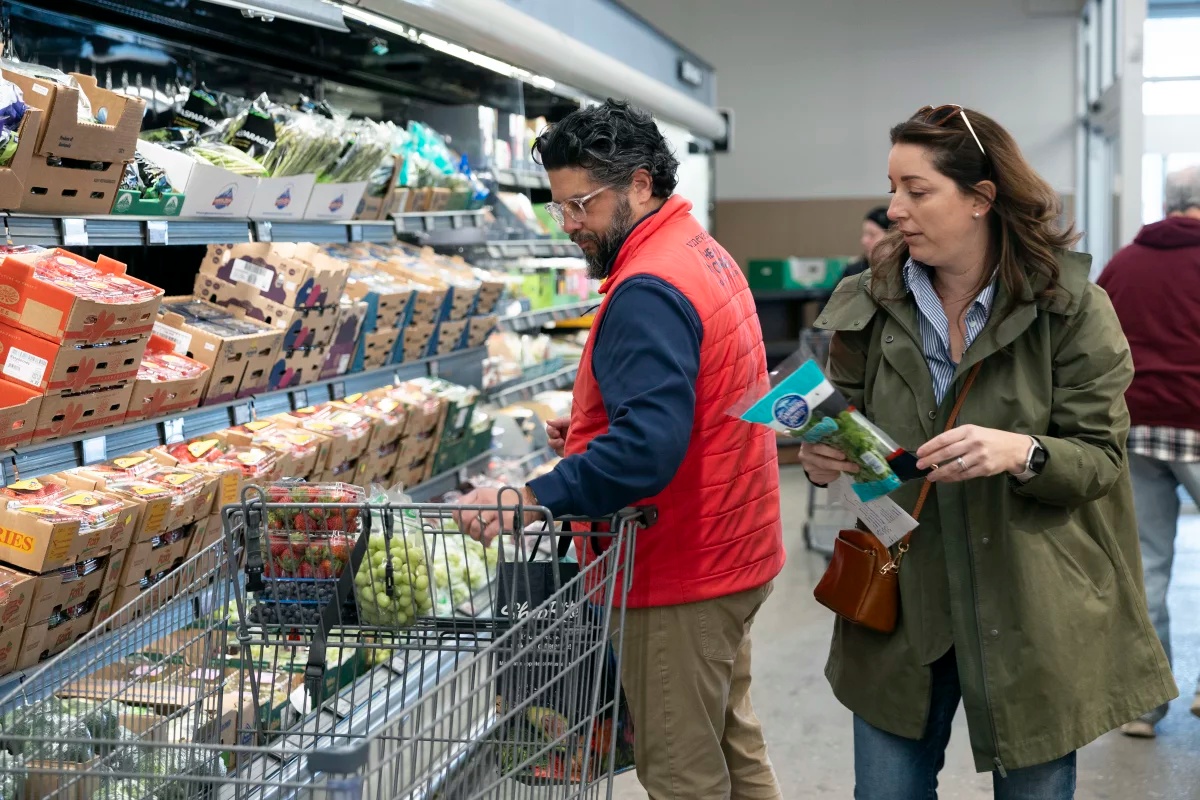 |
Rich Henderson and his wife, Rachel Negro-Henderson, shop for their family's groceries at an Aldi supermarket in Bellmawr, New Jersey. Photo: *NPR*. |
However, in just a few years, everything completely changed. Negro-Henderson, who currently lives with her husband and three children in Audubon, New Jersey, stated that she now frequently encounters acquaintances at Aldi. "Every penny saved helps," she said.
A variety of factors are making affordable meals increasingly difficult to sustain. Food insecurity, which emerged during the Covid-19 pandemic, has worsened as essential goods prices have soared in recent years. This pressure is further compounded by inflation and the risk of tariffs.
A new report from the Brookings Institution, released in late May, assessed people's affordability by comparing income with essential living costs. Data showed that in 2024, about 45,5% of households in the US did not earn enough to cover basic needs.
The report concluded that if annual living costs increased by 1,000 USD, an additional 3 million households would fall into financial hardship.
This precarious situation is partly due to the gap between inflation and wages. According to the Census Bureau, in 2024, national wages only saw a slight increase of 1,3%, significantly lower than the 2,9% inflation rate for that year.
To arrive at these findings, experts collected household income data from all counties across the US, then compared it with estimated costs for essential needs like food and transportation in each locality.
Housing, healthcare, and childcare are the largest expenses in budgets, but families find them almost impossible to cut, said Hannah Stephens, a senior research assistant at the center.
The report also indicated that to bridge the gap between income and living costs, many families have had to skip meals, increase debt, or postpone medical appointments.
Sian Slater, 59, is working multiple jobs in Phoenix, Arizona, where driving is the only way to get to work. Soaring gas prices have eroded her finances. Previously, one gallon (about 3,7 liters) of gas cost under 4 USD, but after the conflict between the US, Israel, and Iran, it rose to about 5,50 USD.
Her newly established cleaning service business also lost some clients as they tightened their spending. Slater herself had to stop contributing to her retirement fund, cancel medical appointments, and cut back on food expenses.
"By the weekend, with gas prices factored in, I only have about 15 USD left for groceries and medicine. I've had to cancel upcoming medical appointments because I can't afford the out-of-pocket fees," she said.
"I've never felt this poor," Slater said.
By Lan Huong (Source: NPR, CNN)