Australia's Department of Foreign Affairs and Trade (DFAT) announced on 25/2 in a social media post that it would offer assistance to those who voluntarily leave Israel, Lebanon, Jordan, Qatar, and the United Arab Emirates (UAE).
"We continue to advise exercising a high degree of caution in these areas", DFAT stated. "The security situation in the Middle East remains highly unpredictable. Regional tensions are still high, and a risk of military conflict persists".
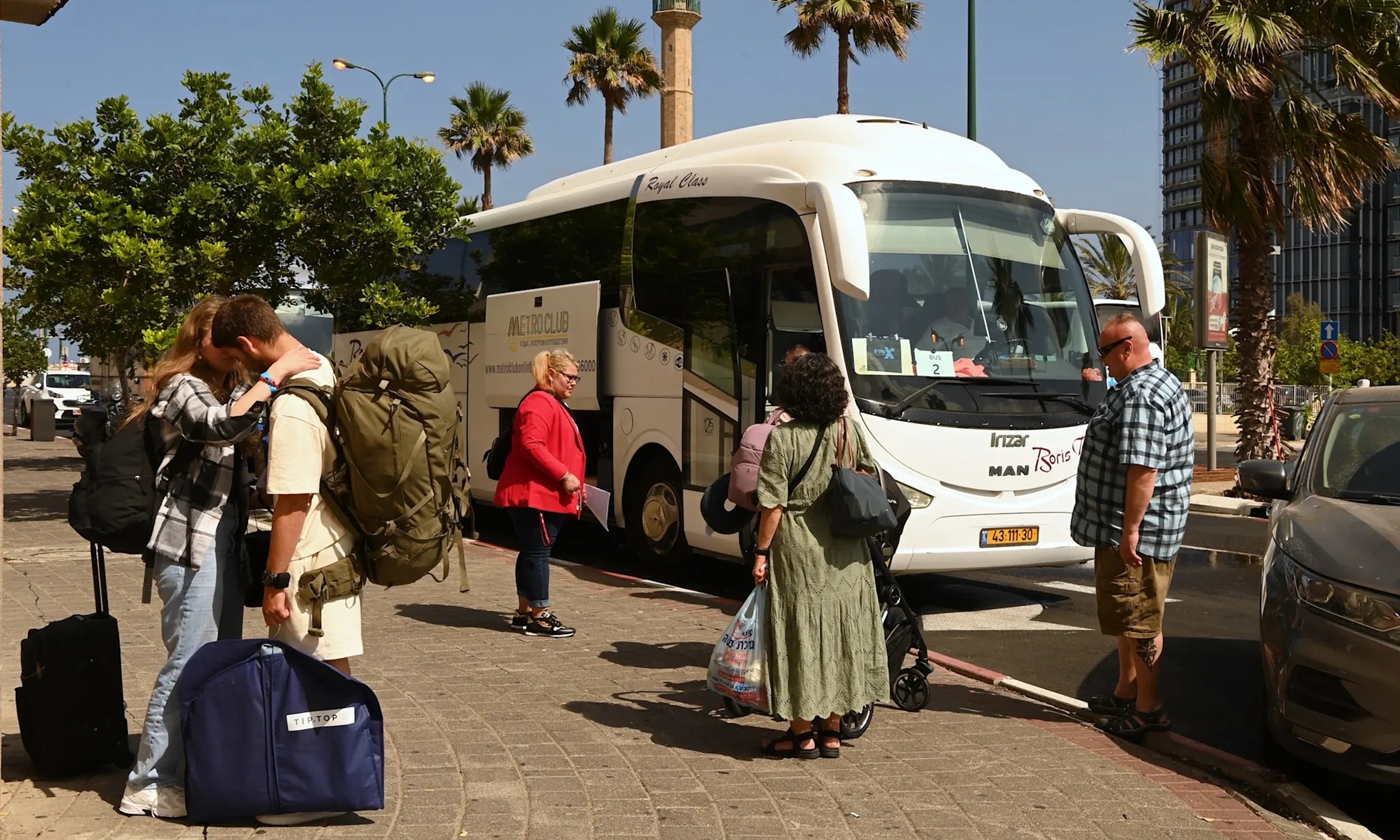 |
Foreign nationals at an evacuation point in Tel Aviv during the 12-day conflict between Israel and Iran last June. *Photo: Brisbane Times*
"Conflict in the Middle East could lead to airspace closures, flight cancellations, and other travel disruptions", the department added.
DFAT also issued a specific warning to Australians in Israel and Lebanon, urging them to "consider leaving while commercial travel options remain available".
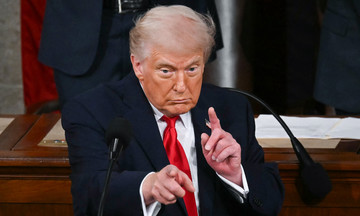
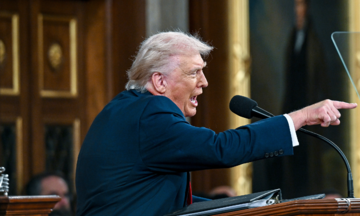
The DFAT recommendation appears to be a response to the situation in Iran. US President Donald Trump stated in his State of the Union address on 24/2 that he prioritized resolving tensions with Iran through negotiation, but did not rule out military action to prevent Tehran from acquiring nuclear weapons.
"We are negotiating with them, they want to make a deal, but we have not yet heard the key words: 'We will never have nuclear weapons'", Trump stated.
The US has increased its military presence in the region in recent weeks. The USS Gerald R. Ford, the largest US Navy aircraft carrier, moved to the Middle East and docked at the Greek island of Crete on 23/2 before continuing its journey to the eastern Mediterranean.
Another aircraft carrier strike group, led by the USS Abraham Lincoln, is in the Arabian Sea.
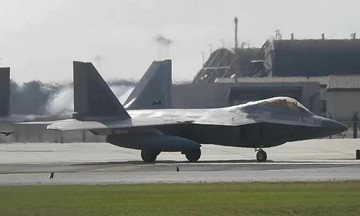
Dozens of US military aircraft have also been deployed to the Middle East, stationed at various locations, such as Al Udeid base outside the capital Doha, Qatar, the largest US military base in the region.
Any military action against Iran carries the risk of widespread regional conflict, especially as Tehran has declared it will respond with "devastating" retaliation to any airstrike, regardless of scale, and attack US bases across the Middle East as well as US allies in the region.
If conflict erupts, air and sea routes through the Middle East risk being paralyzed. Airports in the UAE and Qatar are among the world's busiest, and waterways in the region play a vital role in global supply chains.
Negotiations between the US and Iran on Tehran's nuclear program are ongoing, with the two sides expected to meet on 26/2 in Switzerland. Ahead of the meeting, Iranian Foreign Minister Abbas Araghchi expressed optimism about reaching a deal soon to avoid military conflict.
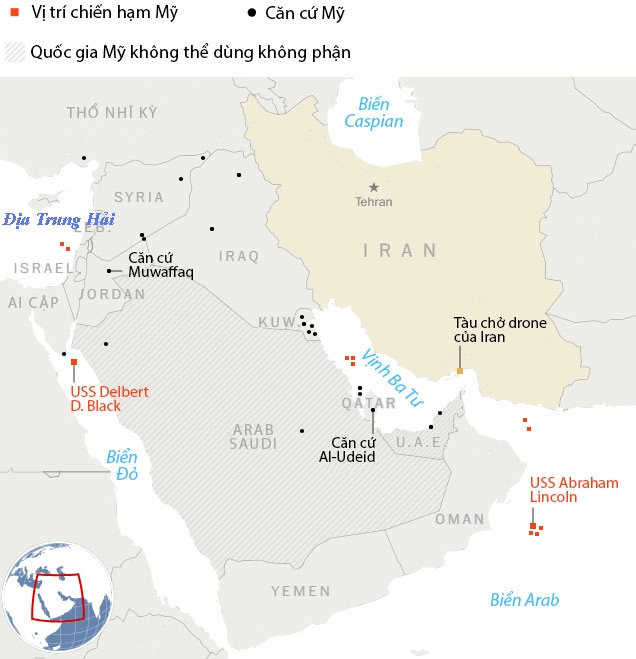 |
Positions of US warships and bases in the Middle East, with the USS Gerald R. Ford aircraft carrier entering the region. *Graphic: Washington Post*
"We are facing a historic opportunity to reach an unprecedented agreement to address common concerns and achieve common benefits", Araghchi wrote on social media, adding that a deal "is within reach, but only if diplomacy is prioritized".
By Vu Hoang (According to ABC News, AFP, Reuters)