At an exhibition booth during the Air and Space Forces Association's annual conference on february 24, Lockheed Martin displayed a scale model of the production version of a new F-22 stealth fighter variant, dubbed "Raptor 2.0".
This upgraded F-22 will build upon the most advanced stealth fighter in the US, exclusively operated by the country's air force. The US has consistently refused to sell the F-22 even to its closest allies, aiming to maintain absolute air superiority.
The most notable feature on the upgraded F-22 is its stealthy external fuel tanks, designed to allow the fighter to fly longer distances in vast regions such as the Indian - Pacific. These tanks feature an angular, low-drag design and can be jettisoned, enabling the F-22 to restore its full combat performance and stealth capabilities when needed.
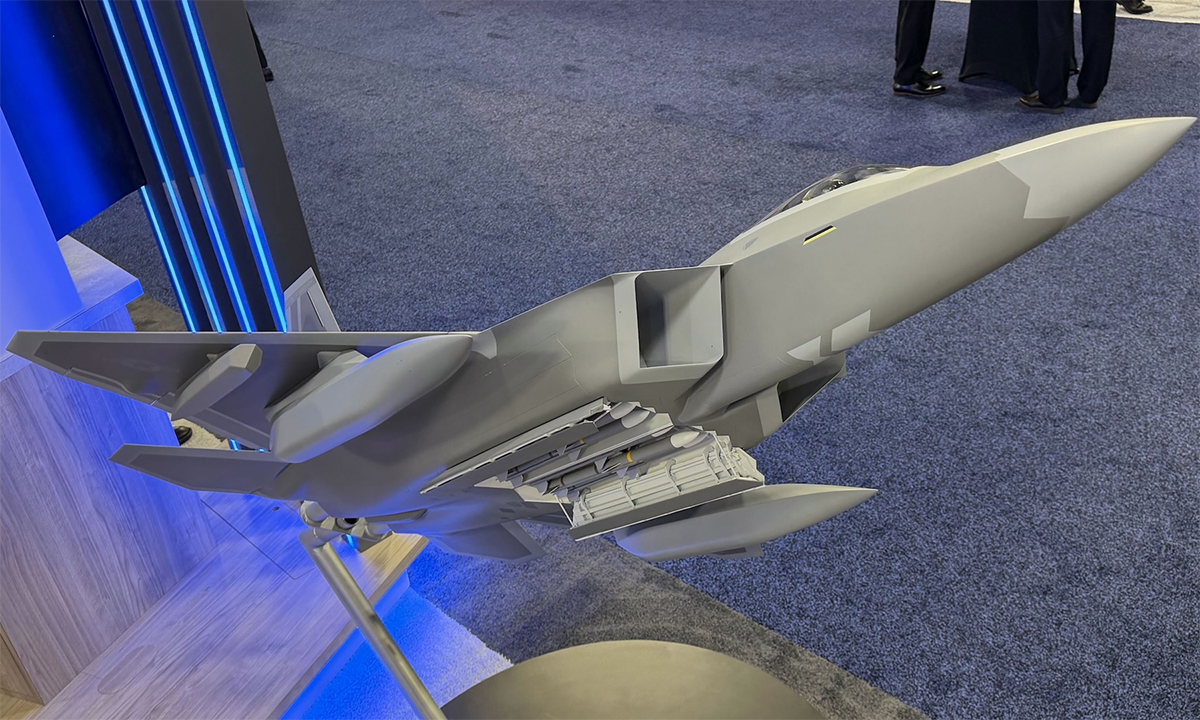 |
A model of the F-22 fighter with external fuel tanks and an IRST sensor pod at the exhibition on february 24. Photo: WarZone
The US previously developed external fuel tanks with a capacity of over 2.200 liters to address the F-22's limited range. However, these were not a viable option as they compromised the fighter's stealth capabilities against advanced enemy air defense systems.
Nevertheless, F-22 fighters stationed at bases in alaska frequently use external fuel tanks for extended missions involving intercepting, identifying, and escorting foreign aircraft over large areas.
The new F-22 variant also incorporates other stealthy equipment pods, including a high-performance infrared search and track (IRST) system. The manufacturer initially intended to equip the F-22 with IRST but removed the system to reduce costs.
IRST is an infrared sensor specifically designed to detect and track heat sources from enemy aircraft engines. This system operates passively, meaning it does not emit signals that would alert targets, unlike radar. IRST is often described as an "all-seeing eye sensor" due to its ability to detect stealth aircraft and identify small targets such as unmanned aerial vehicles (UAVs) and cruise missiles.
"While stealthy in design, the IRST sensor pod still affects the F-22's radar cross-section; however, this might be a worthwhile trade-off due to its utility", stated Thomas Newdick, editor of the US military specialized publication War Zone. "IRST-equipped F-22s can share data with fighters that do not have the system, thereby increasing situational awareness."
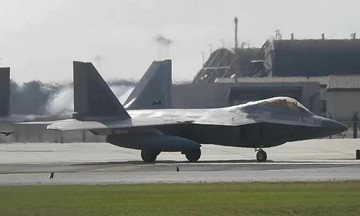
F-22 and T-38 fighters participate in an "elephant walk" exercise at langley air force base in february 2025. Video: USAF
The US has completed testing of the F-22's new external fuel tanks, with delivery possibly scheduled for march. Meanwhile, the IRST system is expected to undergo operational testing and evaluation around mid-year.
"The decision to approve new under-wing stealth equipment for the F-22, including a relatively large component, could pave the way for equipping this fighter with similarly sized systems", Newdick noted.
Additionally, the US is upgrading the F-22 to ensure it maintains its leading position. These new improvements include enhanced computer processing power, new radar, communication systems, and defensive aids, among other equipment.
The US developed the F-22 based on the Advanced Tactical Fighter program, which began in 1981, with the goal of replacing the F-15 and F-16. A total of 195 F-22 aircraft were produced, including eight prototypes and 187 production fighters.
The F-22 can reach a maximum speed of over 2.400 km/h at high altitude and nearly 1.500 km/h at low altitude. The fighter is equipped with a six-barrel M61A2 20 mm cannon, has eight internal hardpoints for air-to-air and air-to-ground missiles or bombs, and four external hardpoints for auxiliary fuel tanks, missiles, or other equipment.
Nguyen Tien (According to War Zone, AFP, AP)