President Donald Trump announced on 22/12 that the United States would build a series of battleships named after him. Though Trump referred to them as battleships, these vessels appear to have the design and armament similar to large cruisers and destroyers developed by many nations.
"We're going to start almost immediately, probably two and a half years," Trump stated when asked about the plan for the first two ships, though it remains unclear which phase of the process he was referring to.
President Trump also declared that the US Navy would acquire a total of 20-25 Trump-class ships to establish a "Golden Fleet." However, military experts are raising many questions about this plan, suggesting that the navy and US shipyards will face numerous obstacles in realizing Trump's ambition.
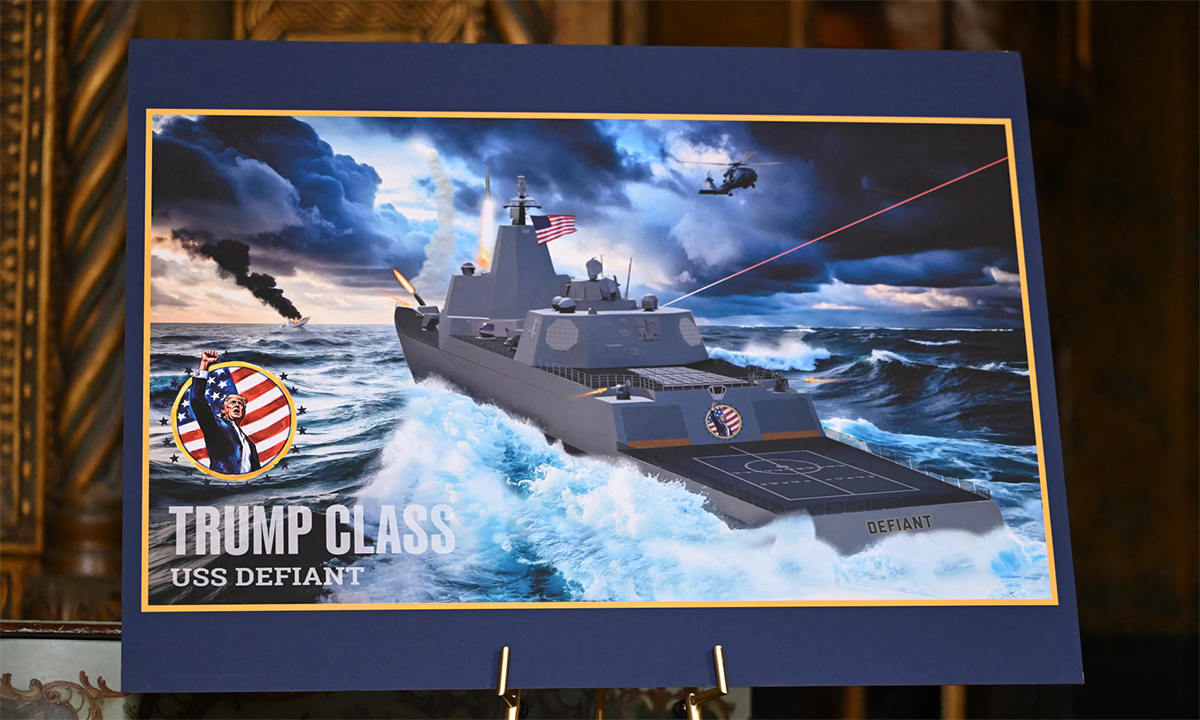 |
A graphic simulation of the USS Defiant displayed on 22/12. Photo: AFP |
One challenge for US companies is that each Trump-class ship is projected to have a displacement of 30,000-40,000 tons. This would make them the largest surface combatants built by the United States since World War II.
Surface combatants typically include cruisers, destroyers, various frigates, battleships, and battlecruisers. Aircraft carriers and amphibious assault ships are not classified as surface combatants, as they rely on embarked aircraft for operations and do not integrate weapons for direct attacks.
A complete design for the Trump-class warship does not yet exist. Engineers will need to develop a suitable design and configuration, including weapon selection, power systems, and manufacturing methods.
The US Navy plans to use artificial intelligence (AI) to assist in the design process, but this tool is not a magical solution to all problems. Moreover, complex ships like the Trump-class warships will require extensive time to build at a very high cost.
When constructing the Cavour aircraft carrier, with a displacement of over 27,000 tons, Italy lacked a shipyard large enough for the work. They had to produce separate modules and connect them offshore to form the complete warship.
The US Navy could build Trump-class warships using a similar modular approach, fabricating sections domestically or in other countries, then assembling them in the United States. A source indicated that President Trump selected South Korea’s Hanwha Group to participate in the construction of the USS Defiant, the first ship of the Trump class.
However, modular shipbuilding is a new approach for US shipyards, and it is unclear if they will adopt this method. The United States also faces a shortage of qualified personnel for a large-scale project like the Trump class.
Beyond design and shipbuilding technology difficulties, experts warn that the production cost of Trump-class warships will be substantial. Each Flight III Arleigh Burke-class destroyer, with a displacement of 9,000 tons, currently costs approximately 2.8 billion USD.
The US Congressional Budget Office previously estimated that each ship in the Next-Generation Guided Missile Destroyer project, code-named DDG(X) and with a displacement of 14,500 tons, could cost up to 4.4 billion USD.
Based on these figures, experts estimate the manufacturing cost of a Trump-class ship to be around 9.1 billion USD, accounting for some project scale advantages. The first warship of any class is often 50% more expensive than the average price. Therefore, the USS Defiant is projected to cost up to 13.5 billion USD, equivalent to the cost of building a Ford-class supercarrier or four Arleigh Burke Flight III destroyers.
When factoring in weapon systems and related equipment, the price of each Trump-class ship could escalate to 25 billion USD. This leads some experts to question the project's cost-effectiveness, as smaller ships could be equipped with similar weaponry at a much lower cost.
The Trump-class warship project also risks depleting the United States' limited existing development resources and shipbuilding capacity, potentially affecting other programs.
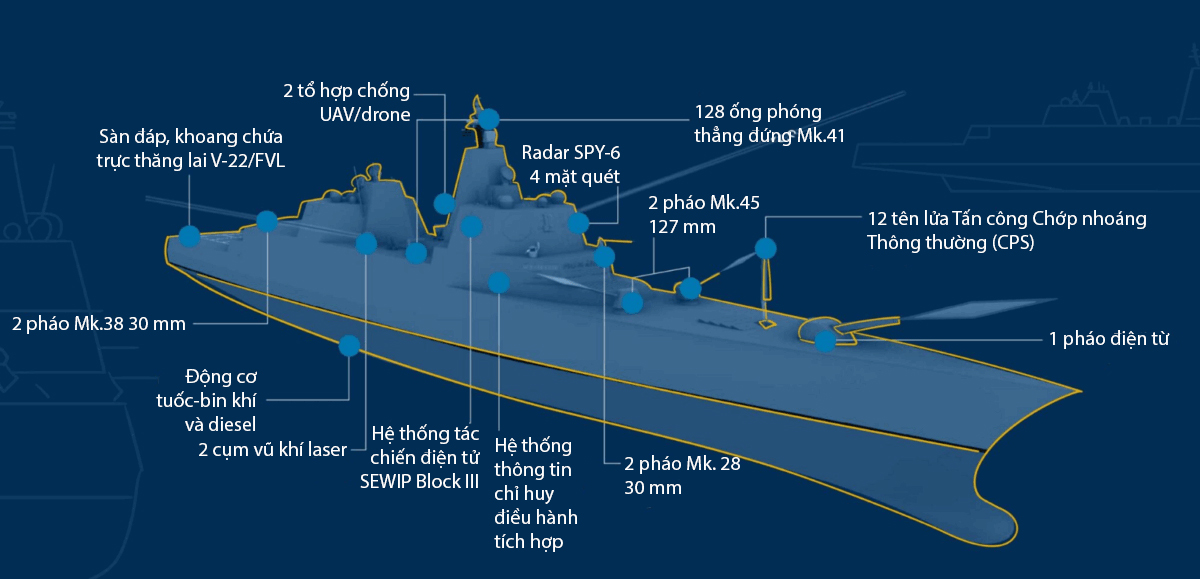 |
Projected weapon systems and sensors on the Trump-class warship. Graphic: US Navy |
Despite plans for powerful weaponry, Trump-class warships are considered cumbersome and vulnerable. This contradicts the US Navy's doctrine of force dispersion, where assets are spread out and networked to coordinate sensors and weapons for maximum firepower.
The US Navy has not yet studied a suitable mission for this new class of warships, nor how they would integrate with existing ships. Additionally, it is unclear what advantages Trump-class ships would offer the United States, especially when confronting peer adversaries.
US Secretary of the Navy John Phelan announced that Trump-class warships would be equipped with nuclear-tipped cruise missiles.
Deploying nuclear weapons on surface combatants was common during the Cold War but ended in 1991. The US Navy would face policy issues in reintroducing such weapons on Trump-class warships and must consider whether sacrificing conventional strike capability for nuclear weapons is worthwhile.
Many other proposed weapons for the Trump-class warship remain untested and unproven, including the Conventional Prompt Strike (CPS) hypersonic missile, laser weapons, and electromagnetic railguns.
Laser weapons and electromagnetic railguns demand immense power, but there is no definitive information about the generator systems on Trump-class ships. The US electromagnetic railgun development program is incomplete, and the system has encountered serious problems during testing, particularly overheating and the requirement for colossal power sources.
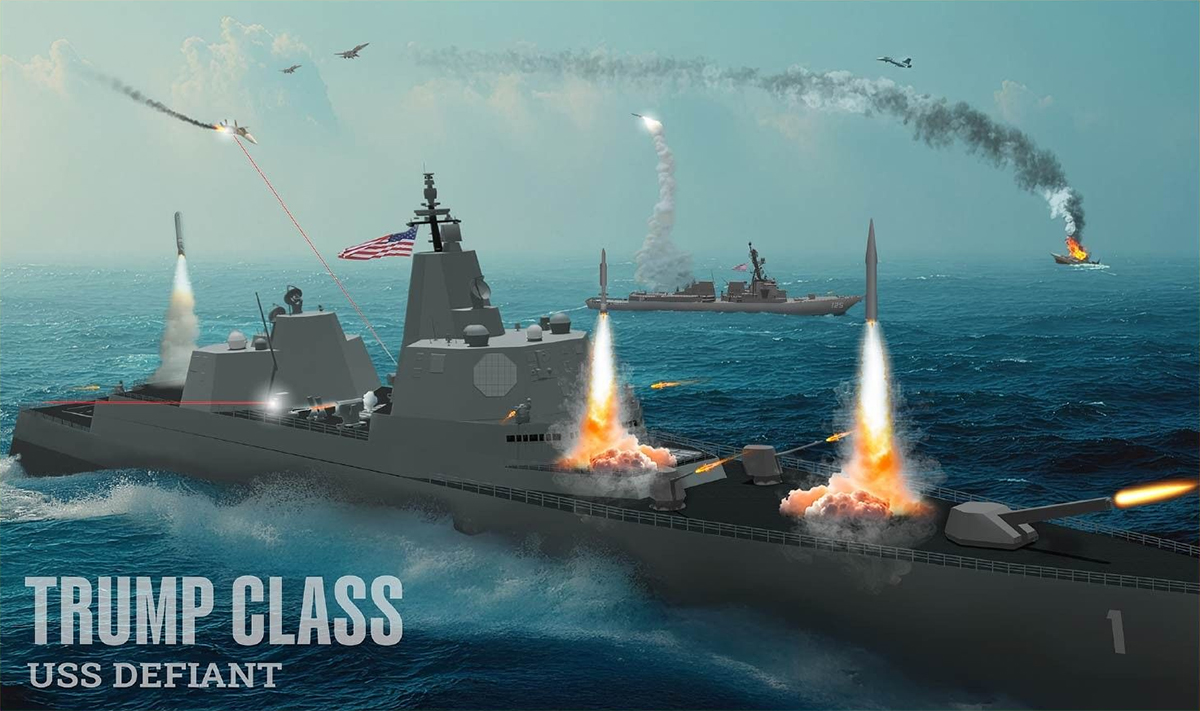 |
Simulation of the USS Defiant, a Trump-class warship. Graphic: US Navy |
Mark Cancian, a former US Marine Corps colonel and senior adviser at the Center for Strategic and International Studies (CSIS), believes the Trump administration was correct in emphasizing the urgent need to build more warships.
"However, building Trump-class warships carries very high risks. The program could be canceled after costs and schedules are finalized, but this would only happen after many years and billions of USD in budget expenditures," he warned.
A similar situation occurred with the Zumwalt-class destroyer, one of the most expensive military projects in US history, which disappointed with numerous design flaws, cost overruns, and delays.
Each Zumwalt-class ship cost over 9 billion USD, including research and development, compared to a projected price of 1.3 billion USD per ship when the project began. The US Congress had to reduce the order from 32 to just three ships, of which only two have been commissioned.
US Navy officials admit that Trump-class warships cannot be built before 2030. Expert Cancian argues that the United States needs to build new ships immediately, rather than initiating costly programs like the Trump class that will span many years.
"It is better to upgrade existing and proven designs while increasing productivity. That is the way to achieve the large number of warships President Trump mentioned, and to expand US presence across the oceans," he stated.
Nguyen Tien (According to Asia Times, AFP, AP, Reuters)