Prime Minister Hun Manet announced today that the Cambodian government officially sent notice to Thailand and the United Nations (UN) Secretary-General. This action initiates compulsory conciliation procedures under the UN Convention on the Law of the Sea (UNCLOS) for the sovereignty dispute in the waters between the two countries.
This decision aims to protect Cambodia's maritime sovereignty and interests in accordance with international law, while continuing to pursue peaceful and cooperative relations with Thailand. Hun Manet stated, "Cambodia always seeks to resolve disputes with its neighbors peacefully. We continue to seek relations with Thailand based on peace, cooperation, and mutual respect, but Cambodia's sovereignty and maritime rights must be respected."
A notice to initiate compulsory conciliation under UNCLOS is a formal legal action in international law. It signifies one state requesting the activation of a specific UN dispute resolution mechanism against another. This "compulsory conciliation" mechanism is initiated unilaterally by one party, and the other party is obliged to participate in forming the Conciliation Commission and the conciliation process, unable to evade or refuse.
For over two decades, Cambodia and Thailand operated under the 2001 Memorandum of Understanding (MOU 2001). This bilateral framework facilitated negotiations on maritime delimitation and allowed for the joint exploitation of the disputed area. According to Prime Minister Hun Manet, Cambodia repeatedly urged Thailand to maintain this framework after Bangkok signaled its intention to withdraw. Thailand subsequently withdrew from the agreement, rendering MOU 2001 ineffective.
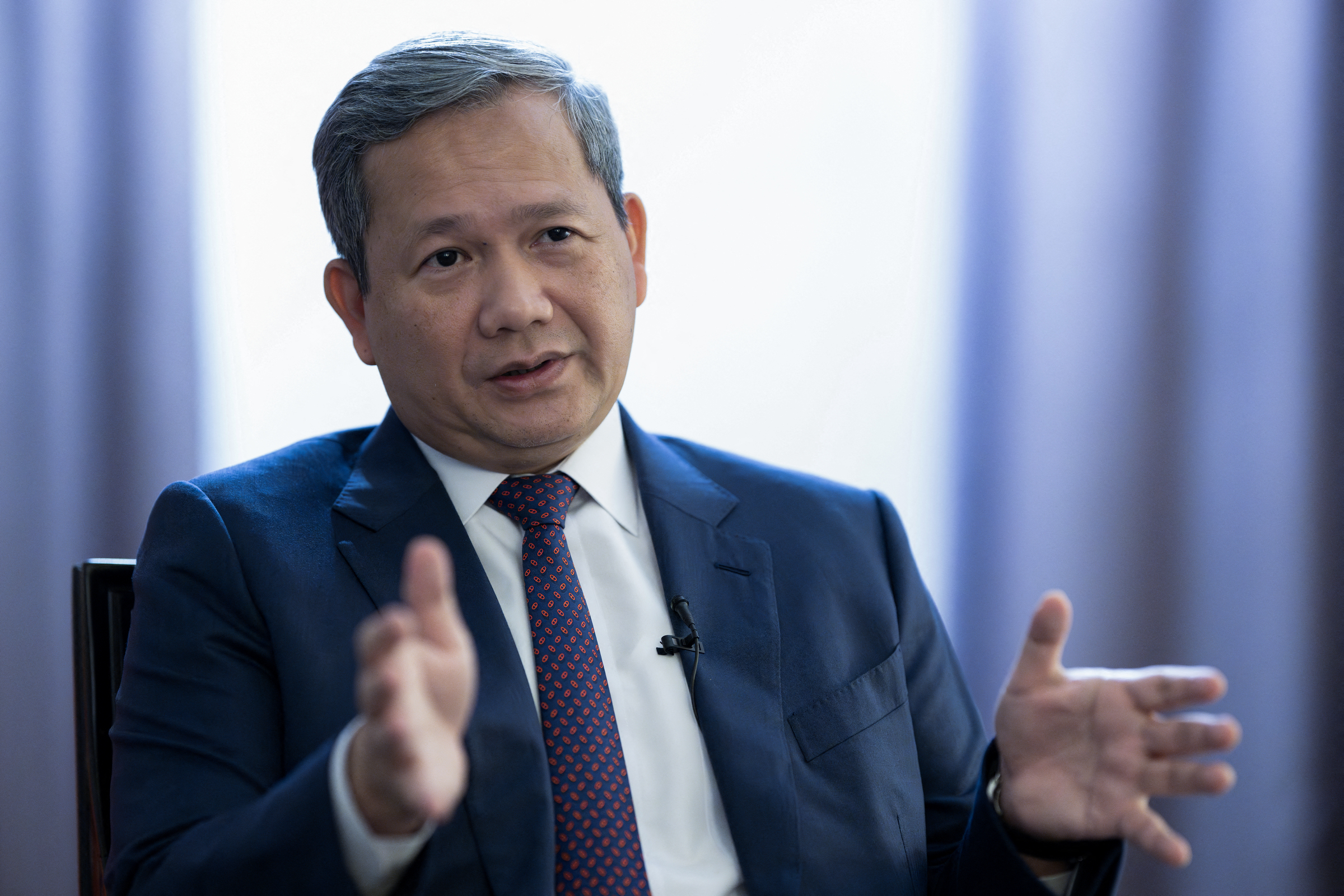 |
Prime Minister Hun Manet during an interview with AFP in Brussels, Belgium, on 25/2. Photo: AFP
"Therefore, bilateral negotiation opportunities have been exhausted," Mr. Manet said in a special message to the people.
Prime Minister Hun Manet affirmed that referring the issue to the UN "is not an abandonment of dialogue but a shift to an international legal framework" where both sides expect respect.
The Thai government has not yet responded to this information.
Under UNCLOS, compulsory conciliation allows an independent panel of experts to review the dispute and issue recommendations. However, the panel's conclusions are not legally binding on either party. Thailand had previously stated it would use UNCLOS as a reference framework during direct negotiations with Cambodia on maritime delimitation.
Both countries claim sovereignty over approximately 26,000 km2 of waters in the Gulf of Thailand. This area is believed to hold natural gas and oil reserves estimated at around 300 billion USD.
Ngoc Anh (Khmer Times, Reuters, Thai PBS)