"This measure aims to ease pressure on drivers facing significant fuel price hikes", Cambodia's Interior Ministry spokesperson Touch Sokhak announced on March 26, attributing the rise to the Middle East conflict's impact on the nation's fuel costs.
Despite the temporary suspension of fines, Cambodian traffic police will continue their deployment to educate the public on road traffic laws and regulate traffic during peak hours. Officials will also maintain alcohol checks and inspect for weapons or explosives during night patrols.
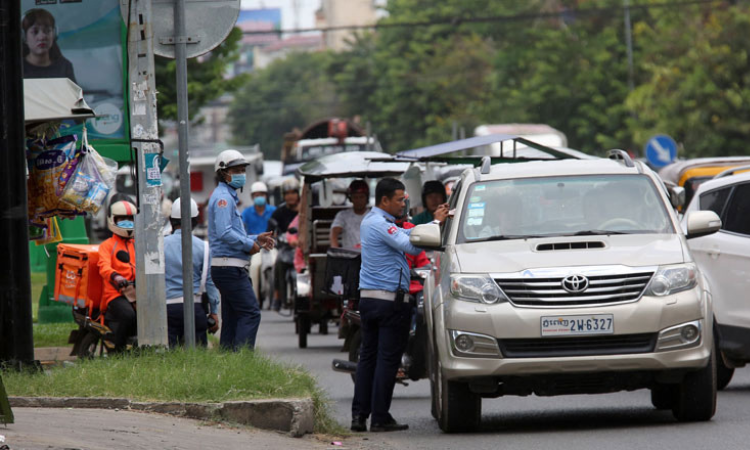 |
Traffic police stop a vehicle for inspection in Phnom Penh, Cambodia. Photo: KT
On the same day, Cambodia's Ministry of Commerce announced that RON 92 gasoline was priced at 5,450 riel (USD 1,35) per liter, marking a 0,92% increase from the previous week. Diesel prices rose by 5,97% to 7,100 riel (USD 1,78) per liter. Gas is currently priced at 3,200 riel (USD 0,8) per liter.
The conflict in the Middle East is disrupting fuel production and supply in the Gulf region, impacting approximately one-fifth of global crude oil and natural gas supplies. Asia is the most heavily affected region, as it sources 75-85% of its oil from the Gulf, according to the International Energy Agency (IEA).
Since the conflict erupted, RON 92 gasoline, diesel, and gas prices in Cambodia have risen by 41,5%, 84%, and 60% respectively.
In response to this situation, the Cambodian government last week initiated reductions in import taxes and other levies on petroleum products. This measure aims to mitigate the impact of global energy price fluctuations, as the Southeast Asian nation is entirely dependent on imported fuel.
Duc Trung (According to Khmer Times, Xinhua, Phnom Penh Post)