China has launched a nationwide campaign to inspect fire safety in high-rise buildings following a devastating fire at the Wang Fuk Court apartment complex in Hong Kong. The Work Safety Committee of China's State Council announced the directive today, aiming to prevent similar tragedies after the 26/11 incident, which resulted in at least 128 deaths and left around 200 people unaccounted for. This marks Hong Kong's deadliest fire in nearly 80 years.
Local authorities have been instructed to immediately begin identifying and rectifying fire hazards in high-rise structures. The inspection will focus on several critical areas: the use of flammable or easily ignitable building materials, the presence of non-fire-resistant bamboo scaffolding or safety nets, the functionality of fire-fighting equipment, and the accessibility of emergency evacuation routes.
The Ministry of Emergency Management also stated today that particular attention will be given to buildings currently undergoing exterior wall renovation and interior repair. The Work Safety Committee emphasized that all serious violations discovered during the inspections will face penalties.
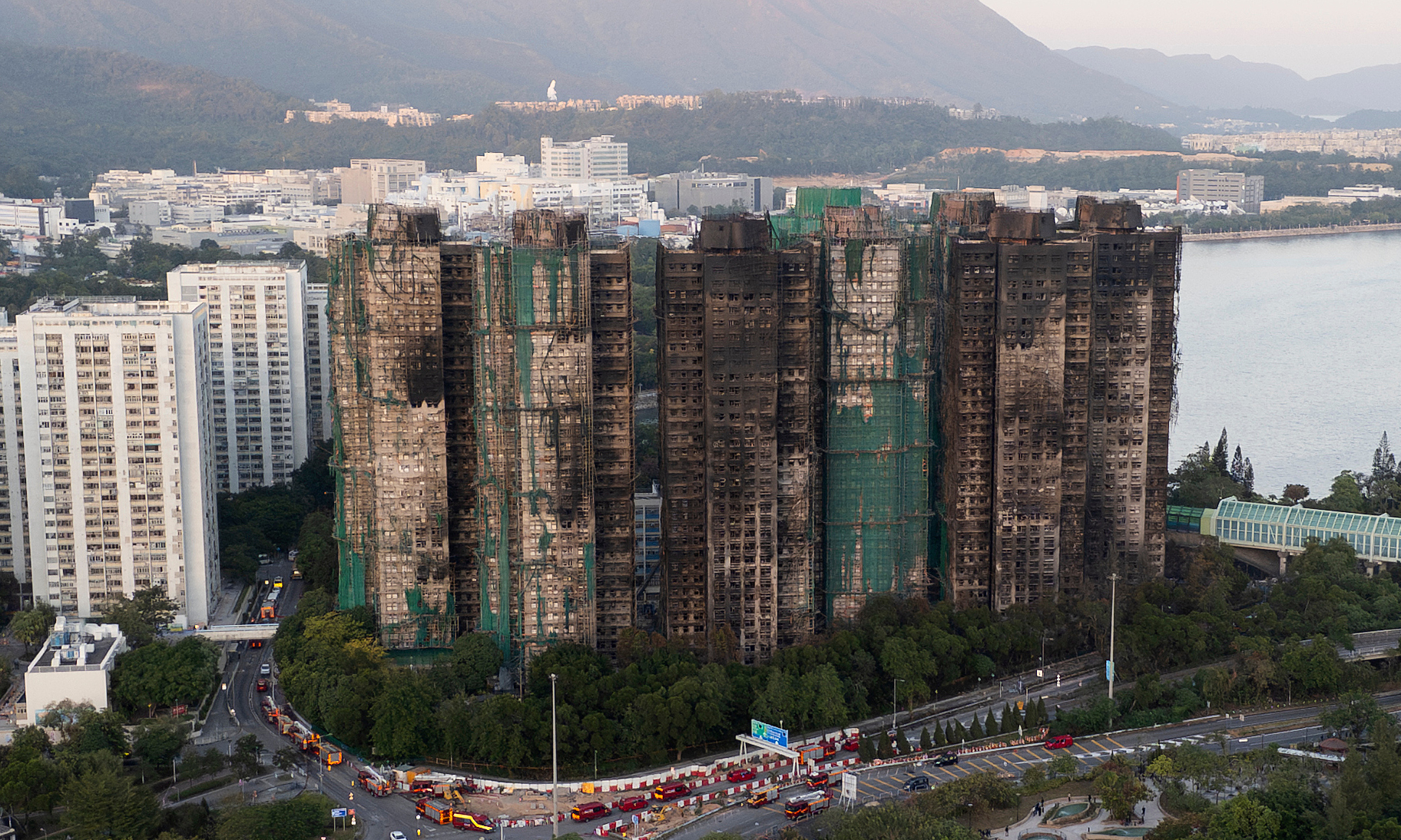 |
Wang Fuk Court apartment complex in Hong Kong on 28/11. *Photo: AP* |
According to a directive quoted by central television CCTV, all regions must "strengthen their sense of responsibility, balance development and safety, and consider inspecting and rectifying major fire hazards in high-rise buildings as a key task". The committee further stressed the need for enhanced supervision and inspection to ensure "practical and clear" results.
The Wang Fuk Court apartment complex, home to over 4,000 residents across approximately 2,000 apartments, was engulfed in flames for about 40 hours after the fire broke out on the afternoon of 26/11.
Preliminary data indicates the fire originated from external safety nets on the lower floors of one building, Hong Kong Secretary for Security Chris Tang said on 28/11. It then rapidly spread upwards due to burning foam panels, affecting multiple floors. Tang added, "High temperatures also caused the bamboo scaffolding and protective nets to catch fire. The burnt bamboo poles broke and fell, causing the fire to spread to other floors".
Thanh Tam (According to China Daily, AFP, Reuters)