Most jewelry gold stores that once lined the main commercial street in Biyang district, Henan province, have now closed.
"Gold jewelry used to be very popular in our small district", said Yu Qian, a 25-year-old kindergarten teacher who frequently bought gold jewelry. "There were once over 20 gold stores operating here, but I estimate more than two-thirds have ceased operations".
This wave of closures is happening across China due to weakening demand. Chow Tai Seng, one of China's largest jewelry and gold, silver, and gemstone retail brands, has cut 473 stores nationwide. The Lao Feng Xiang brand closed 342 sales points in third- and fourth-tier cities.
China Gold reduced 323 locations in the first half of the year, while Chow Tai Fook reported a decrease of 258 stores in mainland China in Q2, primarily due to the shrinking of its franchise system.
 |
Chinese wedding jewelry at an exhibition in Fuzhou city, Fujian province, 9/5/2024. Photo: CFP |
China's gold market is increasingly diverging between jewelry gold and investment gold. Data from the China Gold Association shows that jewelry demand sharply dropped by 33.88% year-on-year to 132,1 tons in the first six months of this year. In contrast, demand for safe-haven gold bars and coins increased by 28.42% to 339,3 tons. Overall gold consumption saw a 1,23% increase.
The reason for this trend is excessively high gold prices, which make manufacturing costs, labor, and brand fees—the most profitable components for jewelry stores—too expensive for buyers. Consumers are no longer willing to pay for decorative value or brand names. They buy gold to preserve wealth, prioritizing gold bars and ingots. If they do purchase jewelry, consumers opt for ultra-light designs, exchange old pieces for new ones, or choose items with the lowest processing fees.
"The willingness to pay exorbitant brand fees just for an attractive appearance has almost completely vanished now", said Fred You, a business development manager in Guangdong for a jewelry brand.
 |
Gold bracelets in a jewelry store in Huai'an city, Jiangsu province, 7/1/2024. Photo: CFP |
In a report published in july, the World Gold Council (WGC) stated that China's jewelry gold demand in Q2 decreased by 28% year-on-year, reaching its lowest Q2 level since 2004.
The WGC identified a declining marriage rate as another factor contributing to the downturn in China's jewelry gold market.
China recorded 3,275 million marriage registrations in the first half of this year, a 7,46% decrease compared to the same period last year, according to the Ministry of Civil Affairs. Economic difficulties, high living costs, and job uncertainty have led young people to postpone or forgo marriage.
Yu agreed that high gold prices affect people's marriage plans. "Many young people here are now hesitant to marry", she said. "Gold jewelry and betrothal gifts have become a significant financial burden for young couples".
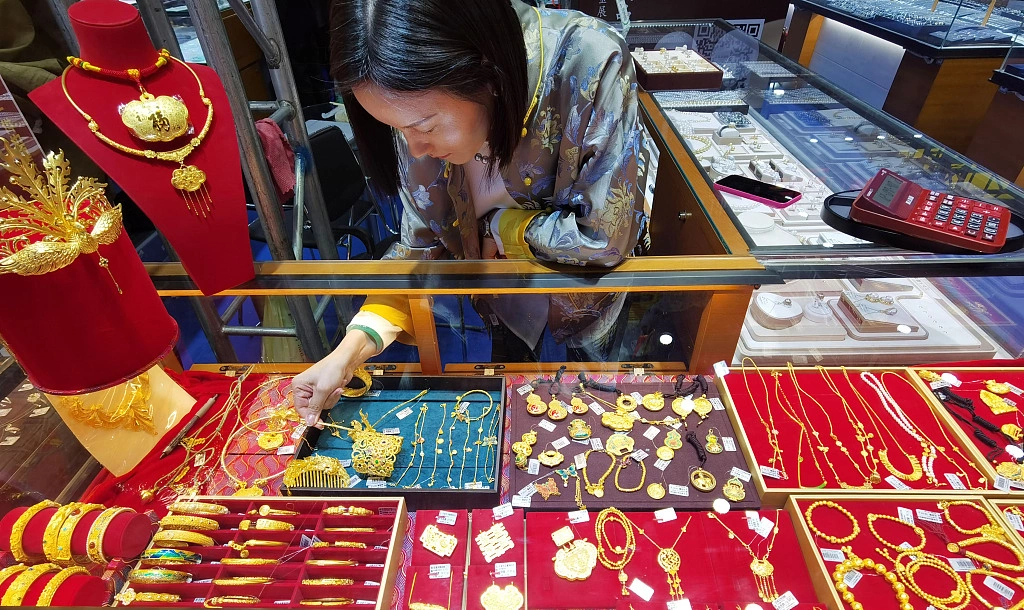 |
A jewelry counter at the Beijing International Jewelry Fair 26/10/2023. Photo: CFP |
Hong Hanh (According to SCMP, Sixthtone)