Following a US operation in Venezuela on the morning of 3/1 that led to the arrest of President Nicolas Maduro, US President Donald Trump stated that a military operation targeting Colombia "sounds reasonable." Trump had previously issued strong warnings to Colombian President Gustavo Petro on multiple occasions.
Washington-Bogota relations were expected to de-escalate somewhat when President Trump spoke with President Petro on the evening of 7/1. On the Truth Social platform, Trump described the exchange as "a great honor." A Colombian official at the time noted the tone of both sides changed "180 degrees."
However, in an interview published by the BBC on 9/1, President Petro stated that the tense situation had not improved significantly. The Colombian leader revealed the phone call lasted less than one hour, with most of the time spent presenting Colombia's views on drug trafficking, the situation in Venezuela, and "developments in Latin America related to the US role."
Petro stated that recent remarks from President Trump targeting Colombia, including the scenario of military action, "have become a real threat." He reiterated that Colombia lost territory in the 20th century due to interventions from Washington, citing the example of Panama's separation from Colombia in 1903 with US backing to allow the construction of a canal connecting the Pacific and Atlantic oceans.
"The prospect of eliminating this threat will depend on ongoing dialogue efforts," President Petro said.
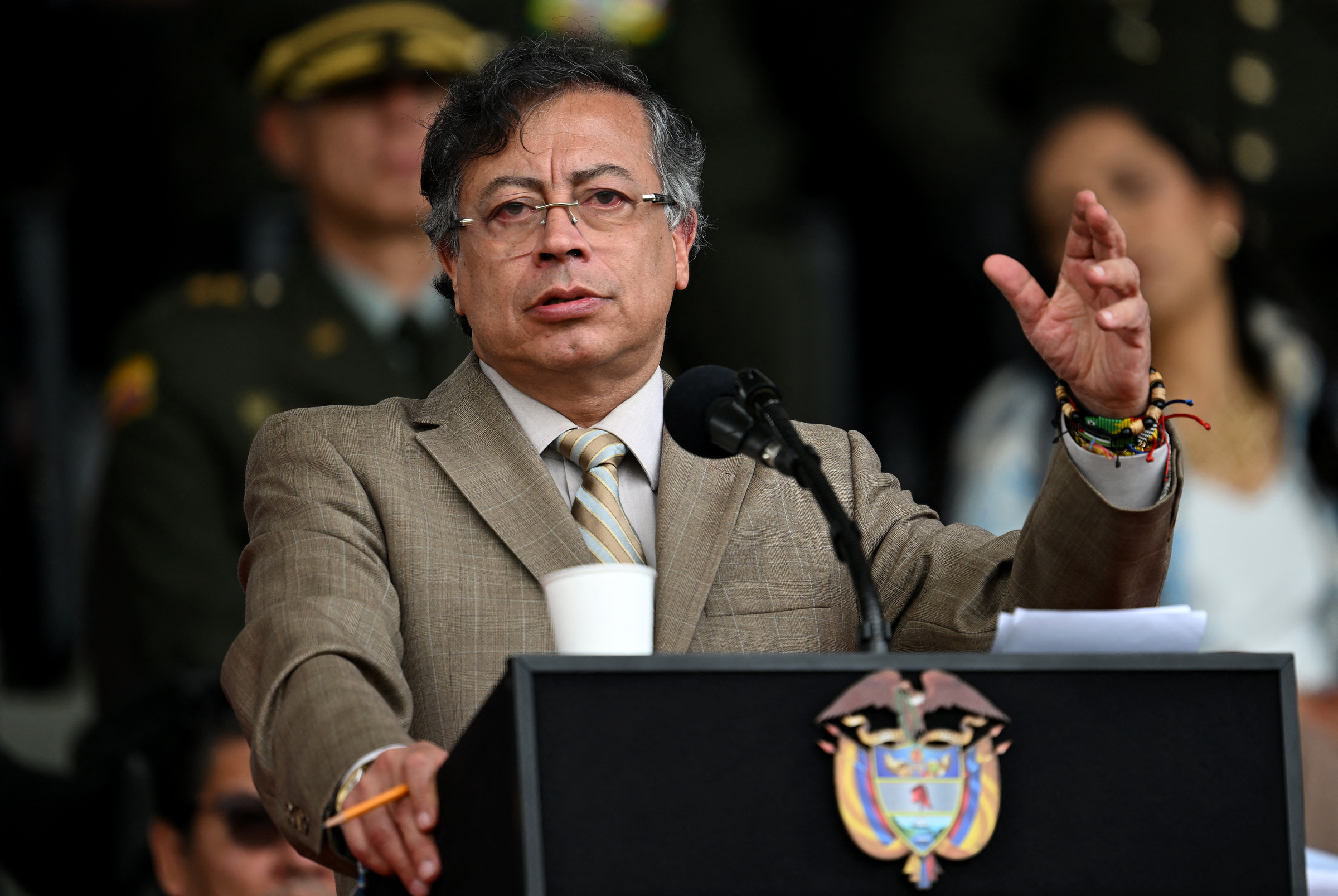 |
Colombian President Gustavo Petro speaks in Bogota on 13/11/2025. *Photo: AFP* |
When asked about Colombia's self-defense capabilities if the US military threat became a reality, Petro did not directly answer the BBC, stating only that Bogota advocates resolving issues through dialogue.
"Colombia's history shows we are ready to confront many large armies. We do not possess weapons comparable to powerful military forces. We even lack air defense weapons. Instead, we rely on our people and mountainous terrain, things never lacking in Colombia," President Petro commented.
President Trump had accused Petro of "liking to produce cocaine to sell to the US," warning that this situation would not continue. President Petro denied this accusation in the BBC interview, emphasizing he has full proof of his innocence.
The Colombian leader stated he has dedicated 20 years to fighting drug gangs, even accepting his family's exile to avoid danger.
Petro further explained that his government is pursuing a "total peace" strategy. On one hand, Bogota prioritizes dialogue with armed groups; on the other, it prepares military operations targeting forces that do not accept peace.
He reported that negotiations are underway in southern Colombia, an area that has seen the largest reduction in coca cultivation and the sharpest decline in homicide rates. "We are not foolish. We understand exactly who we are negotiating with," President Petro said.
The Colombian leader warned that Washington faces the risk of shifting from a "dominant" position to being "isolated from the world" due to current policies, ranging from domestic immigration crackdowns to reduced cooperation on global climate action and military intervention in Venezuela.
Petro asserted that for decades, the US has treated other governments, especially in Latin America, "like an empire," disregarding international law. Following US military action in Venezuela, he accused Washington of pursuing war for oil and coal.
He added that if the US had not withdrawn from the Paris Agreement on climate change (where nations agree to limit global temperature rise by reducing fossil fuel use), "their relations with the world, as well as with South America, would be far more democratic and peaceful."
Thanh Danh (According to BBC, AFP)