Juan Carlos Pino, a mechanic from Aguacate, Cuba, has become a local celebrity by converting his 1980 Polish-made Fiat Polski to run on charcoal. His innovative solution addresses Cuba's severe fuel shortages, drawing attention as the vehicle, with a 60-liter charcoal container welded to its rear, navigates the town's streets. This ingenuity reflects the resourcefulness Cubans have developed over decades of US sanctions.
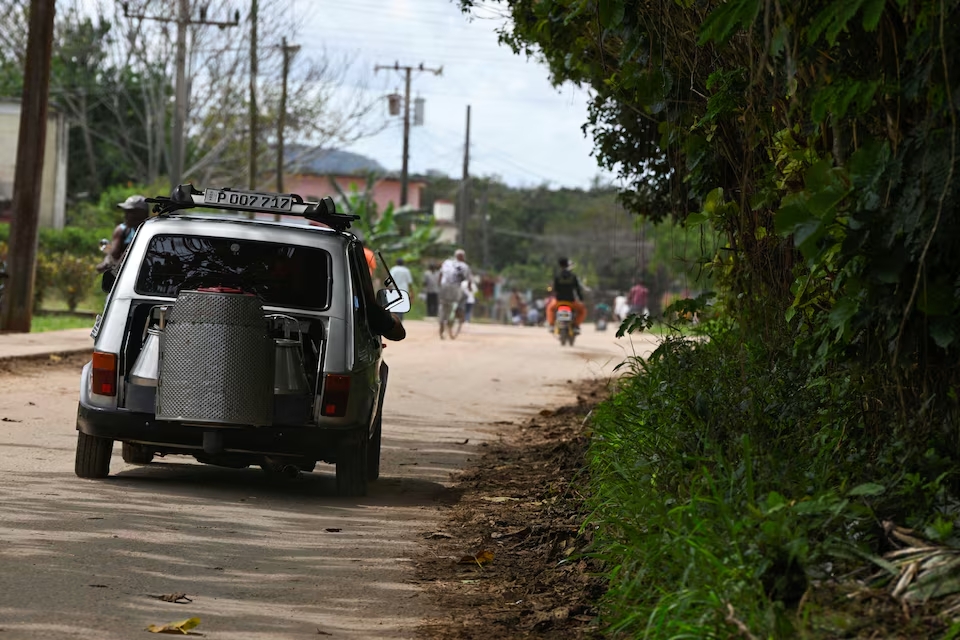 |
Pino's charcoal-powered Polski drives through the streets of Aguacate, Cuba, on 16/3. *Photo: Reuters* |
Passersby often stop to photograph Pino and his unique Polski. While some express skepticism, many inquire if he can replicate the system for their vehicles. "In these difficult times, this is the best option we have", stated Pino, 56, who only completed the 8th grade. "We need to travel, we need transportation to farm".
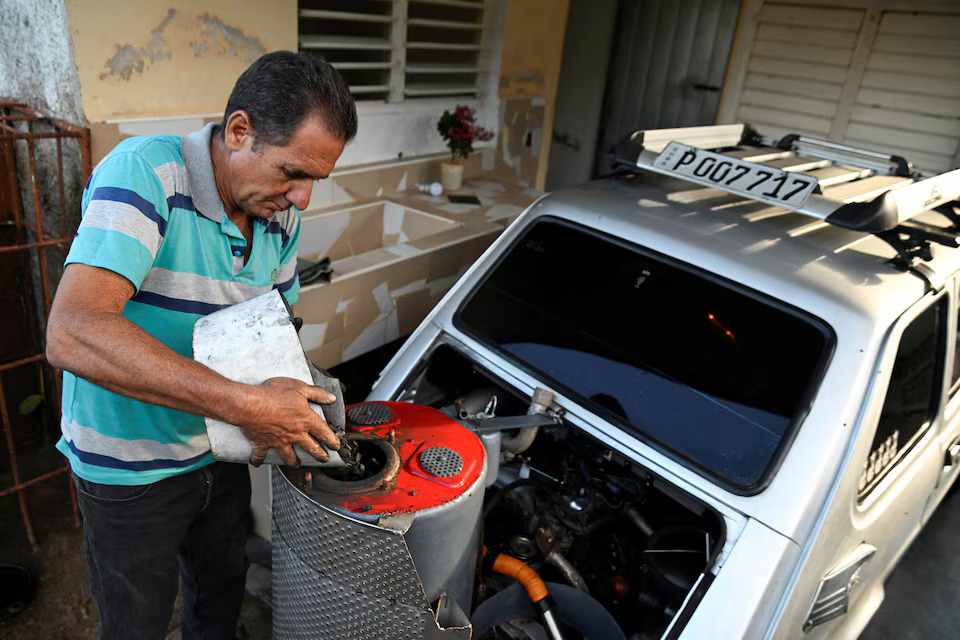 |
Pino loads charcoal into the container attached to the rear of his Polski. *Photo: Reuters* |
Pino explained to media that he constructed the entire engine system from scrap and repurposed items. The charcoal furnace, for instance, is a modified gas tank, sealed with an old transformer lid. For the air filter, he used a stainless steel milk canister packed with old clothes.
The severe fuel crisis in Cuba intensified after the US tightened control over Venezuela's oil exports following an operation to apprehend Venezuelan President Nicolas Maduro on 3/1. This action effectively halted oil supplies to Cuba, with no shipments reaching the island nation over the past three months. According to Havana, Washington's near-total blockade of fuel supplies has exacerbated the energy crisis, leading to rolling blackouts, shortages of medical supplies, and a decline in tourism. In some areas, 20-hour daily power outages are common.
 |
The charcoal-powered Polski drives through the streets of Aguacate, Cuba, on 16/3. *Photo: Reuters* |
Faced with such challenges, Pino has consistently found creative solutions, including once building a motorcycle-powered machine that could milk three cows simultaneously. He had harbored the idea of a charcoal-powered car for years, noting that many other Cubans have called him for guidance. "First, an ice maker, then an ice cream vendor, then a grocery store owner", he recounted.
Pino believes almost any engine can be converted to run on charcoal by directing hot gas into the carburetor instead of gasoline. His Polski made its inaugural journey on 4/3. During its initial test drive, the vehicle traveled 85 km, reaching a maximum speed of 70 km/h.
Many Cubans are amazed by this invention. "It's incredible. I don't know what else to say", remarked Yurisbel Fonseca, 27, who stopped his motorcycle to get a closer look and take photos. Narvis Cruz, 53, hailed the Polski as the "invention of the year", highlighting a common practice of resourceful modification. Cruz himself drives a 1953 Pontiac, powered by a 1940s Perkins engine, a Mercedes gearbox, a Czech-made steering system, and an East German-made differential. "This is Cuba", he concluded.
Duc Trung (According to Reuters, AP, Havana Times)