On 1/4/2025, Donald Trump became the first sitting U.S. President to attend a Supreme Court hearing. The justices heard arguments regarding the legality of an executive order signed by Trump, which sought to deny automatic citizenship to children born in the U.S. if neither parent was a citizen nor a legal permanent resident.
In a departure from his usual attention-seeking style, Trump arrived at the court quietly, taking a seat in the front row reserved for the public. He was accompanied by White House advisor David Warrington and several cabinet members but made no statements.
This session marked the initial debate in the Supreme Court's proceedings concerning the executive order to eliminate "born in the U.S. is a U.S. citizen" policy, which President Trump issued shortly after taking office in 1/2025. Numerous federal judges subsequently blocked the order's enforcement, prompting the U.S. Department of Justice to appeal to the Supreme Court for a ruling.
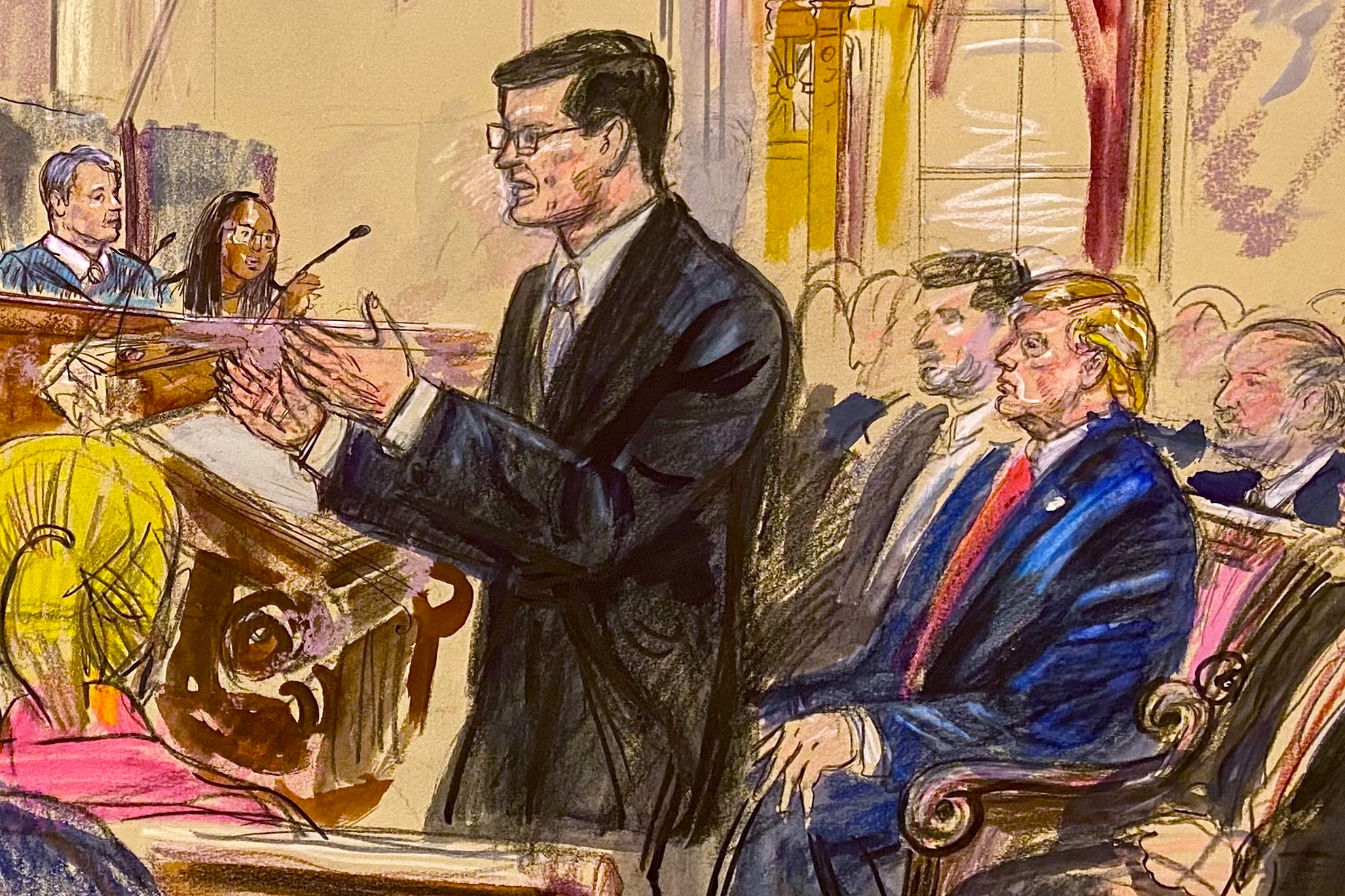 |
Ky hoa cho thay luat su dai dien chinh quyen John Sauer tranh luan truoc cac tham phan Toa an Toi cao, trong khi Tong thong Donald Trump ngoi du khan phia sau trong phien xu ngay 1/4. Anh: AP
The courtroom, devoid of cameras or televisions, was captured only by a sketch artist. The justices ascended the bench and commenced the session at 10:00. President Trump and other attendees stood as customary, while the justices appeared to show no reaction to his presence.
"He did not wave, mumble, or make any sound. He was simply an observer," described Amanda Frost, a constitutional law professor at the University of Virginia, who was seated in the legal counsel section.
President Trump maintained silence and appeared focused throughout the hearing, occasionally closing his eyes briefly. He listened intently to the entire 65-minute presentation and exchange with the justices by D. John Sauer, the government's lawyer and a former personal attorney for Trump.
President Trump has long opposed birthright citizenship, arguing for its abolishment to address the issue of immigrants illegally crossing into the U.S. to give birth, thereby securing U.S. nationality for their children.
Conversely, critics contend that Trump's executive order is unconstitutional. They cite the 14th Amendment of 1868, which states: "All persons born or naturalized in the United States, and subject to the jurisdiction thereof, are citizens of the United States and of the State wherein they reside."
Trump departed the courtroom at 11:20, approximately 13 minutes after Cecillia Wang, national legal director of the American Civil Liberties Union (ACLU), began presenting arguments against the order. He did not stop to address the media outside the court.
"We are the only country in the world foolish enough to allow birthright citizenship!" Trump wrote on Truth Social after returning to the White House. However, more than 30 countries globally, including U.S. neighbors Canada and Mexico, currently apply the principle of birthright citizenship.
Legal experts suggest that President Trump's appearance at the Supreme Court was likely an attempt to project power and exert pressure without uttering a single word.
"Is there any other reason? This is an attempt to pressure the judges. This threatens the independence of the Supreme Court," commented Steven Lubet, an emeritus professor at Northwestern University School of Law.
Kate Shaw, a law lecturer at the University of Pennsylvania, noted that, in principle, Trump's attendance at the debate was acceptable. However, considering his past criticisms of judges who issued unfavorable rulings, Shaw suggested the move "seems to be a way to send the message that judges who vote against the order to abolish 'born in the U.S. is a U.S. citizen' law will face similar attacks."
Earlier this week, President Trump voiced dissatisfaction with the Supreme Court, urging the justices to demonstrate their wisdom by siding with him on the issue of nationality for those born in the U.S. The President and his senior advisors have long maintained that many foreigners are motivated to travel to the U.S. to give birth, and this "birth tourism" poses a threat to national security.
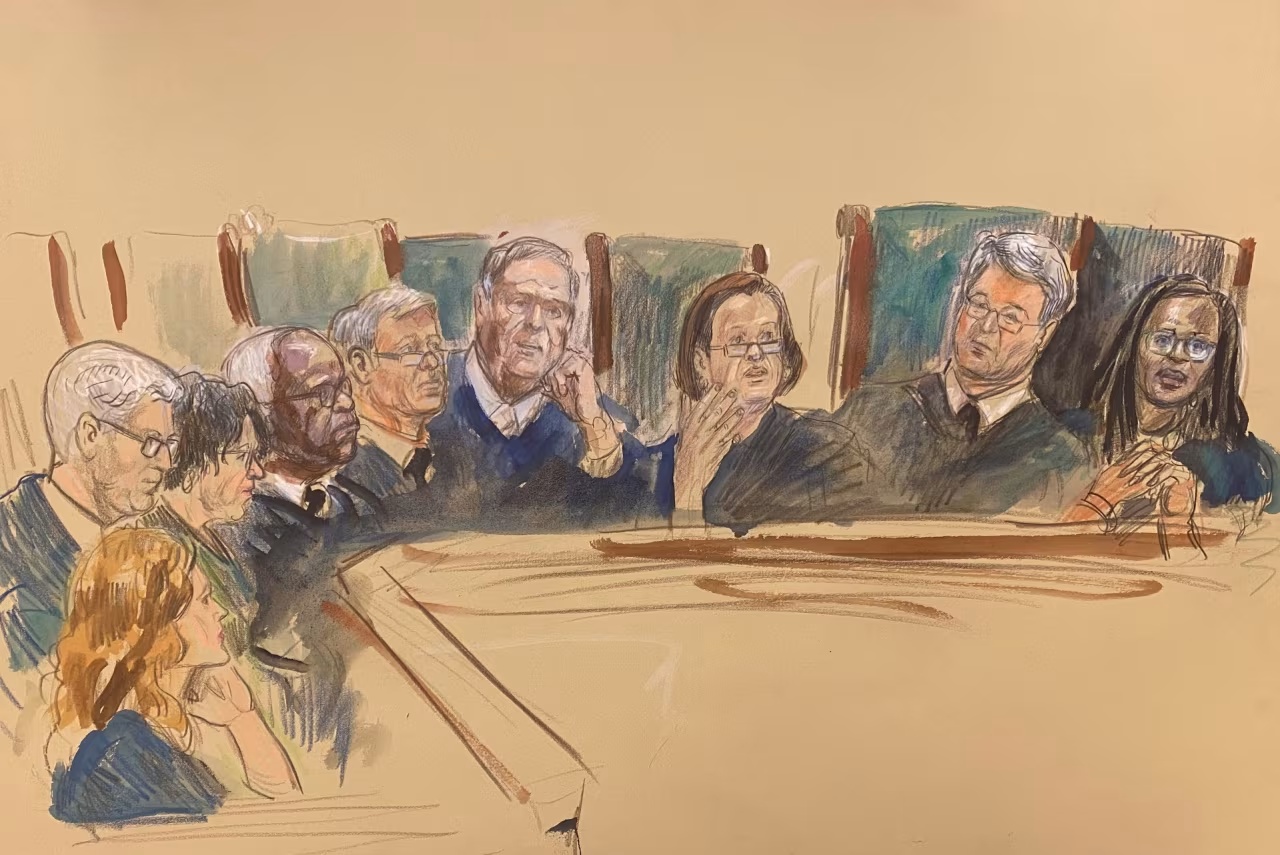 |
Ky hoa 9 tham phan Toa an Toi cao nghe tranh luan tai toa ngay 1/4. Anh: Dana Verkouteren
The White House declined to comment on Trump's Supreme Court appearance. The justices are expected to issue a final ruling in June or July this year.
Should the ruling be unfavorable, it would mark President Trump's latest legal setback in recent months before the nation's most powerful judicial body. In 2/2026, the justices rejected his tariff policy. They also blocked the President's order to deploy the National Guard to Chicago in 12/2025.
If the Supreme Court sides with Trump and permits the termination of birthright citizenship, approximately 250,000 children would be born stateless in the U.S. each year, according to an assessment submitted to the court by dozens of professors. By 2045, this number could rise to 5 million.
Nhu Tam (Theo NBC News, Washington Post, Reuters)