"Nick Ut did not take that photo. It was captured by a freelance photographer, Nguyen Thanh Nghe," Carl Robinson, who was a photo editor for the Associated Press (AP) in Vietnam in 6/1972, wrote in a letter published in the Washington Post on 23/12.
The photograph Robinson referred to is "Napalm Girl," which captures the moment a 9-year-old girl named Kim Phuc runs from the flames of napalm bombs, naked and with a face distorted by pain. This has long been considered one of the most iconic images of the 20th century, associated with AP photographer Nick Ut, who won a Pulitzer Prize for the picture.
However, a Netflix documentary released this year sparked new controversy, questioning the true authorship of the photograph and whether Nick Ut deserved the prestigious award.
"I knew the moment was captured by a freelance photographer, but my superior at the time, Horst Faas, instructed me to credit Nick Ut in the photo caption. Fearing for my job and family, I complied. That decision has haunted me for the past 50 years," Robinson explained in the newly published letter.
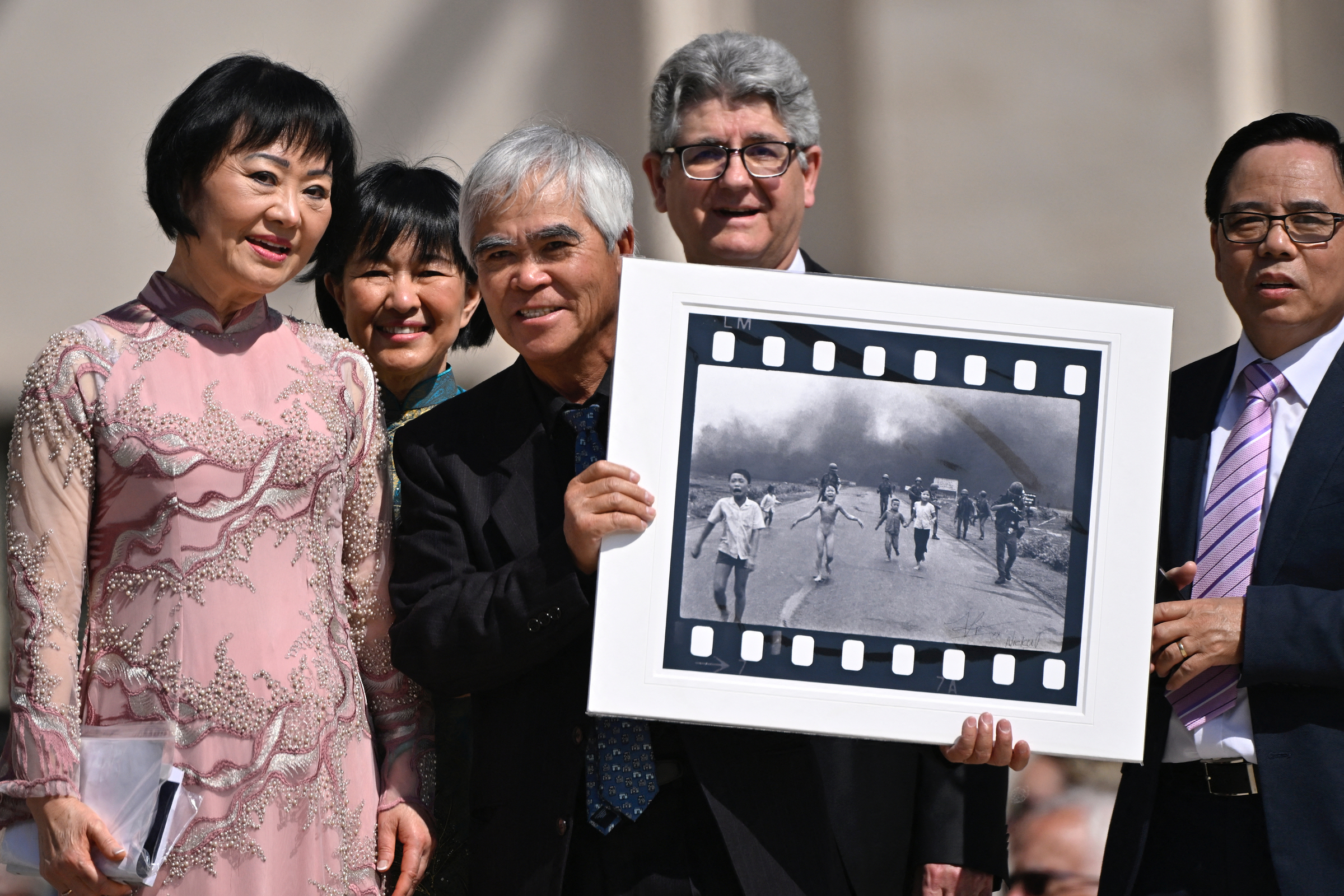 |
Photographer Nick Ut (center) and Phan Thi Kim Phuc (left) with a replica of the "Napalm Girl" photograph at the Vatican in 5/2022. Photo: AFP.
In addition to the Pulitzer Prize, Nick Ut also received the World Press Photo award for this work. However, in May, World Press Photo announced a temporary suspension of crediting Nick Ut as the author due to long-standing questions about the photograph's origin, especially after the documentary aired on Netflix.
The organization's review concluded that Nguyen Thanh Nghe, a driver who occasionally sold photos, along with another photographer named Huynh Cong Phuc, might have been in a more advantageous position to capture that moment.
AP, meanwhile, maintains that there is insufficient compelling evidence to change the credited author, and not enough data or testimonies to reverse a conclusion that has stood for decades.
The controversy became more complex when David Burnett, a photojournalist present at the scene that day, publicly defended Nick Ut's authorship in a letter published by the Washington Post on 10/12. In the letter, Burnett recounted that while changing film in his Leica camera, he saw Nick Ut and reporter Alex Shimkin as the first to react when the group of children ran towards them.
"As I recall, they immediately rushed down the road, outpacing all other journalists, except for a United Press International contributor on the right side of the uncropped frame. At that moment, no other journalist was moving in that direction," Burnett wrote.
Burnett suggested the famous photograph was taken about one or two minutes before other reporters reached the scene.
However, Robinson argued that Burnett was mistaken, noting that Burnett himself admitted he was focused on changing film at that moment and could have been confused about who took the picture. Robinson also refuted Burnett's frequently repeated detail that Horst Faas praised Nick Ut with a German "gut gemacht" (well done) at the scene.
"At that time, the photograph with the incorrect caption was processed and transmitted to Tokyo under my supervision. I returned home in a state of extreme distress, something my wife later recounted in The Stringer," Robinson wrote.
Robinson stated that Burnett has repeated this story for years in numerous presentations and interviews, despite being informed by Robinson about the authorship dispute since 2011.
Nick Ut's lawyer, James Hornstein, has not yet responded to requests for comment on the information provided by Robinson.
In a previous statement to Time magazine, Hornstein affirmed that there is no new documentary evidence sufficient to challenge his client's authorship. "If credible evidence existed to deny Nick Ut's authorship, it would not have only emerged in the accounts of a small group of individuals after five decades, contradicting a large volume of contemporary testimonies," Hornstein stated.
By Thanh Danh (According to Washington Post, Telegraph)