Since taking office in january, US President Donald Trump has intensified crackdowns on undocumented immigration, fulfilling a campaign promise despite mixed reactions. Reuters estimated on 22/12 that the Trump administration had repatriated about 622,000 immigrants, still short of its pledge to deport one million people annually.
Tom Homan, a border policy official for President Trump, stated that the US is preparing for a more aggressive immigration enforcement campaign in 2026, backed by billions of USD in additional funding. The US plans to recruit thousands more Immigration and Customs Enforcement (ICE) staff and open numerous new detention centers to boost the arrest and deportation of undocumented immigrants.
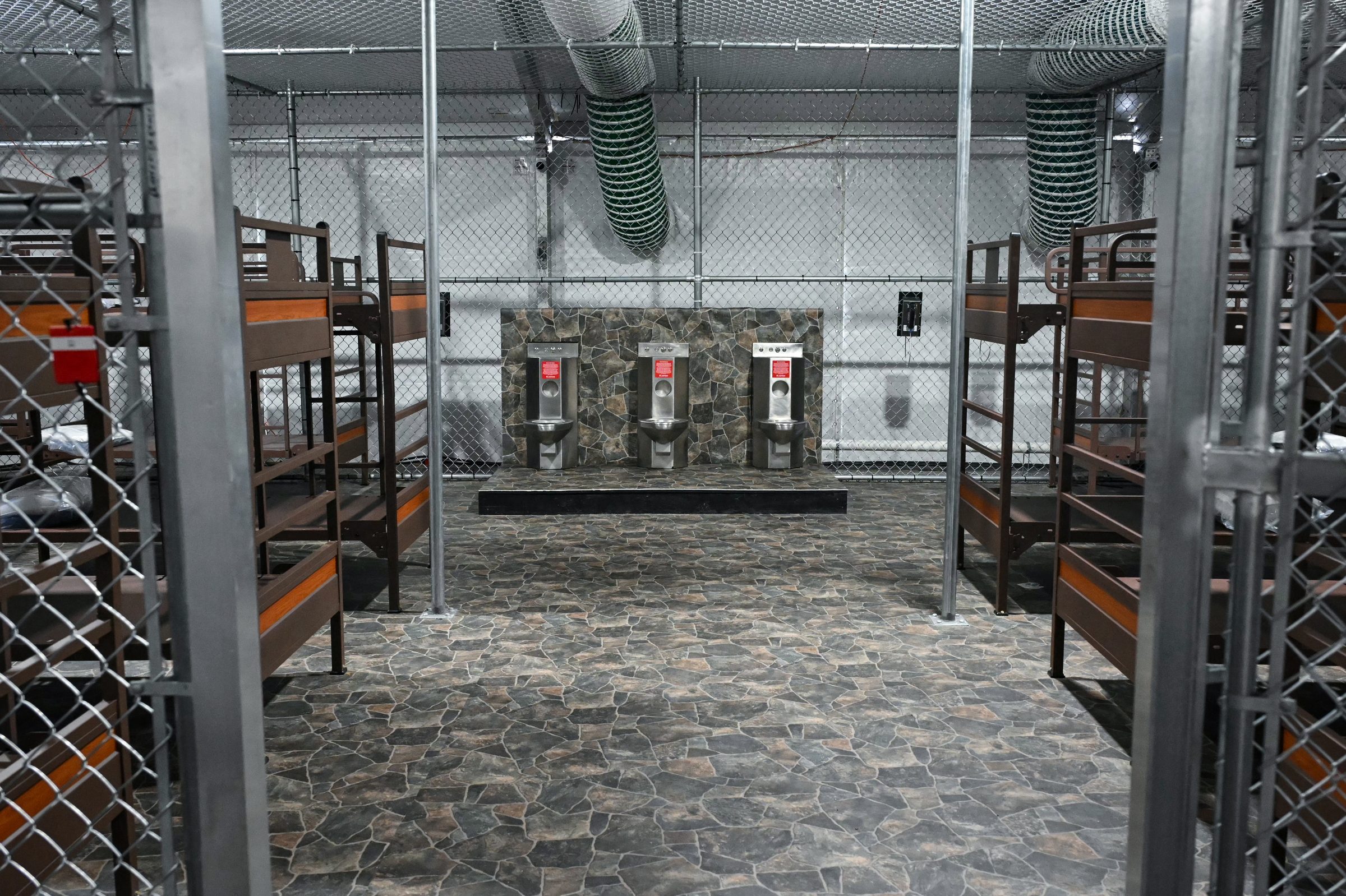 |
Toilets and bunk beds in a cell at the "Alcatraz alligator prison" in Florida on 1/7. Photo: AFP |
Toilets and bunk beds in a cell at the "Alcatraz alligator prison" in Florida on 1/7. Photo: AFP
According to internal ICE documents cited by The Washington Post on 24/12, the agency plans to convert seven industrial warehouses into detention facilities, each capable of holding 5,000 to 10,000 people. The system will also include 16 smaller warehouses, each able to detain up to 1,500 individuals. Such warehouse-converted detention centers could enable ICE to detain up to 80,000 people concurrently.
Detained individuals will be processed at temporary facilities for several weeks before being transferred to larger centers. These warehouse-style detention centers are planned for locations near logistics hubs in Virginia, Texas, Louisiana, Arizona, Georgia, and Missouri.
ICE also intends to establish a "transit system" to streamline the deportation process, moving away from the current practice of sending immigrants to any available facility.
NBC News reported in early november, citing sources from the White House and the US Department of Homeland Security (DHS), that the federal government was considering purchasing warehouses designed for companies like Amazon and converting them into detention facilities. Specific details of the plan were unclear at the time.
According to tender documents, ICE will divide large warehouses into several zones: a reception area, living quarters with bathrooms and toilets, a kitchen and dining area, a medical section, a recreation area, a legal library, and administrative offices. Some facilities will include special accommodation areas specifically for detained families. The US government has allocated 30 million USD to support the "initial assessment and conceptual design" activities for this plan.
The tender documents describe that the new facilities will help reduce detention times, accelerate deportation processes, and ensure the safety, dignity, and respect of individuals under ICE's custody.
A 2015 report highlighted that deportation flights often departed the US with many empty seats due to logistical difficulties in simultaneously gathering enough eligible individuals.
"We need to run the system better, like a business", acting ICE director Todd M. Lyons stated at a border security conference in april. He noted that the administration's goal is to deport immigrants as efficiently as Amazon ships goods.
The documents do not provide an overall timeline for project implementation, but they require facilities to begin accepting detainees within 30-60 days of groundbreaking.
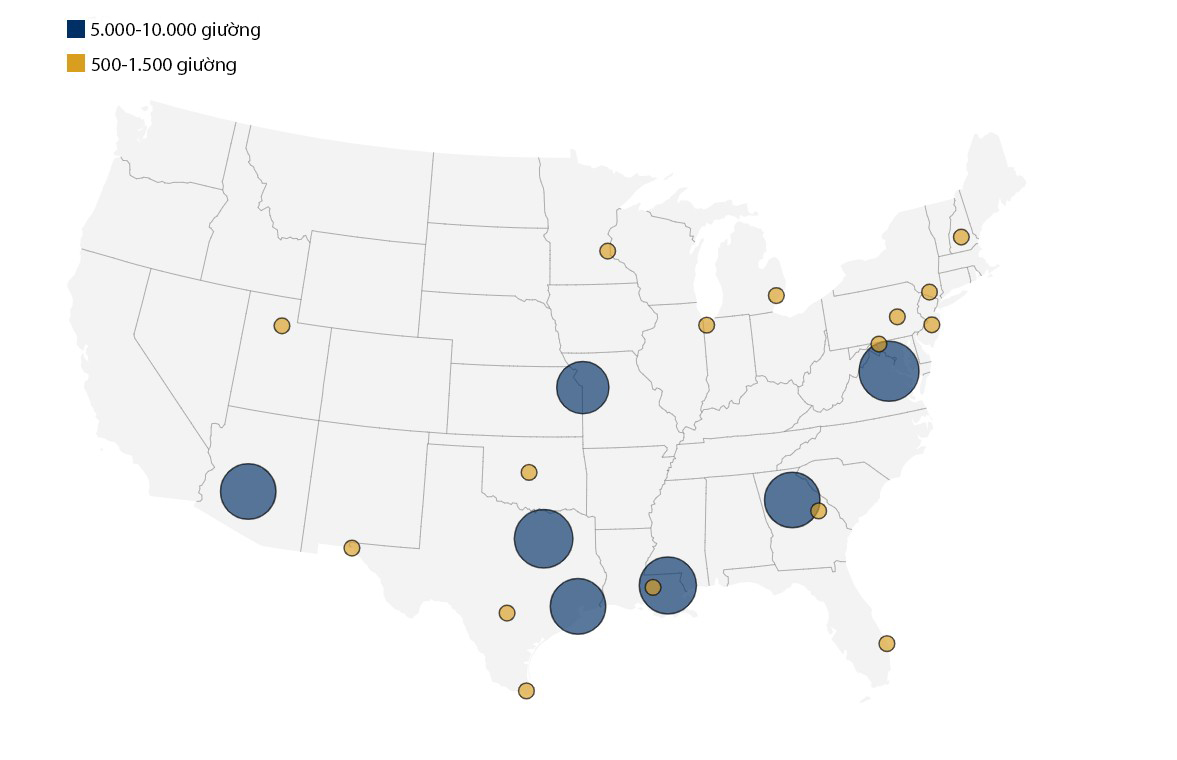 |
Planned locations for ICE immigrant detention facilities. Graphic: Washington Post |
Planned locations for ICE immigrant detention facilities. Graphic: Washington Post
ICE's plan is anticipated to encounter various obstacles.
Most states where the Trump administration plans to establish these types of detention facilities are Republican-led and support the President's immigration policies. Only two areas, Stafford, Virginia, and Kansas City, Missouri, have Democratic-led governments.
"If the federal government leases and renovates warehouses in Stafford, they will have to comply with city regulations and standards", said Pamela Yeung, a Stafford city official. "Immigration policy is a federal issue, while its consequences directly impact local communities. Any facility of this scale would affect infrastructure, public safety, and social welfare."
Commercial real estate experts suggest that concentrating detainees in converted warehouse facilities will inherently create numerous logistical challenges. These structures are designed for storing and transporting goods, not for human habitation. They often have poor ventilation, lack temperature control systems, and do not have the necessary water and sewage infrastructure.
"That is inhumane", said Tania Wolf, an advocate with the National Immigration Project, based in New Orleans, Louisiana.
Jason Houser, a former ICE chief of staff under president Joe Biden, observed that adequately staffing such large-scale detention facilities presents a significant challenge. He explained that the potential workforce would require medical or other specialized training and must pass federal security clearance processes.