ukraine conflict unlikely to end
Four years after the Russia-Ukraine conflict erupted, a peaceful resolution remains elusive, despite mediation efforts by US President Donald Trump. Both Moscow and Kyiv remain committed to their conditions without compromise, especially regarding territory, making the prospects for successful peace talks fragile.
Next year will be a test of wills, determining which side can endure longer in the prolonged war of attrition that has inflicted heavy resource losses on both sides, noted Orysia Lutsevych, head of the Ukraine Forum at the London-based research organization Chatham House.
Ukraine must adjust its economy to a protracted conflict as financial aid from the US is cut and support from the European Union becomes much more difficult. Kyiv also needs to boost its industrial capacity to increase self-sufficiency in weaponry, as Western support diminishes.
 |
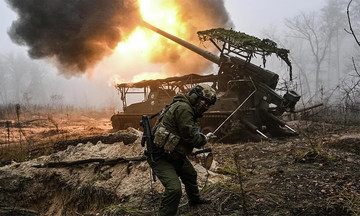
Ukrainian soldiers fire a howitzer towards Russian forces near the front-line town of Pokrovsk in the Donetsk region on December 11. *Reuters* |
Ukraine's success in the technological race for drone interception, alongside its ability to strike deep into Russian territory, is an equally important objective.
However, Ukraine's challenge is that Russia also continuously innovates in defense technology. Russia has increased its drone production capacity and now even surpasses Ukraine in this field. Moscow's ballistic missiles can now better evade interception systems, including US-made Patriot air defense systems.
Whether Europe's "coalition of the willing" can sustain its support for Ukraine is an equally crucial question as the US gradually withdraws from the region. To hold the front lines in 2026, Ukraine will require approximately 100 billion USD in military aid, financial support, and the transfer of optimal equipment.
Ukraine's Priority Requirements List (PURL) initiative, launched by NATO, which encourages member states to purchase US weapons for Ukraine, also needs additional funding in 2026. To date, 13 bloc members have only pledged to spend 2 billion USD. The NATO summit in Ankara, Turkey, in July 2026 could be a significant milestone to help the bloc strengthen this commitment and achieve consensus on future security arrangements for Ukraine.
fragile peace in the middle east
The year 2026 will test whether ceasefires in the Middle East can become the foundation for meaningful diplomatic efforts and sustainable peace agreements. The US-brokered Gaza ceasefire in October offered a valuable respite for the region's people after two years of devastation from the conflict between Israel and Hamas.
 |
Devastation in Gaza City in November. *Reuters* |
President Trump's engagement in regional diplomatic efforts created much-needed pressure on both Israel and Hamas, but the peace plan still lacks a detailed framework, a specific timeline, and commitment from both sides. International action, particularly from regional powers, will be essential to transform the ceasefire agreement into a broader political and reconstruction process.
Lebanon and Syria remain institutionally fragile, making both nations vulnerable to renewed conflict. Lebanon's parliamentary elections, scheduled for May 2026, could offer an opportunity to stabilize the internationally backed technocratic government there. Despite direct talks between Israel and Lebanon, numerous intractable issues persist, such as the disarmament of Hezbollah.
In Syria, although the new administration completed its first parliamentary elections and violence has subsided, reconstruction efforts are stagnating. Interim President Ahmed al-Sharaa's historic visit to the White House in November 2025 and the lifting of US sanctions on Syria could signal new economic opportunities for the nation.
Meanwhile, the specter of another Israel-Iran confrontation looms over the region after the 12-day clash in June. While Israel is reluctant to engage in dialogue, re-establishing diplomatic channels with Iran is essential to prevent Tehran from restarting its nuclear program.
If Israel continues to focus on deterrence instead of diplomacy and promoting peace in Gaza, observers believe Tel Aviv could face further isolation in 2026.
Elections are almost certain to be held in Israel in 2026, and the challenge for Prime Minister Benjamin Netanyahu is whether he can secure another victory.
us-china rivalry for influence intensifies
The trajectory of US-China relations is expected to become clearer in 2026, as President Trump and President Xi Jinping plan mutual visits following the trade truce in October.
Although US political and security circles believe they must prepare for decades of strategic competition with China, President Trump views Beijing as a partner with whom he can do business, even if it requires using threatening tactics to secure short-term advantages.
Regardless of how President Trump approaches China, President Xi remains convinced that Washington is attempting to contain Beijing in the long term. When announcing China's 15th five-year plan in March 2026, President Xi will likely accelerate China's efforts to achieve technological and industrial self-sufficiency, thereby enabling the country to overcome "chokepoints" controlled by the US, such as high-quality semiconductors.
The trajectory of US-China relations will impact the rest of the world. This will be evident as the two superpowers, along with India, host important summits in 2026, including the BRICS summit in India, APEC in China in November, and the G20 in the US in December.
Elsewhere in Asia, the new leaders of Japan and South Korea, Prime Minister Sanae Takaichi and President Lee Jae-myung, will need to continue managing domestic political polarization and stagnant economic growth while balancing complex relationships with the US and China.
impact of us tariffs on the global economy
The biggest surprise for the global economy in 2025 was that President Trump actually delivered on his campaign promises. So far, the world economy has been less affected than anticipated by the US imposition of reciprocal tariffs on numerous countries. The International Monetary Fund (IMF) forecasts global growth at over 3% in 2026, and numerous stock markets have recently reached all-time highs.
This outcome is partly because other countries chose not to retaliate against increased US tariffs and continued to trade with each other under World Trade Organization (WTO) terms. Additionally, there were other offsetting factors, such as the boom in artificial intelligence investment in the US, Germany's easing of debt limits, and a weakening US dollar.
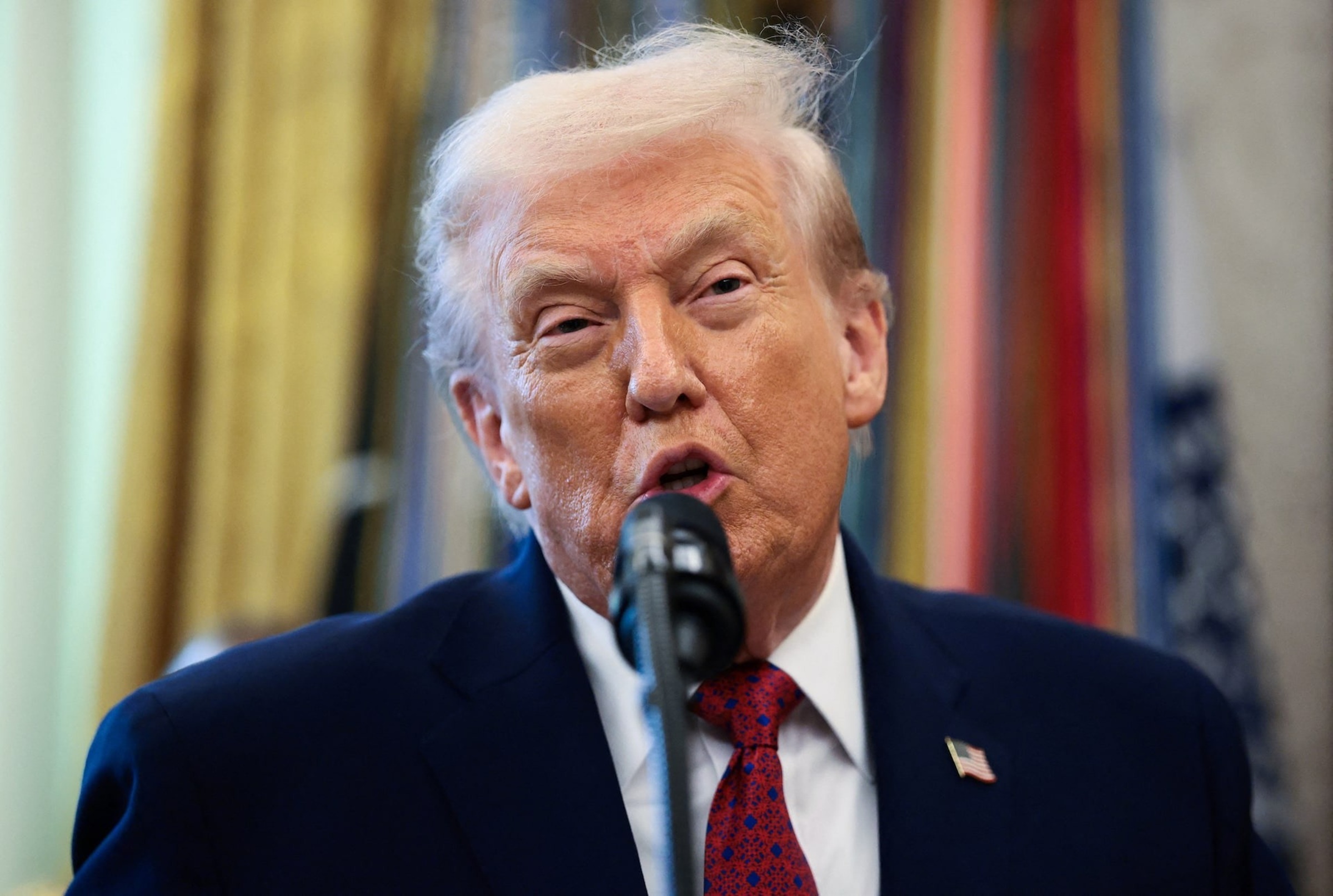 |
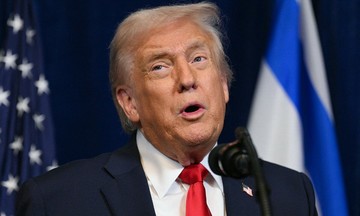
US President Donald Trump at the White House on December 15. *Reuters* |
A key question for 2026 is whether these dynamics will continue to sufficiently counterbalance the negative impacts of President Trump's actions on the US and global economies. One possible scenario is that financial markets could experience a sharp correction or even collapse, amplified by a wave of credit reductions in private credit markets.
The second question relates to China's somewhat sluggish economic growth. A combination of factors, such as weak domestic demand, falling home prices, excessive domestic competition, and increasing foreign protectionism against heavily subsidized Chinese exports, could eventually compel Chinese officials to implement necessary fiscal and monetary measures to boost domestic consumption.
Laurel Rapp, director of the US and North America Program at Chatham House, suggests that if Washington lacks a new strategy, the world will face a turbulent 2026 with tariff wars, military pressure, or containment actions against US partners seeking to maintain ties with China.
However, the US Supreme Court in 2026 could rule to significantly limit President Trump's authority to use tariffs. If the Democratic Party gains control of the US Congress in the mid-term elections in November 2026, President Trump's power will be further diminished.
Vu Hoang (According to AFP, Reuters, Chatham House)