At the University of Wyoming, students in Professor Catherine Hartmann's religion course face a challenge: a 30-minute direct conversation, replacing traditional essays or computer-based multiple-choice tests.
Professor Hartmann began reforming student assessments last year. She requires students to avoid electronic devices in class and practice discussions throughout the semester.
Before the exam, students receive a list of core concepts. Their task is to explain and persuasively argue these concepts before the professor, demonstrating a deep understanding of the subject.
This trend is spreading across North America. Mark Chin, a professor at Vanderbilt University, Tennessee, recently conducted the first round of oral exams for his data science course. Recognizing AI's proficiency in solving programming exercises, Professor Chin opted to show students pre-existing code snippets and ask them to explain their functions on the spot.
"I want to see if students are truly reading and understanding the material", he shared.
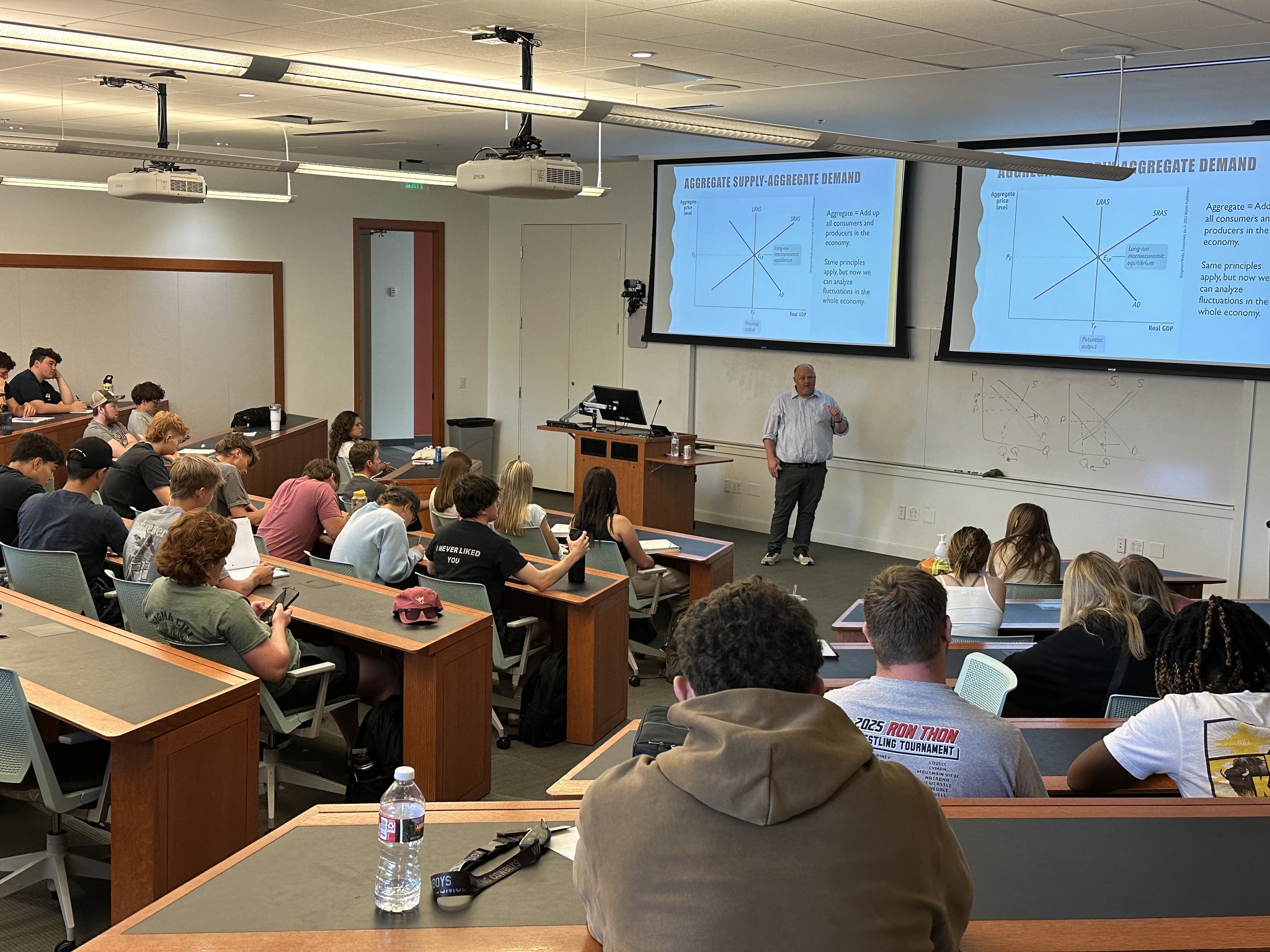 |
A classroom at the University of Wyoming, US. *Photo: University of Wyoming* |
Oral exams are not limited to small classes. At Western Ontario University, Canada, professors administered oral exams to a business class of 600 students. Similarly, the University of California-San Diego, US, has implemented this format across 6 large-scale engineering courses.
According to an Inside Higher Ed survey, 85% of students admit to using AI for brainstorming or preparing for quizzes. Additionally, 25% use it to complete homework assignments. While some professors have employed AI detection software, they have found that these tools do not always provide reliable results.
Professor Hartmann confided that when grading essays, she often felt like she was "playing detective", searching for AI-generated content. "I do not like such an adversarial relationship", she stated.
The shift to oral exams has shown positive impacts for both professors and students.
After 11 rounds of oral exams, Professor Chin observed that despite initial stress, students were able to answer questions that had challenged them months prior. He believes that learning a new and difficult skill is both the purpose and the greatest reward of this assessment format.
Carley King, a student at the University of Illinois, appreciates the ability to present her knowledge quickly, avoiding the time-consuming nature of written exams or essays.
Tricia Bertram Gallant, director of the Office of Academic Integrity at the University of California-San Diego, recommends that departments assess student competency through oral questioning at least once.
"These assessments are not always the most suitable, but they can develop students' ability to speak clearly – a valuable skill for most professions", she added.
By Khanh Linh (adapted from The Washington Post, The Rundown)