President Vladimir Putin visited the Yasny seafood processing complex on Iturup Island, part of what Russia calls the Kuril Islands, on 13/8. Putin's first visit to the Kurils immediately drew sharp criticism from Japan, which also claims sovereignty over the archipelago, referring to it as the Northern Territories.
Japanese Foreign Minister Toshimitsu Motegi summoned Russian Ambassador Nikolay Nozdrev to protest. Prime Minister Sanae Takaichi called President Putin's actions "completely unacceptable". "The Northern Territories are an inherent part of Japan's territory, both historically and under international law", Foreign Minister Motegi and Prime Minister Takaichi both emphasized.
In response, Moscow immediately rejected Tokyo's statements, describing them as "groundless and outrageous". Russian Foreign Ministry spokesperson Maria Zakharova stated: "They are politically inappropriate, offensive, and, of course, have no legal basis. The entire Kuril Islands archipelago is an inseparable part of our country. There is no doubt about Russia's sovereignty and jurisdiction over these islands". This incident once again heightened tensions between Russia and Japan, making the prospect of mending bilateral relations more distant than ever.
The dispute centers on the Kuril Islands, a chain of 56 volcanic islands and islets that separate the Sea of Okhotsk from the North Pacific Ocean. This island chain stretches approximately 1,300 km, situated between the southern tip of Russia's Kamchatka Peninsula in the Far East and the northeasternmost point of Hokkaido, Japan's northernmost island. Along with Sakhalin Island, the Kuril Islands currently form Russia's Sakhalin Oblast, one of the country's 83 federal administrative units.
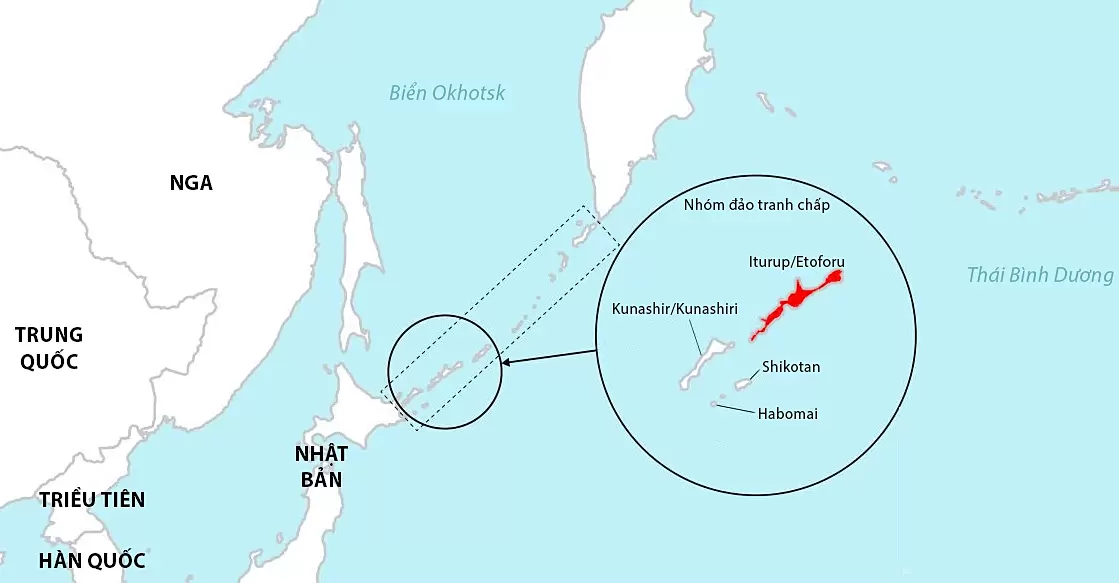 |
Location of the disputed islands between Russia and Japan. *Graphics: GIS* |
Japan claims sovereignty over four islands: Iturup (Etorofu in Japanese), Kunashir (Kunashiri), Shikotan, and Habomai, located in the southern part of the archipelago. These islands are the closest to Japan, just off the coast of Hokkaido. Tokyo considers these four islands part of Hokkaido prefecture and views their occupation by Moscow as "illegal". Russian Empress Catherine the Great asserted sovereignty over the Kuril Islands in 1786 after her government declared these islands were discovered by "Russian explorers" and therefore "must certainly belong to Russia". In the first treaty between Russia and Japan in 1855, the border between the two countries was established just north of the four islands closest to Japan. Two decades later, a new treaty transferred the entire island chain to Japan, in exchange for Russia's control over all of Sakhalin Island. Japan regained control of the southern half of Sakhalin Island after the Russo-Japanese War in 1905.
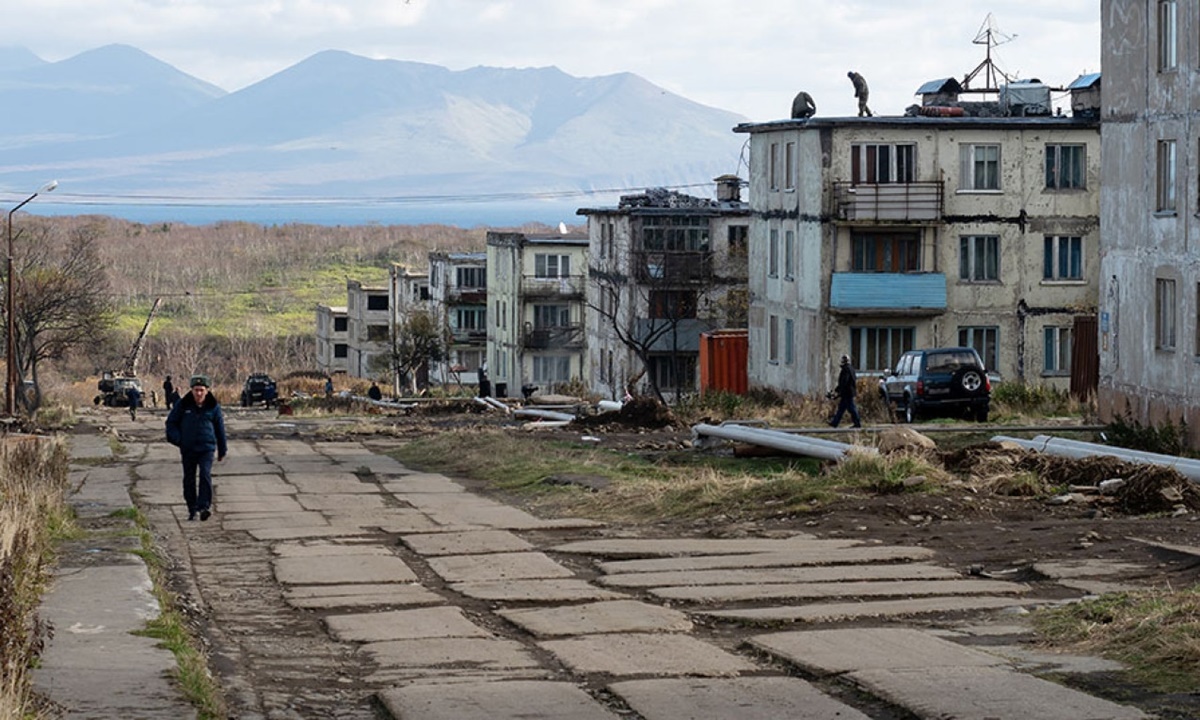 |
The Gorny residential area on Iturup Island, part of the Kuril Islands. *Photo: TASS* |
The Kuril Islands became the focal point of the territorial dispute when Soviet troops advanced on them in the final days of World War II, after the United States dropped atomic bombs on Hiroshima. Moscow asserts that at the Yalta Conference in 2/1945, US President Franklin Roosevelt promised to return the Kuril Islands to Soviet leader Joseph Stalin in exchange for the Soviet Union entering the war against Japan. The Soviet Union's control over the Kuril Islands prevented Moscow and Tokyo from signing a formal peace treaty after World War II, despite repeated attempts by both sides to reach an agreement over the past 70 years. In 1956, Soviet leader Nikita Khrushchev offered to cede the two smallest islands, Shikotan and Habomai, to Japan in exchange for the two countries signing a peace treaty, but he abandoned the idea after Tokyo signed a military alliance agreement with Washington.
Despite a total population of only about 20,000 people, these islands hold high economic and strategic value. The surrounding waters are rich in seafood reserves and possess deposits of minerals and rare metals, including rhenium, used in the production of hypersonic aircraft. Control of the archipelago allows Russian naval warships to move freely into the Pacific Ocean year-round, as the strait between Kunashir and Iturup does not freeze in winter. In recent years, Russia has increased its military presence on the Kuril Islands. In 2016, Russia deployed Bal and Bastion coastal defense missile systems on two of the four Kuril Islands. In subsequent years, the country brought air defense missile systems there and established an air base on Iturup Island.
The dispute between the two sides had quieted until Russian state media announced Putin's visit to the Kurils. Prime Minister Takaichi stated that the visit "hurt the feelings" of the Japanese people and complicated anti-Russian sentiment in the country. She suggested this could further hinder the process of restoring bilateral relations, already strained by the conflict in Ukraine. While observing a missile cruiser exercise on 13/8, President Putin also addressed Russia-Japan relations, stating that Moscow had made "great efforts" to bring the two sides' positions closer. "Unfortunately, we can see some changes in the position of our neighbor", Putin said. "We are not threatening Japan at all".
Vu Hoang (*According to AFP, Reuters, Inquirer*)