China's Central Television (CCTV), citing information from the country's Ministry of Water Resources, reported that as of the evening of 29/8, the landslide-dammed lake formed after the 26/8 landslide was "naturally draining" and had "basically drained".
Previously, regional officials had warned of potential new floods after two new lakes were discovered near the landslide area. Nepal and China had to suspend critical emergency response operations on 28/8 due to concerns about the natural dams of these lakes breaching.
Data from both countries indicate nearly 3,000 people are missing, and 682 bodies have been recovered. Many bodies are believed to have been swept downstream as far as India.
In China alone, as of 6 p.m. on 29/8, 16 people had died and 546 were missing, including more than 250 foreign nationals.
Rescue efforts in Tibet continue to face significant challenges due to rain, blocked access roads, and rugged terrain. Firefighters navigate dangerous currents using rafts or are transported across by large drones. Excavators and bulldozers work continuously to restore access routes to the affected areas.
The meteorological agency forecasts light to moderate rain across most of the region until 30/8. According to Xinhua, a total of 2,141 Chinese search and rescue personnel are near the scene in Gyirong, with more than 500 having reached the worst-hit areas. Currently, 499 Chinese citizens and 555 foreign nationals have been evacuated from the disaster zone.
The U.S. Geological Survey (USGS) reported that the disaster in the China-Nepal border region was caused by a glacier ice collapse, which carried a large amount of mud and rocks downstream. The flood surged down the steep valley at over 160 km/h, carrying gravel, boulders, and large tree trunks, creating flood waves up to 21 m high. The flood's speed and destructive power were immense.
During a phone call with his Nepali counterpart Shisir Khanal on 28/8, Chinese Foreign Minister Wang Yi described the event as "the most serious cross-border disaster between the two countries in recent years". He also predicted that the scale of relief operations in the coming days would be "unprecedented", as would the complexity and difficulty of the emergency response.
The Chinese government has dispatched a specialized rescue team to Nepal to assist in rescuing those trapped in tunnels. China will also provide Nepal with "emergency financial assistance" and "disaster relief materials".
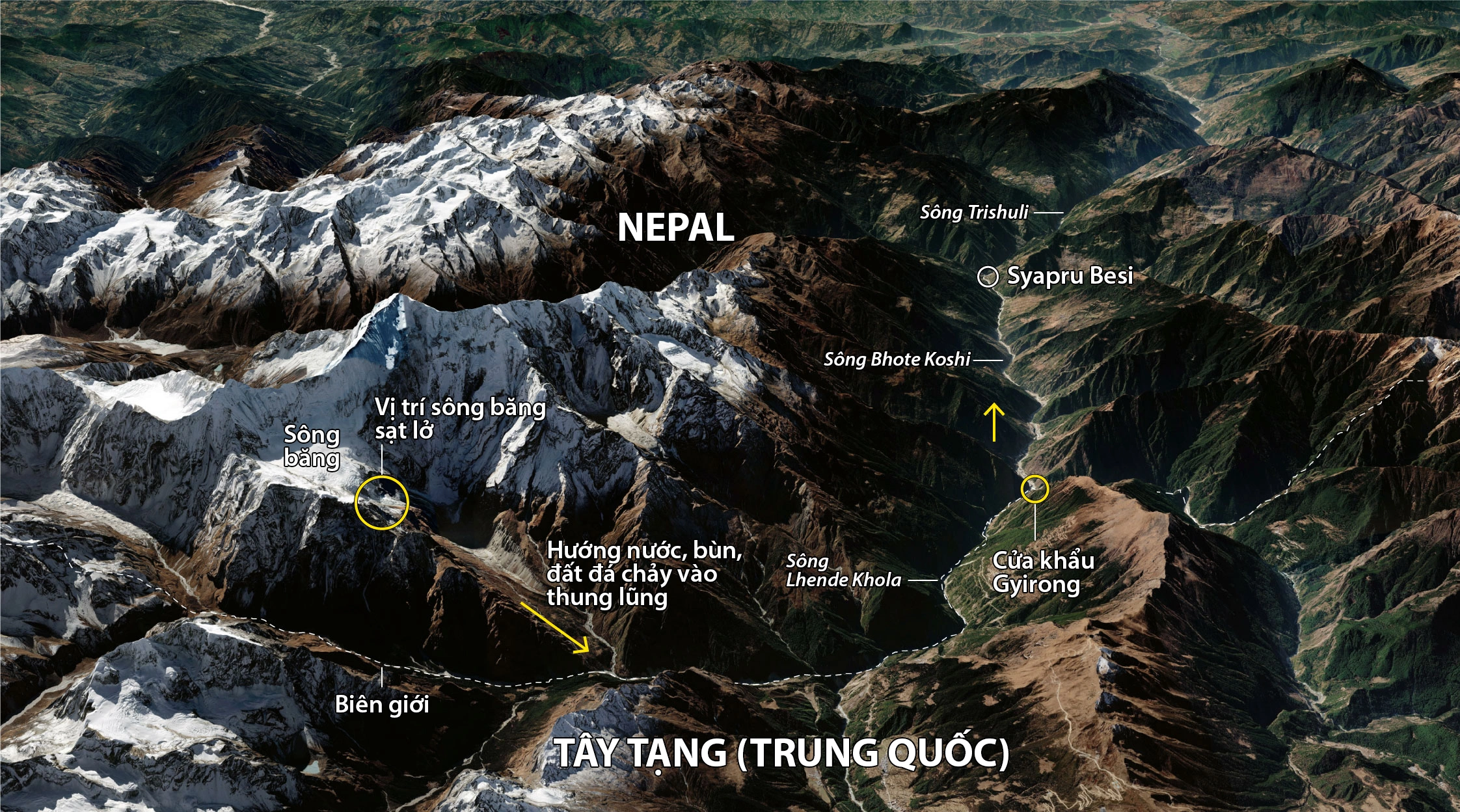 |
Location of the glacier collapse in the Himalayas. Graphic: Guardian |
Huyen Le (According to AFP, CNN)