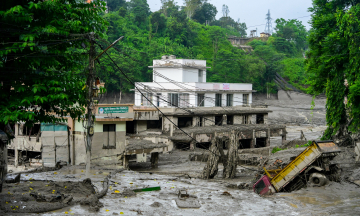
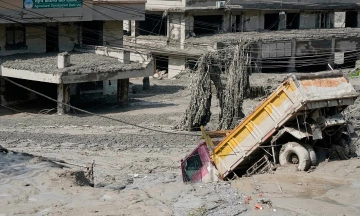
Venezuelan officials released casualty figures on 5/7, revealing the extensive damage from the recent seismic event. Nearly 200 buildings completely collapsed, with the majority of destruction concentrated in La Guaira state, the area hardest hit by the earthquake. The disaster also left over 17,000 people homeless, forcing them into shelters and temporary camps.
While Caracas has not yet announced the number of missing persons, the United Nations estimates this figure could tragically reach 50,000.
Many families are still desperately searching for relatives amidst the vast expanses of rubble. "I can't remember how many days have passed. I'm not sane anymore, but I won't leave because I know my son is there", stated July, a resident of Catia la Mar city in La Guaira state.
 |
A woman amidst the rubble in La Guaira, Venezuela on 2/7. *AP* |
July is currently sleeping in a public square near her son's workplace. She recounted her ongoing search: "I found his motorcycle and helmet. My son is still there, I pray to God he is alive. If not, at least let me find him and see him. I won't leave without my son."
Attention has now shifted from rescue efforts to the solemn task of burying the victims recovered from the debris and commemorating those who perished. Many international rescue teams have concluded their search for survivors and are now packing up equipment.
At La Esperanza cemetery in La Guaira, over 150 unidentified bodies have been interred, with two excavators continuously digging more graves to accommodate the influx of victims.
Eli Zavala, a local resident assisting with the burials, expressed the community's grief: "We are deeply saddened. People started working here on 25/6, immediately after the earthquake, so all victims could be honorably laid to rest."
The United Nations estimates the twin earthquakes caused 6,7 billion USD in damages, a sum equivalent to 6% of Venezuela's Gross Domestic Product (GDP). The international airport serving the capital, Caracas, sustained significant damage after the disaster and remains closed to commercial flights.
Many Venezuelans have voiced criticism regarding the government's initial response, particularly before the arrival of international search and rescue teams.
 |
A woman stands before photos of missing persons after the earthquake in Caracas, Venezuela on 4/7. *AP* |
Venezuela's acting President Delcy Rodriguez defended the government's actions, stating that thousands of officials and rescue teams were promptly deployed. She dismissed concerns that the twin earthquakes would lead to instability, emphasizing that the event instead strengthened "deep social unity" within the nation.
The initial 7,2 magnitude earthquake struck about 160 km west of Venezuela's capital, Caracas, on the evening of 24/6, with its epicenter at a depth of 22 km. Less than a minute later, a second 7,5 magnitude quake occurred just a few kilometers away, with an epicenter at a depth of 10 km. This devastating event marks Venezuela's strongest earthquake since 1900.
Pham Giang (According to AFP)