In his book "The Future", published in 3/1926, British engineer Archibald Montgomery Low predicted that future subway passengers would sit in comfortable armchairs, holding books, with snacks served to them.
"News and current events from around the world will be transmitted wirelessly and displayed on screens in train cars", wrote Low, known as the "father of radio guidance systems".
 |
British engineer Archibald Montgomery Low in London in 1928. Photo: CBC |
British engineer Archibald Montgomery Low in London in 1928. Photo: CBC
In 12/1926, Doctor Ernest Alexanderson, an engineer at General Electric, announced that television, with its moving images created by light beams, was no longer a distant dream. Researchers at the time claimed to have the necessary conditions to create technology for moving images on screens with accompanying sound.
Nikola Tesla, the renowned Serbian-American scientist of the 20th century, also predicted the advent of the smartphone in 1926.
"When wireless technology is perfectly applied, the entire Earth will be transformed into a gigantic brain, which it actually is, as all matter consists of particles forming a rhythmic whole. We will be able to communicate with each other in an instant, regardless of distance", he stated.
"Not only that, through television and telephony, we will see and hear each other as if meeting face-to-face. The device enabling this will be astonishingly simple compared to current telephones. One will be able to carry this device neatly in a vest pocket", Tesla predicted.
In 8/1926, scientists gathered at the American Institute of Politics at Harvard University predicted that copper, lead, and tin would be depleted within a few decades. However, they noted that "the age of composite materials has arrived; the day the world escapes dependence on raw materials is not far off". Scientists believed that composite materials could replace everything from wood in construction to rubber.
A scientist working at the Massachusetts Institute of Technology in 1926 once predicted a catastrophic global famine in the next century. He suggested that reindeer could become a crucial food source if humans failed to find more efficient methods of food production and preservation.
In 9/1926, an NYTimes article quoted an aircraft manufacturer predicting new advancements in aviation that would make "airplanes safer and affordable enough for an average person who owns a car to buy an airplane".
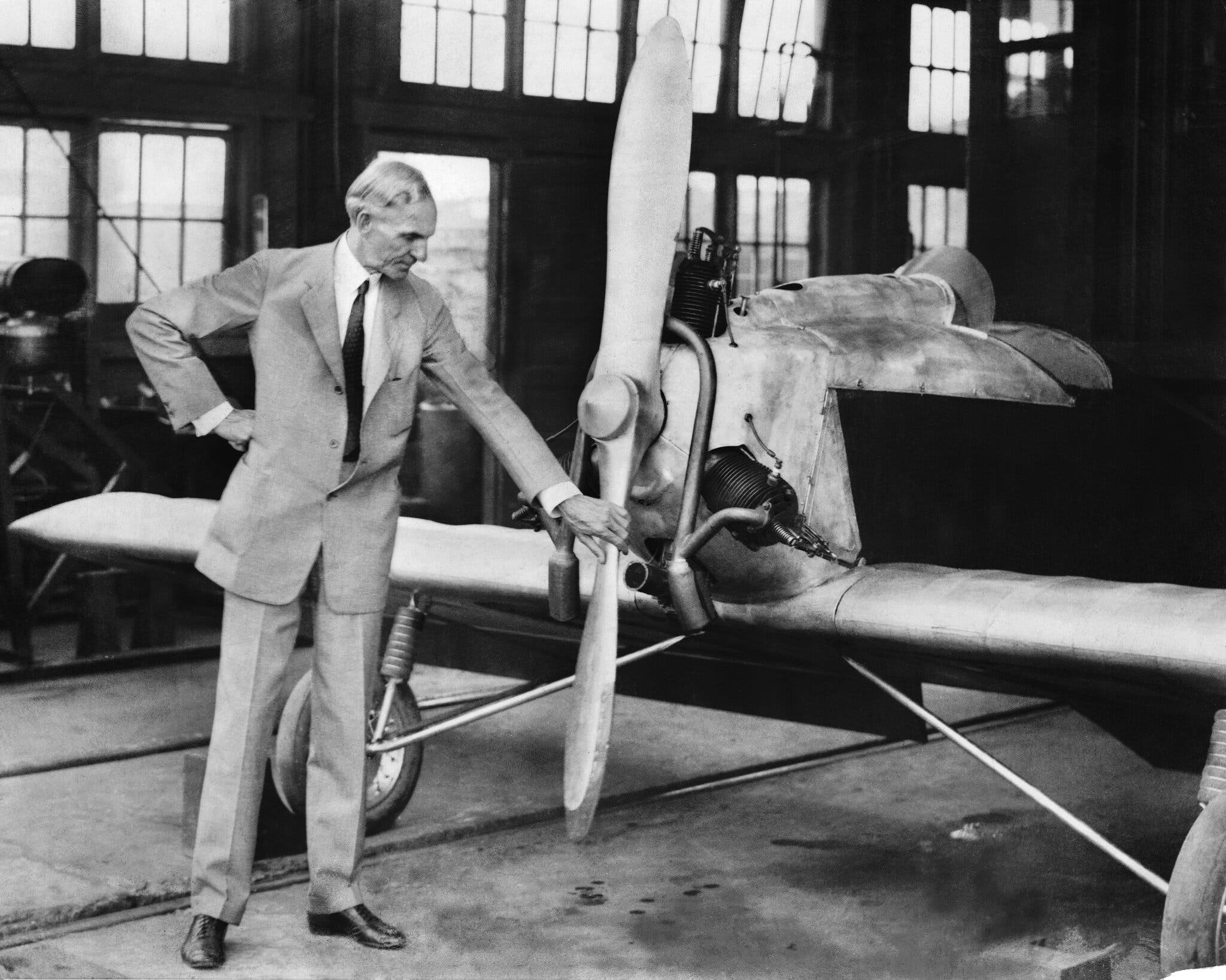 |
Henry Ford introduced the compact one-seat Flivver airplane, with a wingspan of about 6,7 m, on his 63rd birthday on 30/7/1926. Photo: NYT |
Henry Ford introduced the compact one-seat Flivver airplane, with a wingspan of about 6,7 m, on his 63rd birthday on 30/7/1926. Photo: NYT
Scientists and sociologists in 1926 also predicted that human lifespan would increase after 100 years due to medical progress. Four years after insulin therapy was introduced for diabetes treatment in the US, despite rumors that the method was dangerous, doctors in 1926 declared that deaths from diabetes would become rare with proper treatment. A century later, more than 8 million Americans with diabetes continue to live thanks to daily insulin therapy.
Hornell Hart, an American sociology professor, predicted in an article in 2/1926 that the average lifespan for those born after 2000 would exceed 100 years, nearly double the average lifespan in 1926.
"Unless we destroy civilization in the next 75 years, which is highly unlikely, many children will live up to 200 years, and it will be normal for men and women to live over 100, but instead of being wrinkled and frail, they will remain full of vitality", Hart remarked.
Hong Hanh (According to NYT, BI, Beacon Journal)