Serhiy Beskrestnov, a Ukrainian expert in radio technology and electronic warfare, stated that Ukrainian forces first detected a Russian Geran-2 suicide unmanned aerial vehicle (UAV) equipped with man-portable air defense missiles on 4/1. The aircraft also featured a camera and a radio modem, enabling its operators to control it from Russian territory and actively choose the moment of engagement.
"I have advised military pilots to pay attention to this new threat," Beskrestnov said. "They should avoid direct confrontation and be more cautious when detecting UAVs flying in circular trajectories."
Geran UAV equipped with Verba man-portable missiles in a video posted on 5/1. Video: X/bayraktar_1love
The missile launcher, coded 9P333, identifies it as Russia's most modern 9K333 Verba man-portable air defense system. The Verba system entered service with the Russian military in 2014, gradually replacing the Igla model. Its missiles employ a multi-spectral optical seeker, featuring three distinct sensors to detect ultraviolet, near-infrared, and mid-infrared signals, unlike the Igla-S series which uses only two sensors.
This enhancement allows Verba missiles to better distinguish targets from decoys, while also limiting the effectiveness of countermeasures such as infrared flares and laser emitters. The missile can engage targets at a range of 6,5 km and an altitude of 4,5 km. Its 1,5 kg fragmentation warhead is potent enough to destroy various types of helicopters, light aircraft, and enemy UAVs.
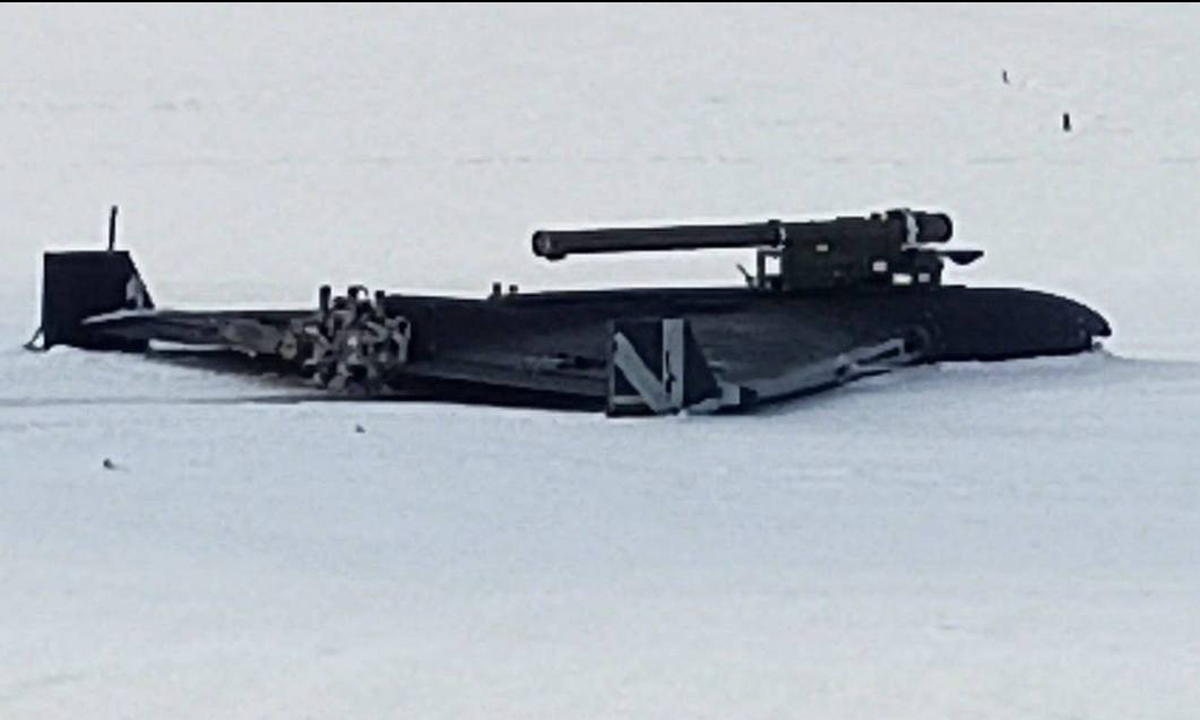 |
Russian Geran UAV carrying man-portable missiles in an image posted on 4/1. Photo: Ukrainska Pravda
Beyond ground-based air defense units, Ukraine regularly deploys fighter jets, propeller aircraft, and helicopters to counter Russian long-range UAVs. This appears to have motivated Russia to experiment with equipping Geran-2 UAVs deployed in Ukraine with air-to-air missiles. Ukrainian Deputy Defense Minister Yury Myronenko stated that Russia is using crewed Geran-2s to target fighter aircraft tasked with intercepting UAVs. These drones establish connections with their operating crews via a series of antenna stations in Russian-controlled territories and Belarus.
Images released by Ukraine in early 12/2025 revealed a Russian Geran-2 aircraft fitted with a launcher and an R-60 short-range air-to-air missile, typically seen only on fighter jets. Geran UAVs carrying air-to-air missiles can be deployed independently or in formations, particularly in frontline areas. They will serve to prevent unexpected Ukrainian air strikes and coordinate with other UAVs in large-scale combined assault operations.
"The presence of air-to-air and man-portable air defense missiles on Russian UAVs will pose significant risks for Ukrainian helicopters and fixed-wing aircraft conducting interception missions," stated Dylan Malyasov, a writer for the military publication Defence Blog.
Beskrestnov previously shared images of Geran-2 UAVs equipped with infrared searchlights, suggesting these could be a form of directed infrared countermeasures (DIRCM), designed to emit infrared beams that blind heat-seeking missile seekers and sensors on enemy equipment. Another possibility is that the light clusters could assist in guiding infrared-sensor-equipped UAVs during formation operations.
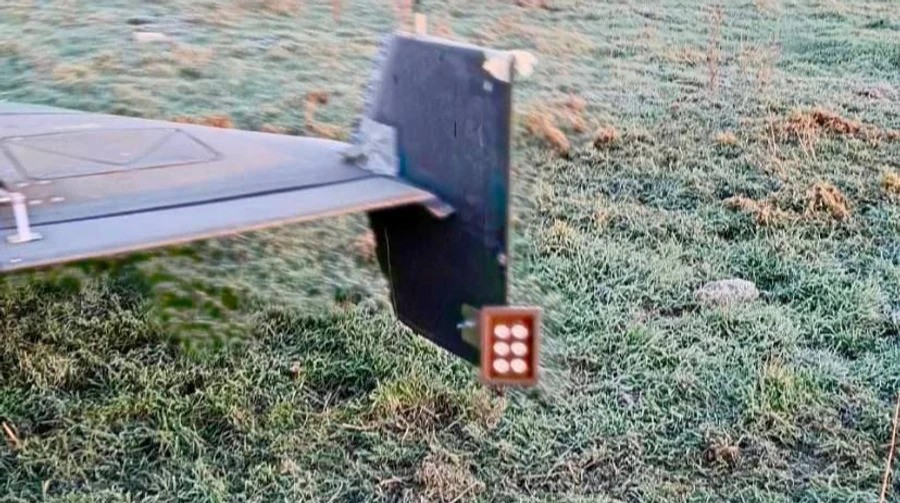 |
Infrared searchlight mounted on a Russian Geran-2 UAV in an image posted on 2/1. Photo: Ukrainska Pravda
Russia has repeatedly upgraded its Geran-2 UAVs, incorporating heavier warheads, electro-optical sensors, and cameras. They have also developed a jet-powered variant capable of flying beyond the range of some Ukrainian air defense units. Russian forces have also adapted their attack tactics with Geran UAVs. These include using the drones to clear a path for missiles, launching swarm attacks to overwhelm Ukrainian air defenses, and even employing camera-equipped variants to hunt down enemy mobile air defense units and designate targets for allied UAVs to strike.
Pham Giang (According to Ukrainska Pravda, Defence Blog)