Russia showcased its advanced Shturm robot tank during the Tsentr-2026 large-scale military exercise, marking a significant development in autonomous military technology. The heavy assault robot complex (TShRK) Shturm participated in a live-fire drill at the Chebarkul training ground in Russia's Chelyabinsk province on 2/10.
The Tsentr-2026 exercise, held from 28/9 to 3/10, covered central Russia and the Caspian Sea region, with the main activities taking place on 2/10 at the Chebarkul training ground. Approximately 47,000 personnel from Belarus, China, Mongolia, Kyrgyzstan, Pakistan, and Tajikistan joined Russian forces in the drills.
The Shturm complex, developed by Uralvagonzavod, is built on the chassis of T-72 and T-90 main battle tanks. During the exercise, it was remotely controlled by an operating crew in a nearby command vehicle, moving alongside a T-90M main battle tank and firing at least one cannon round while advancing. While primarily designed for remote operation, the Shturm also retains space and equipment for a direct onboard crew.
The robot tank is armed with a 125 mm D-414 main gun. Its barrel length is significantly shortened compared to the 2A46 cannons found on main battle tanks, a design choice enabling the turret to rotate 360 degrees, which is crucial for urban combat. The Shturm's automatic loader can hold 22 artillery rounds, utilizing a mechanism similar to those found in the T-72/90 tanks. Additionally, the complex is equipped with a dozer blade and multiple blocks of explosive reactive armor covering its hull. The turret can also be fitted with other weapons, such as thermobaric rocket launchers.
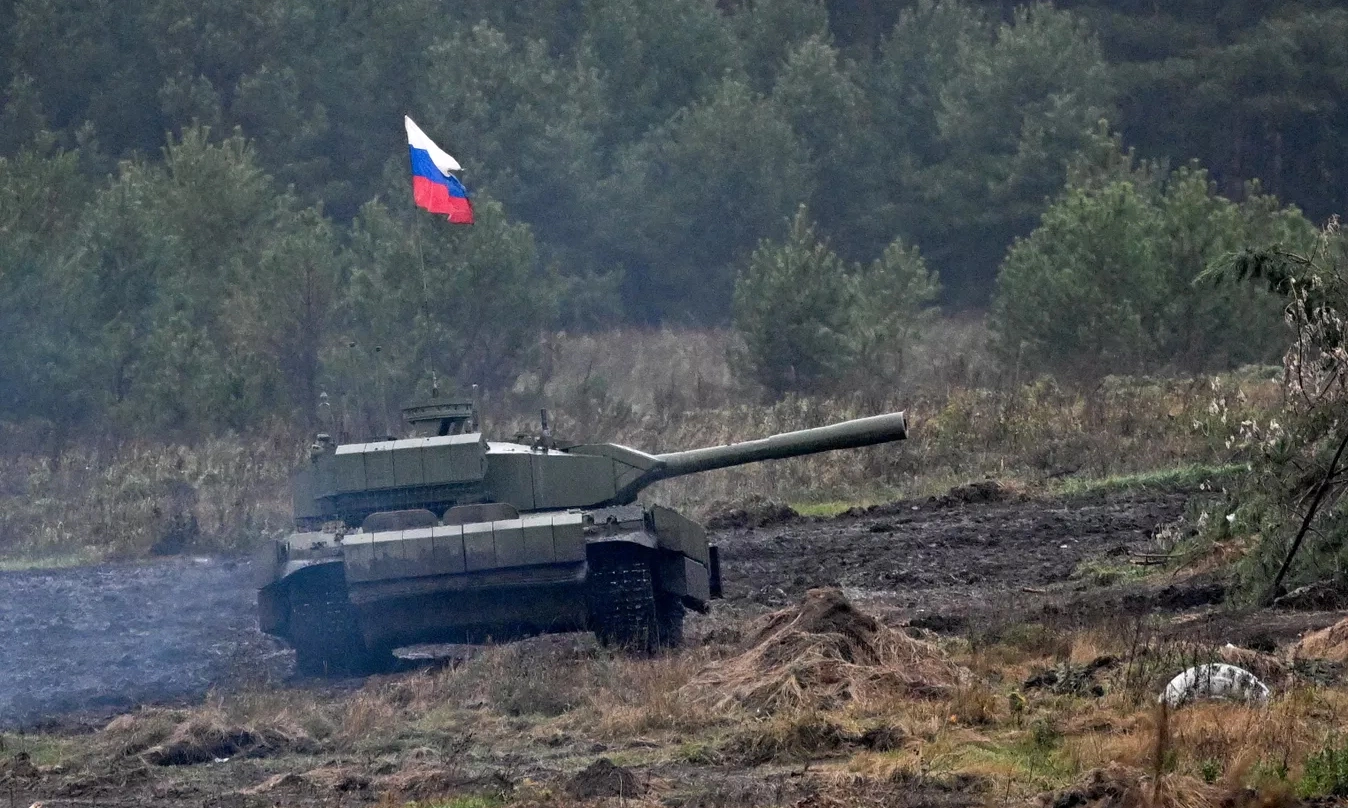 |
The Shturm robot tank participates in an exercise in a photo released on 2/10. Photo: RIA Novosti |
Despite its capabilities, military experts have identified potential vulnerabilities. According to Russian military specialized website Top War, "however, requiring a separate command vehicle creates several issues in current conditions. Due to the limited range of secure communication equipment, the command vehicle must operate relatively close to the robot tank, making it vulnerable to enemy unmanned aerial vehicles (drones)," Top War noted. To mitigate this, Top War suggested that deploying a satellite communication system like Rassvet, dubbed "Russia's Starlink", would allow personnel to control Shturm from a significantly greater distance, eliminating the need for the command vehicle to be near the combat zone.
Uralvagonzavod began developing the Shturm in 2018. The concept for such a vehicle first emerged in the 1980s, but the technical capabilities of the Soviet Union at that time did not allow for its realization. The Shturm combat vehicle and its command vehicle were previously featured in a video released in 7/2025, showing them returning to the factory in Nizhny Tagil after a testing phase.