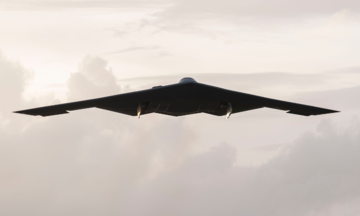
A formation of Russian Tu-95MS strategic bombers and Chinese H-6 bombers conducted a flight on 9/12 in international airspace over the Sea of Japan, the East China Sea, and the Western Pacific Ocean. Russian Su-30SM and Su-35S fighters, along with Chinese J-16 fighters, escorted the formation during the approximately 8-hour flight, according to the Russian Ministry of Defense.
The ministry stated that "foreign fighters" also accompanied the Russian-Chinese bombers in some areas, but did not name the countries or aircraft types. A video released by the Russian Ministry of Defense showed at least one F-35 stealth fighter trailing a Tu-95MS bomber.
Russian Tu-95MS bombers conducting joint training with a Chinese formation on 9/12. *Video: Russian Ministry of Defense*
The Japanese Ministry of Defense also released a graphic on the same day, illustrating the flight path of two Russian Tu-95MS bombers and two Su-30 fighters, which flew north-south through the waters between Japan and South Korea.
Upon reaching the area west of the Miyako Strait, the Russian formation linked up with two Chinese H-6 bombers and 8 J-16 fighters. They then flew through the area, turning northeast. 4 J-16 aircraft later returned, while the remaining planes continued further before circling back along the same route.
A Russian A-50 early warning aircraft, escorted by two Su-30 fighters, flew through the northern Sea of Japan, off the west coast of Honshu island.
"To address this situation, the Southwestern Air Defense Force Command of the Japan Air Self-Defense Force and other units scrambled fighters," the Japanese Ministry of Defense stated, without providing information on the specific aircraft involved.
The South Korean Joint Chiefs of Staff announced on the same day that it had "scrambled fighters as a precautionary measure against unexpected situations" after detecting two Chinese aircraft and 7 Russian aircraft entering its air defense identification zone (AIDZ).
According to the South Korean military, the Russian-Chinese formation entered and exited South Korea's AIDZ multiple times within one hour before leaving the area. South Korea did not specify the types of Russian and Chinese aircraft.
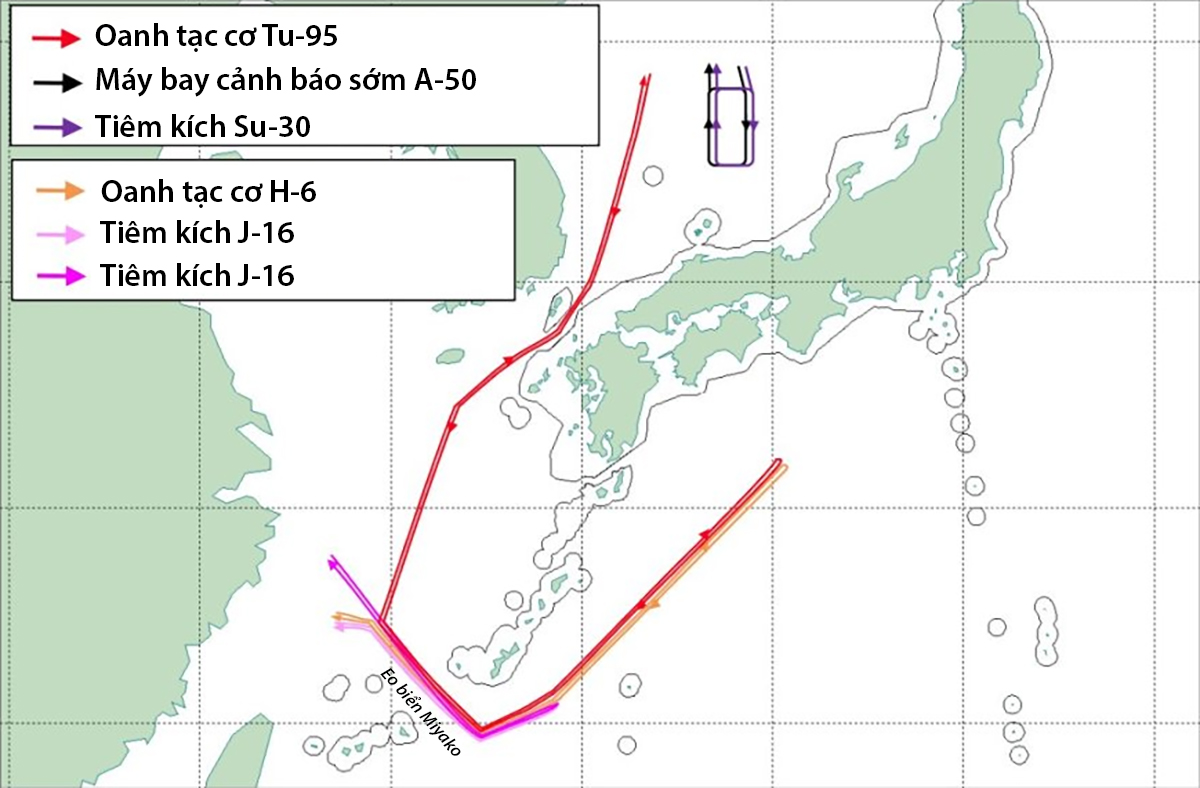 |
Flight path of the Russian-Chinese aircraft formation on 9/12. *Graphic: Japanese Ministry of Defense*
Russia and China have conducted joint flights in Northeast Asia multiple times, with the first occurring in 6/2019. South Korean fighters fired 20 mm warning shots when a Russian A-50 aircraft entered the airspace over the disputed Dokdo/Takeshima islands, claimed by both Seoul and Tokyo.
The 9/12 flight took place amid escalating tensions between Japan and China concerning remarks made last month by Prime Minister Sanae Takaichi regarding Taiwan island. The Japanese Prime Minister later softened her tone to ease tensions, but China did not accept this and continued to demand she retract her statement.
By Nguyen Tien (According to War Zone, RIA Novosti, Kyodo, Yonhap)