Based on satellite imagery, maritime and aviation tracking data, and statements from US officials, The Washington Post reported that the Pentagon deployed dozens of fighter jets to bases near Iran along with about 12 warships of various types in the Middle East in 1/2026, when bilateral tensions peaked.
The US began increasing its military presence in the Middle East after protests erupted in Iran in late December 2025, escalating into violence that resulted in thousands of deaths. President Donald Trump at the time publicly mentioned the possibility of intervention, including an air campaign against Iran, bringing the Middle East to the brink of a large-scale conflict.
However, the US naval and air forces in the Middle East at that time had not reached the scale seen in June 2025, when the US collaborated with Israel on a large-scale air campaign targeting Iranian nuclear facilities. Some US officials and their allies in the Middle East worried that Washington lacked sufficient firepower to respond if Tehran launched retaliatory missiles. This concern reportedly led Mr. Trump to rescind the strike order at the last minute.
Iranian officials announced on 21/1 that "the rebellion has ended", vowing to severely punish those behind the protests. President Trump immediately directed US forces to strengthen their military presence in the region with "a large fleet".
US media, citing informed sources, reported that this "large fleet" included the aircraft carrier USS Abraham Lincoln, along with several destroyers equipped with the aegis combat system, such as the USS Spruance, USS Frank E. Petersen Jr., and USS Michael Murphy. These destroyers are also capable of launching tomahawk cruise missiles with a range of 1,500-2,000 km, allowing deep strikes into inland areas when ordered.
These deployments aimed to reinforce President Trump's warnings of military action as he sought to negotiate a peace agreement with Iran.
"They are deploying forces to expand strike options in case the President orders direct airstrikes", said Dana Stroul, a researcher at the Washington Institute.
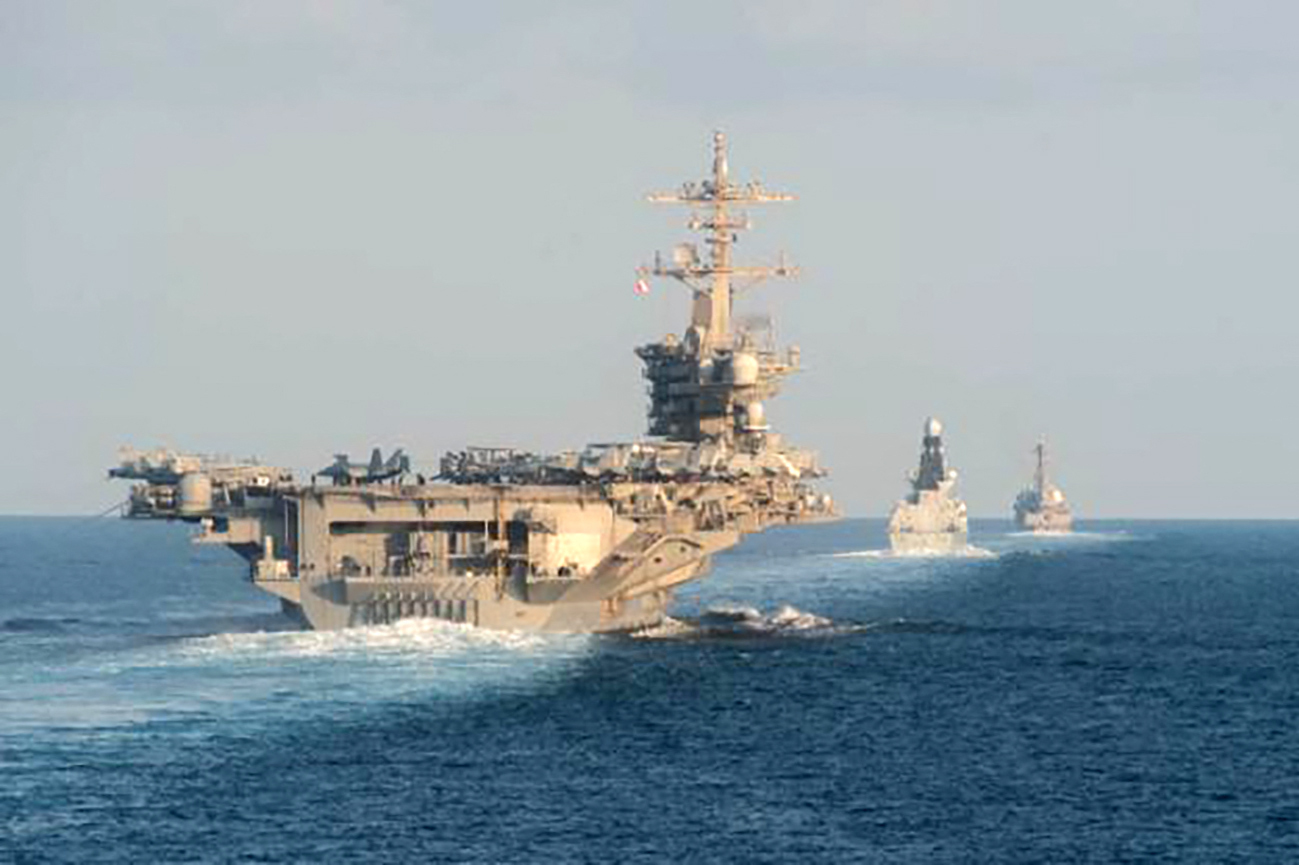 |
The aircraft carrier USS Abraham Lincoln (left) and two escort ships passing through the Strait of Hormuz in 11/2019. Photo: AFP |
The aircraft carrier USS Abraham Lincoln (left) and two escort ships passing through the Strait of Hormuz in 11/2019. Photo: AFP
United States Central Command (CENTCOM), responsible for US military operations in the Middle East, confirmed on 26/1 that the Abraham Lincoln carrier strike group was deployed to the Middle East to promote security and stability in the region, operating in the Arabian Sea.
Flight tracking data showed an Osprey transport aircraft from the Abraham Lincoln carrier group repeatedly flying from the Arabian Sea to Oman. This marked the first presence of a US aircraft carrier in the Arabian Sea since October 2025, although the Pentagon previously maintained a consistent carrier presence in this area.
Public images of the USS Abraham Lincoln currently show F-35C stealth fighters and EA-18G Growler electronic warfare aircraft, capable of jamming radar and disrupting communications.
Gregory Brew, an Iran analyst at the Eurasia Group risk consultancy, suggested that Growler electronic warfare aircraft would be particularly useful if the US intended to penetrate Iranian airspace before any operation. Meanwhile, F-35C stealth fighters are typically used to neutralize enemy air defense systems, creating a safer environment for other aircraft.
Tracking data also indicated that the US positioned at least 8 other warships in the region, including two guided missile destroyers, the USS McFaul and USS Mitscher, near the Strait of Hormuz.
Iran has also recently deployed unmanned aerial vehicles (drones) to operate in the same area. Satellite images captured on 30/1 showed the presence of the drone carrier Shahid Bagheri in the strait.
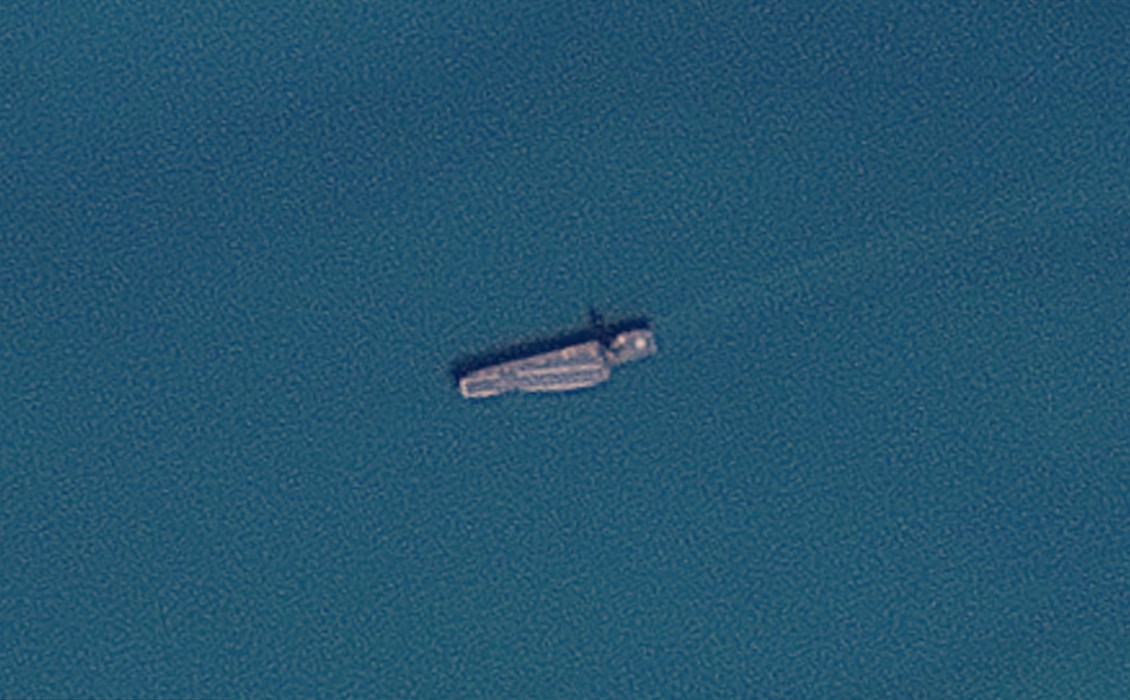 |
Satellite image of the drone carrier Shahid Bagheri in the Strait of Hormuz on 31/1. Photo: Planet Labs |
Satellite image of the drone carrier Shahid Bagheri in the Strait of Hormuz on 31/1. Photo: Planet Labs
CENTCOM confirmed on 3/2 that F-35C fighters from the USS Abraham Lincoln shot down an Iranian Shahed-139 series drone, citing "self-defense and the protection of the aircraft carrier and its personnel". The drone was accused of "continuing to fly towards the USS Abraham Lincoln despite de-escalation measures taken by US forces", while the carrier operated about 800 km off the Iranian coast.
Beyond warships, the US has deployed over 30 aircraft, including fighters, drones, refueling aircraft, reconnaissance aircraft, and transport aircraft, to US bases in the region or operating in the Middle East since 13/1. Most were destined for al-Udeid Air Base in Qatar.
Over 10 F-15E fighters and 9 A-10C Thunderbolt II close air support aircraft arrived at Muwaffaq Salti Air Base in Jordan on 25/1. These F-15E fighters were part of the same unit that conducted airstrikes in Iran in June 2025, according to Nicole Grajewski, an associate professor at Sciences Po University, France.
United States Air Forces Central Command (AFCENT) previously announced a "multi-day combat readiness exercise" in its area of responsibility, including the Middle East.
AFCENT stated that the exercise enhances force maneuverability, strengthens partnerships with host nations, and prepares for "dynamic responses". It remains unclear whether these aircraft deployments are related to AFCENT's announcement.
According to flight tracking data, two HC-130J Combat King aircraft, typically operating at night for combat search and rescue missions, departed Chania island, Greece, last week and flew towards Jordan. Both flights turned off their tracking signals upon descending.
Experts suggest that the deployment of additional HC-130J Combat King aircraft indicates the Pentagon may be preparing for search and rescue operations, often conducted when US pilots and special forces personnel need to be rescued in enemy territory.
Such aircraft, including helicopters optimized for soldier rescue, were rapidly deployed to the Caribbean about three weeks before the raid to capture Venezuelan President Nicolas Maduro. Satellite images from 2/2 showed at least one MQ-9 Reaper unmanned aerial vehicle (UAV) and several multi-purpose helicopters at the Jordan base, seemingly newly deployed.
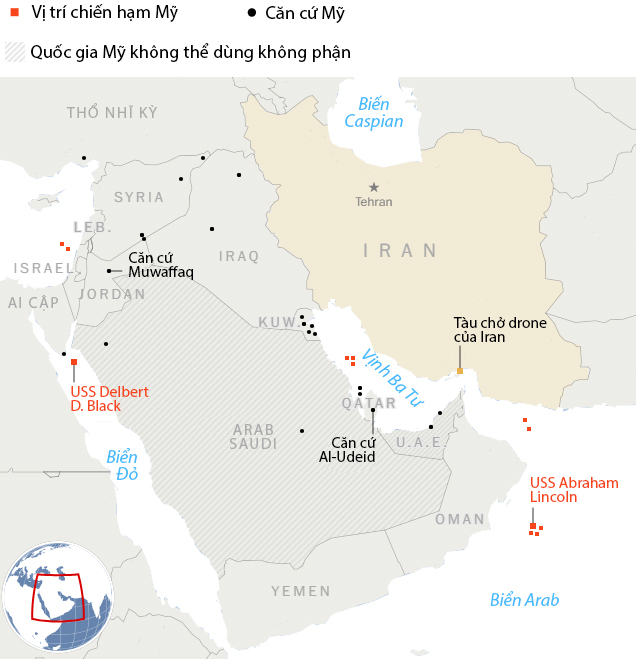 |
Positions of US warships and bases in the Middle East. Graphic: Washington Post |
Positions of US warships and bases in the Middle East. Graphic: Washington Post
In addition to warships near the Strait of Hormuz, the US last week also sent the destroyer USS Delbert D. Black to Eilat, a southern Israeli city, on 30/1. This destroyer departed Eilat on 1/2 and operated in the Red Sea. According to US defense officials, two other destroyers, the USS Bulkeley and USS Roosevelt, were in the eastern Mediterranean Sea.
These moves suggest that "both the US and Israel are very concerned about potential Iranian retaliation against Israel, even if Israel is not directly involved", Brew observed. Iran has threatened a strong response if the US attacks, declaring that US interests in the region and Israel would become targets.
According to Fabian Hinz, an expert on Iran's missile program at the International Institute for Strategic Studies (IISS), almost every ballistic missile in Iran's arsenal is designed to target Israel or US military bases in the region.
"All these systems have sufficient range to strike bases in the region", he added. "This short-range missile inventory is likely still largely intact after last year's 12-day air campaign by Israel and the US".
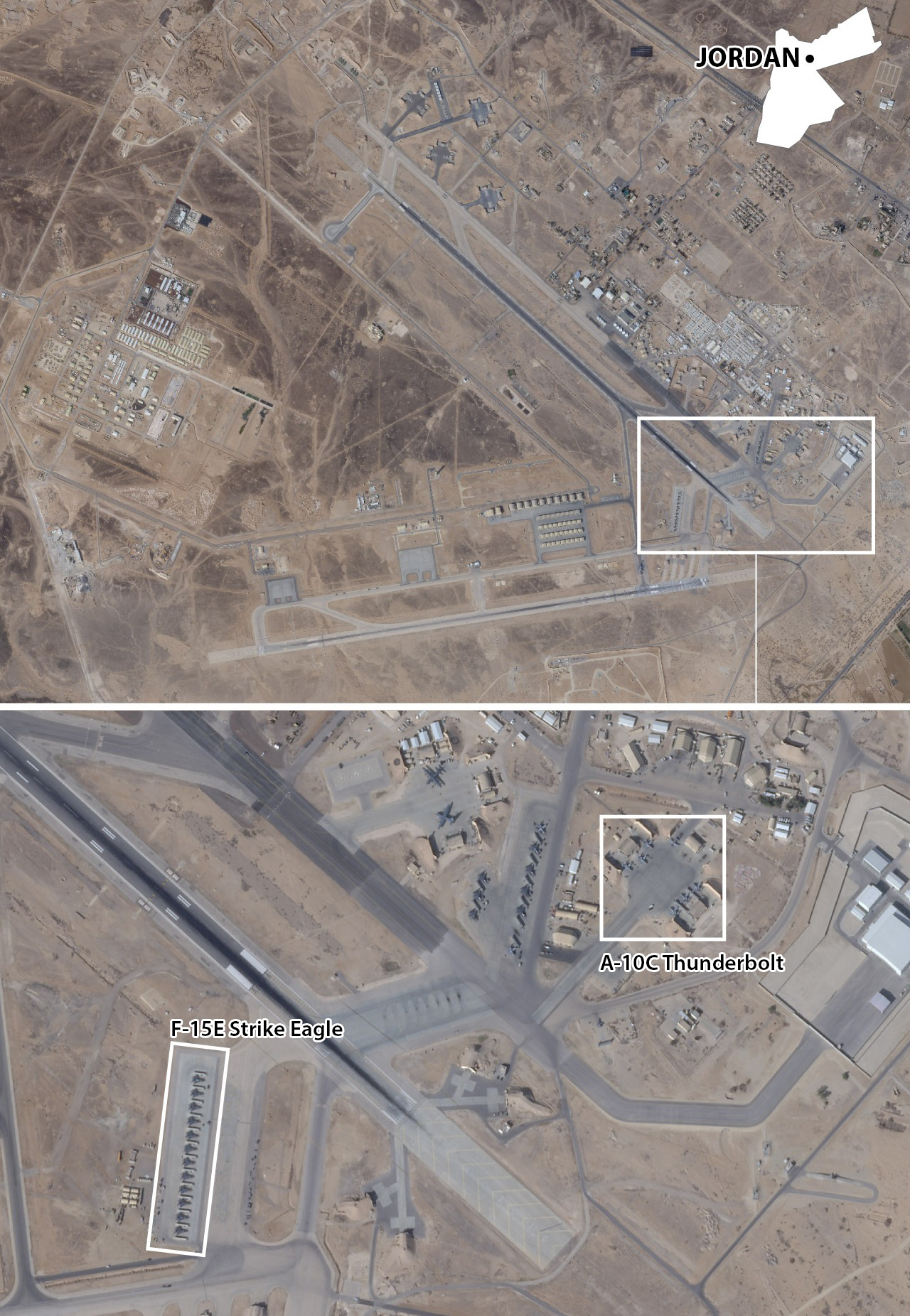 |
US F-15E fighters and A-10C attack aircraft at a base in Jordan. Photo: Washington Post |
US F-15E fighters and A-10C attack aircraft at a base in Jordan. Photo: Washington Post
Parallel to these military deployments, the US continued diplomatic efforts with Iran to de-escalate tensions. On 31/1, Mr. Trump stated that Tehran "is reaching out to us and Washington will see what can be done next". Iranian Foreign Minister Abbas Araghchi declared that Tehran was negotiating but also ready for war.
The Wall Street Journal reported on 3/2, citing unnamed White House officials, that the confrontation between the USS Abraham Lincoln and the Iranian drone angered President Trump, leading him to consider abandoning negotiations.
However, White House Press Secretary Karoline Leavitt later confirmed that talks between the US and Iran would still take place this weekend, indicating that the diplomatic door remains open for both sides to resolve the crisis.
Sanam Vakil, director of the Middle East and North Africa program at Chatham House in London, warned that with a dense US military presence around Iran, any aggressive action could ignite tensions.
Maritime security company Vanguard warned clients on 3/2 that the risk of maritime operations in the region was increasing. "With increased military activity and escalating regional tensions, the risk of miscalculation cannot be ruled out", Vanguard stated.
Nhu Tam (According to The Washington Post, Al Jazeera, Reuters)