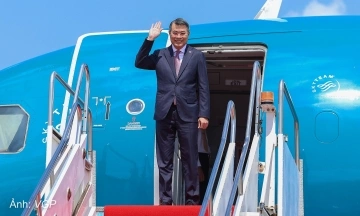
Kang Yu-jung, spokesperson for South Korea's Presidential Office, stated that President Lee Jae Myung observed the first test launch of a domestically researched and developed hypersonic glide vehicle (HGV) this afternoon.
According to Kang, the test aimed to verify core technologies, including flight trajectory and warhead speed. "This is considered a game-changing strategic capability, allowing for precise and surprise attacks on enemy targets," the South Korean official added.
South Korean authorities have not yet released data on the launch, only publishing images of President Lee Jae Myung observing the event.
 |
President Lee Jae Myung observes the test launch of a hypersonic glide vehicle on 8/10. *Photo: Yonhap*
"The HGV successfully separated from its booster and followed its planned trajectory. This event is a significant milestone, demonstrating that South Korea has completed preparations to acquire new deterrence capabilities, capable of striking key targets across the Korean peninsula," the spokesperson for South Korea's Presidential Office added.
South Korea tested the HGV just days after North Korea fired a long-range missile towards the waters east of the peninsula. According to North Korea's official Korean Central News Agency (KCNA), the launch was part of training for missile units operating a "hypersonic strategic weapon system."
"This is a demonstration of deterrence capabilities," KCNA quoted North Korean leader Kim Jong-un as saying during the event. Kim stated that the missile launch aimed to "accelerate the development of the country's nuclear war deterrence capabilities."
Technically, South Korea and North Korea are still at war because the 1950-1953 conflict ended only with an armistice, not a peace treaty.
 |
A Hyunmoo-2 ballistic missile fired by South Korea in 11/2024. *Photo: AFP*
Hypersonic weapons travel at speeds exceeding 6,000 km/h, operating on the principle of trading the extreme re-entry speed of ballistic missiles for increased ability to penetrate multi-layered enemy defenses.
After the acceleration phase, the HGV warhead separates from the missile and enters a glide phase. It continuously changes altitude and trajectory, unlike conventional ballistic missiles that follow a fixed parabolic trajectory, making interception efforts difficult for the enemy. In the final stage, the warhead dives towards its target at an extreme angle and speed, rendering air defense systems unable to intercept it.
By Nhu Tam (AFP, Yonhap)