Admiral Pairoj Fueangchan, commander of the Royal Thai Navy, announced on 20/11 plans for fleet modernization in 2026, designating it a "year of operational readiness". This initiative aims to adapt to evolving warfare and enhance operational effectiveness.
A key component of the plan involves studying the conversion and upgrade of the HTMS Chakri Naruebet into a "mother ship" capable of deploying various unmanned systems, including aerial drones, submersibles, and surface vessels. The initial phase of this project will focus on identifying the necessary modifications and corresponding procurement needs.
"If the report indicates a requirement for 24 unmanned aerial vehicles (UAVs), we will formulate a plan," Admiral Pairoj stated. He emphasized that "warfare is changing, technology is changing, and unmanned systems enable more effective operations with fewer resources."
While acknowledging the increasing role of unmanned systems, the commander underscored the continued importance of traditional surface vessels and submarines for maintaining presence and accessing operational areas. Unmanned assets and anti-drone countermeasures will be integrated across warships and land units to bolster combat capabilities.
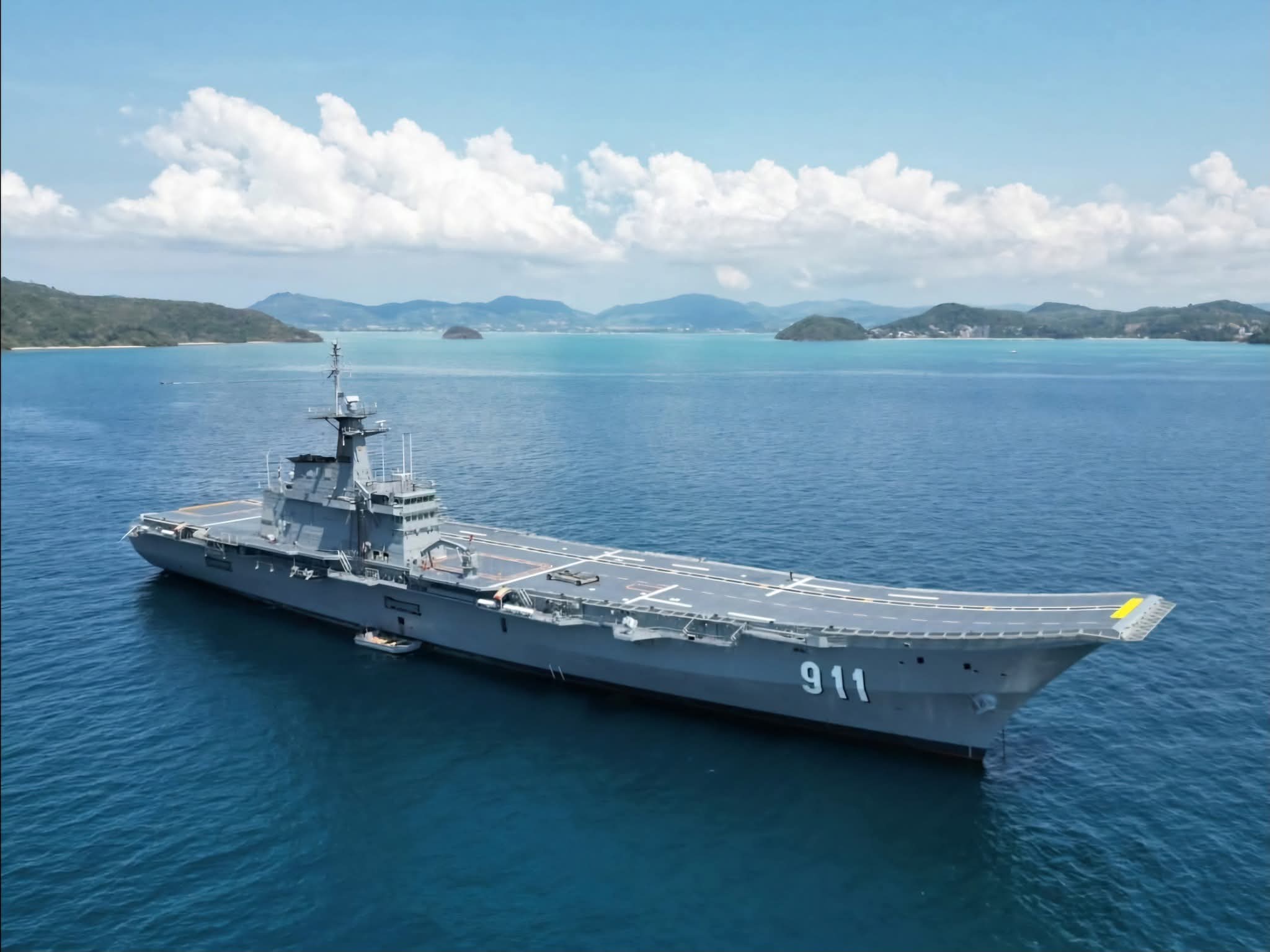 |
The aircraft carrier HTMS Chakri Naruebet during its deployment in 2023. *Photo: Office of the Prime Minister of Thailand* |
The Royal Thai Navy has already incorporated MARCUS-B reconnaissance UAVs into its inventory. This marks the return of fixed-wing aircraft to the HTMS Chakri Naruebet since the AV-8S Matador attack aircraft ceased operations in 2006.
The MARCUS-B project, developed by the Naval Research and Development Office (NRDO), successfully completed trials in 2022 and is currently awaiting budget allocation for mass production. Thailand designed the UAV for unarmed reconnaissance missions to manage costs, but is also developing a suicide variant within the MARCUS series.
Each MARCUS-B unit features a 4,8 m wingspan, a maximum weight of 50 kg, a cruise speed of 90-130 km/h, a maximum altitude of 5.000 m, and an operational range exceeding 200 km. Its vertical takeoff and landing (VTOL) capability makes it well-suited for operations from the HTMS Chakri Naruebet's relatively small flight deck.
The HTMS Chakri Naruebet serves as the flagship of the Royal Thai Navy and remains the nation's one and only aircraft carrier. Constructed in Spain, based on the Principe de Asturias-class design, the warship was commissioned and became operational in early 1997.
Currently, it is the smallest active aircraft carrier globally. The HTMS Chakri Naruebet measures 182 m in length with a displacement of over 11.400 tons. It can reach a maximum speed of approximately 48 km/h and boasts an operational range of over 18.500 km at a cruising speed of 22 km/h. However, financial challenges faced by Thailand following the 1997 financial crisis have restricted the HTMS Chakri Naruebet's deployments to approximately one day per month, primarily for training. For the remainder of the time, it is docked at Sattahip and open to tourists.