Data from civilian flight tracking website FlightRadar24 shows a U.S. F-35A stealth fighter, tail number 13-5067, activated its transponder over United Arab Emirates (UAE) airspace early this morning, at an altitude of 10,600 m and a speed of 680 km/h.
The aircraft continuously descended, with its speed fluctuating. Three minutes after activating its transponder, the F-35A switched to transponder code "7700" and continued to reduce altitude.
Code "7700" is used in airborne emergency situations, such as engine failure, loss of cabin pressure, or when someone requires medical assistance. After activating code 7700, the pilot must inform air traffic control in the area about the specific issue they are encountering.
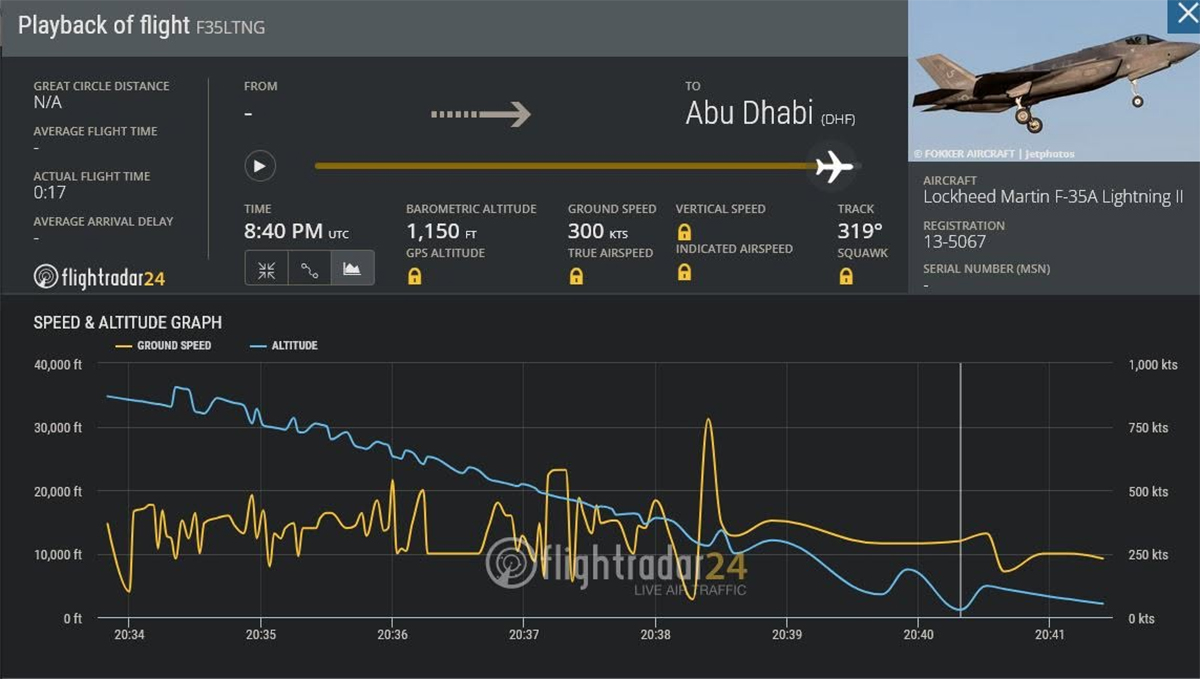 |
Altitude and speed chart of the U.S. F-35A fighter jet, tail number 13-5067. Graphics: FlightRadar24
FlightRadar24's chart reveals several anomalies during the aircraft's descent. At one point, its speed dropped to just 129 km/h, lower than takeoff speed, before surging to over 1,400 km/h and exceeding the speed of sound. In the final phase, the aircraft descended to 1,200 m, climbed to 2,200 m, then abruptly dropped to just 300 m, before returning to 1,400 m and gradually decreasing.
It is unclear whether the F-35A experienced a malfunction affecting its operational capability or if its navigation system was faulty, providing erroneous data. The signal was lost at an altitude of 640 m and a speed of 425 km/h, near Al Dhafra Air Base in Abu Dhabi. Open-source intelligence accounts suggest the aircraft landed at this location.
U.S. Central Command (CENTCOM), responsible for U.S. military operations in the Middle East, has not yet commented on the information.
Ian Petchenik, a Boeing 767 captain, states that 99% of cases where a 7700 transponder code is activated and recorded on civilian tracking sites are "normal events". He notes that a 7700 signal does not mean the aircraft is in imminent danger, but rather that the pilot is being cautious and wishes to report an unusual situation.
F-35A fighter jet refueling during a patrol in the Middle East, in a video released on 16/7. Video: CENTCOM
The incident occurred more than two hours after U.S. forces launched their sixth consecutive night of attacks against Iran, targeting "maritime surveillance infrastructure, air defense sites, and military logistics."
On 19/3, a U.S. F-35A fighter jet had to make an emergency landing at a Middle Eastern base while participating in airstrikes against Iran, reportedly due to enemy fire. Iran later claimed to have hit an F-35A, causing significant damage to the fighter.
Air & Space Forces Magazine later cited informed sources confirming that the incident severely damaged the F-35A, requiring extensive repair time, and the pilot was also injured by shrapnel.
On 25/5, Iran's Islamic Revolutionary Guard Corps (IRGC) announced it had launched an air defense missile at another F-35, forcing the U.S. aircraft to turn back and retreat. The IRGC also stated at the time that it had shot down an MQ-9 Reaper reconnaissance unmanned aerial vehicle (UAV) and forced an RQ-4 Global Hawk long-range reconnaissance UAV out of the operational area.
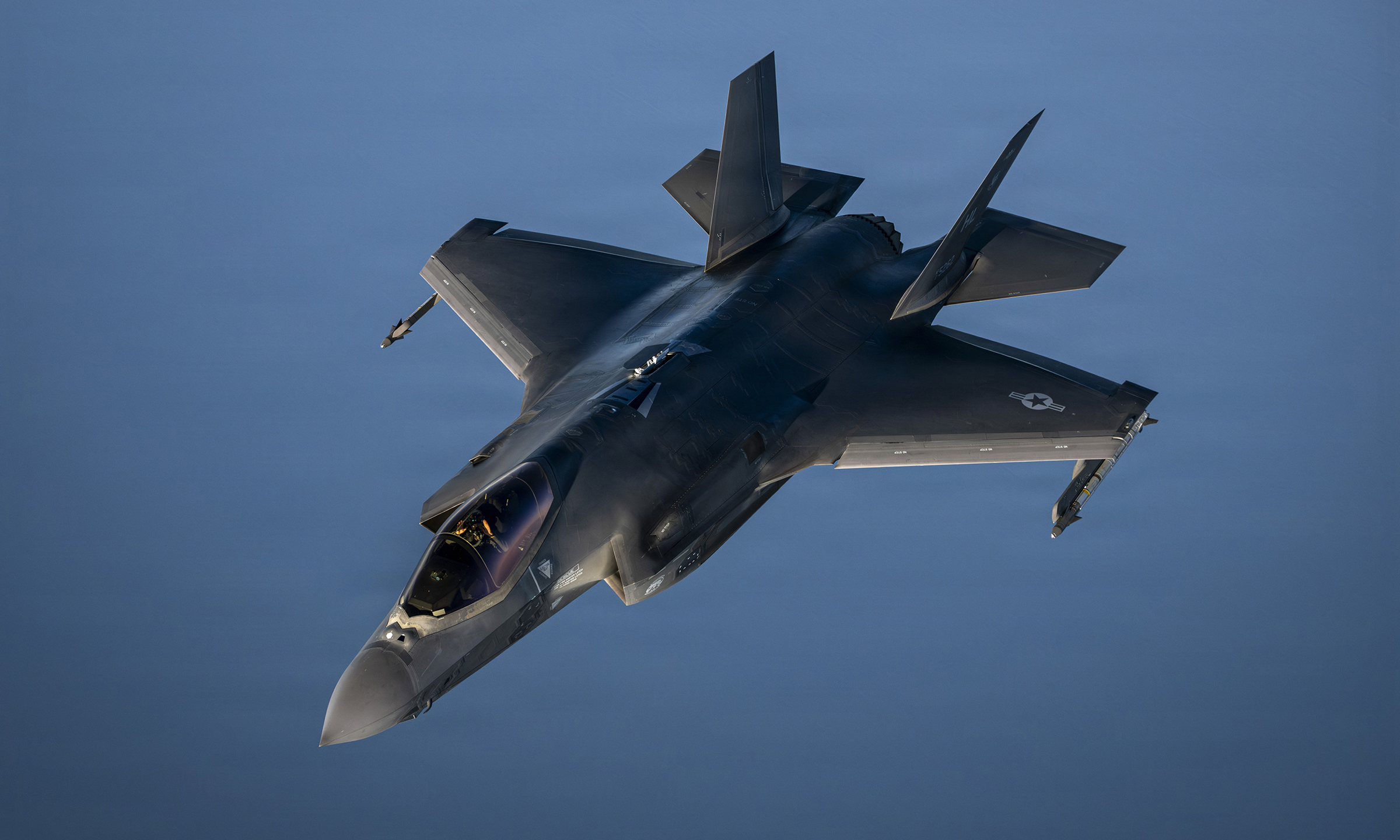 |
F-35A fighter jet operating in the Middle East on 10/6. Photo: USAF
The F-35A is the Air Force variant of the F-35 stealth fighter series, costing approximately 80-82.5 million USD per unit, depending on the contract. The F-35A has a maximum speed of nearly 2,000 km/h at high altitude and 1,300 km/h at low altitude, with a combat radius of over 1,200 km when carrying external fuel tanks.
The F-35A fighter jet is equipped with a 25 mm GAU-22/A four-barrel rotary cannon with 180 rounds of ammunition, four internal hardpoints, and six wing pylons that can carry air-to-air missiles, air-to-ground missiles, anti-ship missiles, bombs, and support equipment.
Nguyen Tien (According to AP, AFP, Reuters)