Ukraine's 11th Army Aviation Brigade announced on 9/2 that one of their Mi-24 attack helicopters crashed during a combat mission, killing its two-person crew. The unit did not specify the location, time, or cause of the incident.
Yuri Podolyaka, a Kremlin-backed blogger with 3 million followers, suggested the Ukrainian Mi-24 helicopter was hit by a short-range R-60 air-to-air missile launched from a Russian Geran-2 suicide drone.
Podolyaka stated, "This could be the third, or even 4th, Ukrainian aircraft shot down in this manner. It shows the successful integration of the R-60 missile, which was long decommissioned and gathering dust in storage."
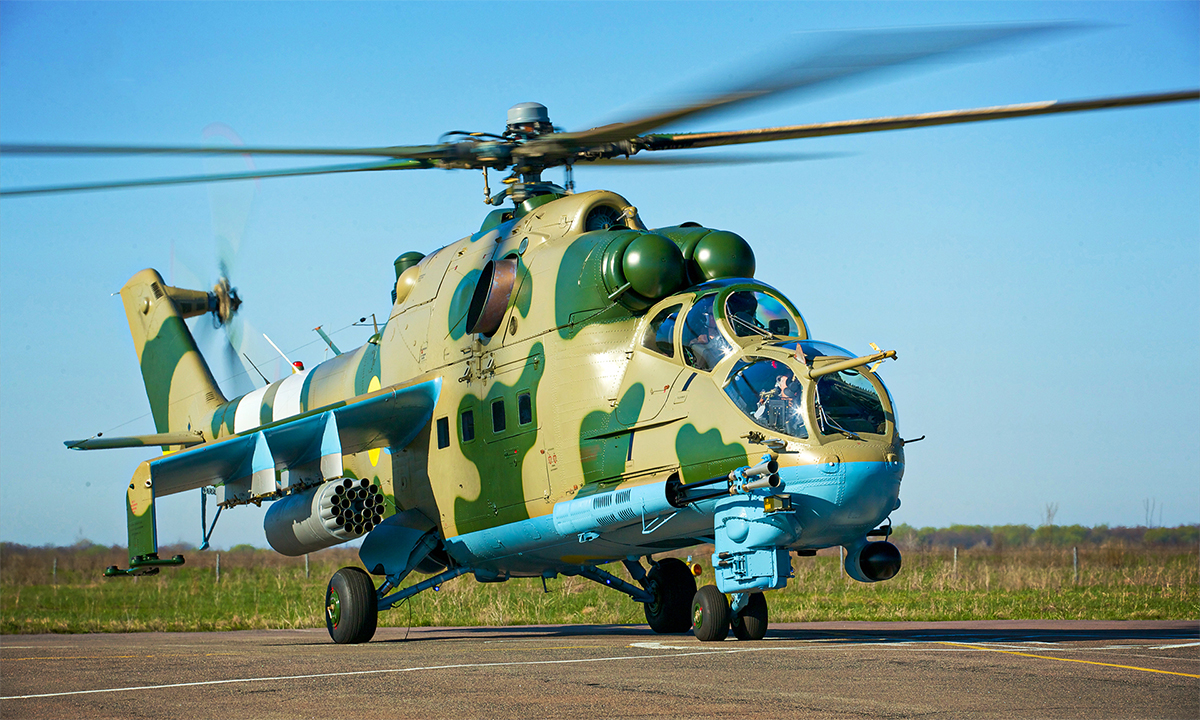 |
Mi-24 helicopter of Ukraine. Photo: Aviacon
Ukrainian media in early 12/2025 released a video showing a Ukrainian drone approaching a Russian Geran-2 UAV carrying an R-60 missile on its back. Serhii Beskrestnov, an advisor to Ukraine's Minister of Defense, warned then that missile-equipped Geran-2s could shoot down aircraft deployed to intercept them.
The R-60 is a short-range, infrared-guided missile developed by the Soviet Union. It entered service in 1970 and began mass production three years later. At its debut, it was one of the lightest and most maneuverable air-to-air missiles globally.
Each R-60 missile is over 2 m long, weighs 44 kg, has a maximum range of about 8 km, and carries a 3 kg continuous-rod fragmentation warhead. The original R-60 could only lock onto targets directly ahead, while the R-60M variant, introduced in 1982, could track heat sources up to 20 degrees off the aircraft's nose.
The firing mechanism and target detection method for the Geran-2 UAV carrying air-to-air missiles are unclear. Western and Ukrainian experts believe the drones are equipped with a remote control system, using radio links with a repeater and a 4G SIM for supplementary connection.
Geran UAV carrying a launch rail and R-60 air-to-air missile in a video released on 1/12/2025. Video: Sternenko Community Foundation
Ukraine inherited 45 Mi-24 helicopters after the dissolution of the Soviet Union, though it is unclear how many remained operational when the conflict began.
In the early stages of the conflict, Ukraine's Mi-24 fleet often conducted attacks on Russian targets near the front lines and provided fire support for infantry. They were also deployed for interception missions, specifically against Russian Geran-2 suicide drones.
Oryx, a Netherlands-based conflict intelligence analysis website, estimates that the Ukrainian military has lost at least 12 Mi-24 helicopters since the start of the conflict.
Nguyen Tien (According to AFP, AP, Pravda)