The United States and Israel today launched strikes at multiple locations across Iran, including the capital Tehran, in what US President Donald Trump described as a "large-scale operation." Iran immediately retaliated with missiles targeting Israel and US bases in the region.
Tensions between Washington and Tehran have simmered for many years, but the current escalation stems from the collapse of the nuclear deal over a decade ago.
The original nuclear agreement, known as the Joint Comprehensive Plan of Action (JCPOA), was signed by Iran and the P5+1 group (comprising the UK, France, China, Russia, the US, and Germany) in 2015. Under this agreement, Iran accepted limitations on its nuclear program in exchange for Western nations agreeing to lift all sanctions against Tehran.
However, in 2018, during his first term, President Trump announced the US withdrawal from the JCPOA, arguing that the deal's structure "would not prevent Iran from building a nuclear bomb." Trump called for a "new and lasting agreement" that would not only impose deeper limits on Iran's nuclear program but also target its ballistic missile project and its support for various armed groups across the Middle East.
Former US President Barack Obama criticized the decision to withdraw from the JCPOA as a "serious mistake, potentially damaging Washington's credibility worldwide." Iran also opposed Trump's decision, initially pledging to continue adhering to the agreement.
Iran gradually abandoned compliance with several nuclear control commitments after efforts to resume negotiations with the US failed, primarily due to disagreements over uranium enrichment levels, sanctions relief, and regional security issues.
Iranian officials admitted to accelerating uranium enrichment to 60% purity, close to weapons-grade level of 90%. The International Atomic Energy Agency (IAEA) repeatedly warned that this was a concerning trend.
After returning to power in 2025, Trump reimposed a "maximum pressure" stance on Iran. He emphasized that Iran must cease uranium enrichment, abandon its nuclear weapons development ambitions, and restrict missile development.
Simultaneously, the White House signaled a readiness to negotiate. This created a contradictory message, as Washington warned of military action while keeping the door open for diplomacy.
Indirect negotiations between the US and Iran took place in Geneva, Switzerland, in recent weeks. At the World Economic Forum in Davos on 22/1, Trump stated, "Iran really wants to negotiate, and we will talk."
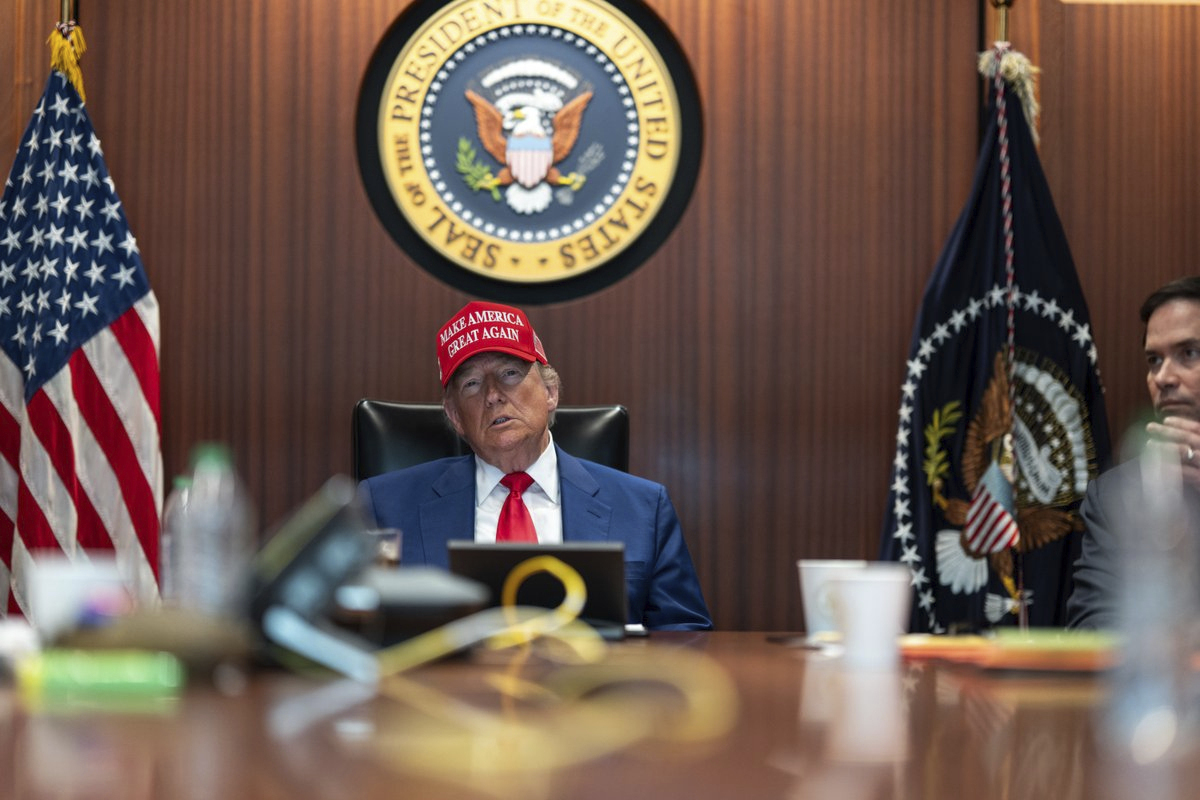 |
US President Donald Trump in the White House Situation Room on 21/6/2025. Photo: AP |
However, he also announced a "large fleet" of US forces heading towards Iran "in case it's needed," adding that Washington was monitoring Tehran "very closely."
The US leader's two-pronged message, preparing for conflict while discussing dialogue, increased regional instability.
Protest movement in Iran
In late December 2025, Iranian merchants protested dissatisfaction with the economic situation and the depreciating rial. The protests, initially peaceful, quickly escalated into deadly violence.
Iranian officials reported 3,117 deaths in the protests, including civilians, security forces, and those they described as "terrorist elements." In contrast, the US suggested the casualty count was much higher.
 |
Protesters march in Tehran on the evening of 10/1. Photo: AFP |
The protests intensified Tehran-Washington tensions when Iran accused "Israeli and American terrorist agents" of inciting riots, while the US Department of State denied the claims, stating Tehran was "distracting public opinion from internal issues."
President Trump repeatedly mentioned the possibility of supporting protestors, not ruling out ordering airstrikes on Iran.
Escalating military pressure
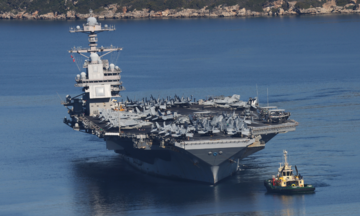
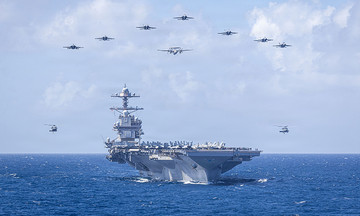
In recent weeks, the US deployed substantial military forces across the Middle East, including two aircraft carrier strike groups and over 100 combat aircraft of various types to the region.
Naval forces, aircraft, and defense systems were positioned closer to Iran. This increased military presence raised concerns that Washington was preparing for airstrikes even as negotiations were ongoing.
Trump stated on 27/2 that he was "not satisfied" with the progress of US-Iran negotiations, believing Tehran was "unwilling to meet our needs."
"We are not truly pleased with how they are negotiating. They cannot have nuclear weapons," he said, adding that the US wanted Iran "not to enrich uranium" that could be used to build a nuclear bomb.
The US Embassy previously authorized non-essential personnel and their families to leave Israel due to "security risks."
 |
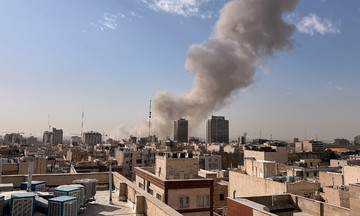
People look at a plume of smoke rising after an explosion in Tehran, Iran, on 28/2. Photo: AP |
By the morning of 28/2, Israel announced it had launched missile attacks on Iran. Trump later declared the start of a campaign targeting sites in Iran.
Fars news agency reported that multiple missiles struck University Street and the Jomhouri area in the capital Tehran, as well as near the headquarters of the Islamic Revolutionary Guard Corps (IRGC). Satellite images showed the residence of Iranian Supreme Leader Ali Khamenei destroyed, but Iran stated Khamenei had been moved to safety.
Explosions also occurred in the Seyyed Khandan area in northern Tehran, according to Iran's Tasnim news agency. Additionally, cities such as Kermanshah, Qom, Tabriz, Isfahan, Ilam, and Karaj were targeted in the attack.
US objectives
Announcing the attack on Iran, Trump stated the campaign's goal was to "destroy their missile launchers and flatten their missile industry."
"We will wipe out their navy," Trump further wrote on social media.
He also stated that the US would ensure Iran's "proxies," referring to Tehran-backed armed groups in the region such as Hamas, Hezbollah, and the Houthi, "can no longer destabilize the region or the world."
He reiterated his earlier statement that he would not allow Iran to develop nuclear weapons, despite Tehran's repeated assertions that it has no interest in building such weapons. "They will soon realize that no one should challenge the strength and might of the US armed forces," he said.
Reuters quoted a US official who stated the Trump administration was planning a "multi-day operation."
Iran's response
Ebrahim Azizi, chairman of the Iranian parliament's National Security Committee, threatened a strong retaliation.
"We warned you! Now you have started a path whose end is no longer in your control," Azizi wrote on social media.
The IRGC later announced the start of the "first wave of a fierce missile and UAV attack campaign" targeting Israel. "This is retaliation for the enemy's aggressive actions and crimes against Iran," the IRGC stated.
Iranian state media, citing IRGC information, reported they targeted four US bases: Al-Udeid airport in Qatar, Al Salem in Kuwait, Al-Dhafra in the UAE, and the US Navy's 5th Fleet base in Bahrain.
 |
A plume of smoke rises from the US Naval Support Activity (NSA) in Bahrain on 28/2. Photo: AFP |
Observers suggest how the conflict unfolds will largely depend on Iran's response in the coming days.
"The retaliation will depend on the extent of the damage they sustain, but it's too early to say anything," said Mohammed Eslami, a political scientist at the European University Institute.
Thanh Tam (According to Gulf News, Al Jazeera, TRT World)