Academics from Harvard, Stanford, and Dartmouth analyzed test scores of students from grade 3 to grade 8 in over 5,000 school districts across 38 states, using data from the National Assessment of Educational Progress. Between 2022 and 2025, only five states and Washington D.C. saw significant increases in reading comprehension scores. Across the US, reading comprehension scores were lower than pre-pandemic levels, while math scores were only slightly higher.
"The pandemic was like a mudslide that hit after seven years of continuous academic decline," stated Harvard University Professor Thomas Kane, a member of the analysis team.
Researchers are debating the causes of this decline in US student reading skills. They suggest one factor could be the rise of social media on smartphones, coupled with a corresponding decrease in children's recreational reading habits.
Kane noted that the drop in reading skills also coincided with states relaxing strict measures for schools where students did not show progress on standardized tests.
For many years, US schools taught reading using methods that placed less emphasis on phonics, encouraging students to guess words based on context. As reading comprehension scores fell over the past decade, parents, academics, and literacy advocates pushed for a more suitable teaching approach, primarily through spelling and sounding out each word based on phonics.
States that adopted this "science of reading" method, such as Louisiana, Maryland, Tennessee, Kentucky, and Indiana, all saw improved student reading comprehension scores.
In addition to reforming teaching methods, these states also required schools to screen for learning disorders like dyslexia and hire coaches to support teachers in improving reading instruction skills.
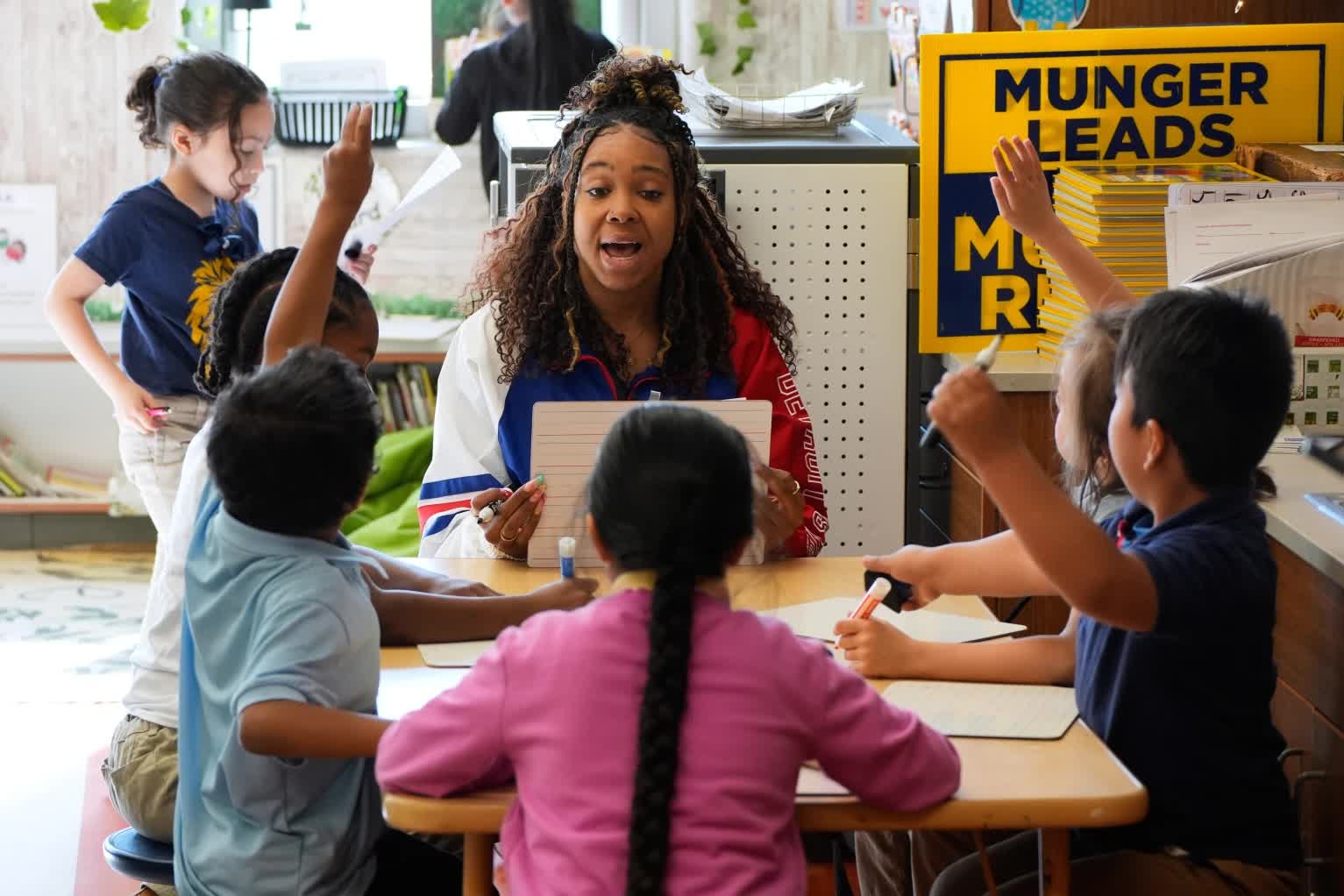 |
Teacher Aja Penick guides first-grade students at Munger Elementary-Middle School in Detroit, Michigan, on 7/5. Photo: AP |
In Modesto, California, reading instruction methods were changed during the pandemic, while the math curriculum had been adjusted several years prior. The school district established a dedicated department to support English language learners and enhanced teacher training. Each teacher received 5,000 USD for completing the intensive science of reading LETRS program.
Modesto's test scores improved by the equivalent of 18 additional weeks of learning in math and 13 weeks in reading skills. However, the district still has much work to do, as overall student scores remain significantly below grade-level standards.
Over the past decade, the South has emerged as a leader in education reform, contrary to its long-standing image of often ranking at the bottom. States in the region quickly transitioned to research-based teaching methods and invested in teacher training and support.
These efforts are beginning to show results. Louisiana and Alabama are two states whose 2025 math scores surpassed pre-pandemic levels. Louisiana is also the only state where reading scores exceeded the pre-pandemic average, with 87% of traditional public school students attending districts with higher scores than in 2019.
Alabama recorded a notable increase in reading skills post-pandemic, thanks to a law requiring all schools to adopt phonics-based teaching methods. In 2022, the state legislature built on this success to reform math education. The resulting act standardized math instruction, requiring periodic testing and mandatory intervention for students who had not achieved necessary math skills.
Researchers emphasize that this progress can be replicated across the US, as it has happened before. From the 1990s to the mid-2010s, test scores and graduation rates in the US increased for many years, while disparities between ethnic groups narrowed.
"For over 30 years, the US has made great progress in education," said Sean Reardon, a professor at Stanford University. "This shows that we can improve the quality of education and expand learning opportunities."
By Ha Linh (AP)