Deputy Prime Minister Bui Thanh Son and Chinese Foreign Minister Wang Yi co-chaired the 17th Session of the Steering Committee for Bilateral Cooperation between Vietnam and China on the morning of 17/3, according to the Ministry of Foreign Affairs.
Both sides agreed to continue strengthening strategic trust and increasing high-level and various-level contacts. They also committed to effectively leveraging the overall coordinating role of the Steering Committee for Bilateral Cooperation, enhancing practical cooperation in all fields, expanding local cooperation and people-to-people exchanges, and strengthening coordination in multilateral forums.
Deputy Prime Minister Bui Thanh Son proposed that both sides promote the establishment of intergovernmental working groups in key areas. He emphasized high priority for railway cooperation, aiming for the early completion of three standard-gauge railway projects connecting the two countries. This would be accompanied by providing Vietnam with preferential loans, technology transfer, and railway personnel training.
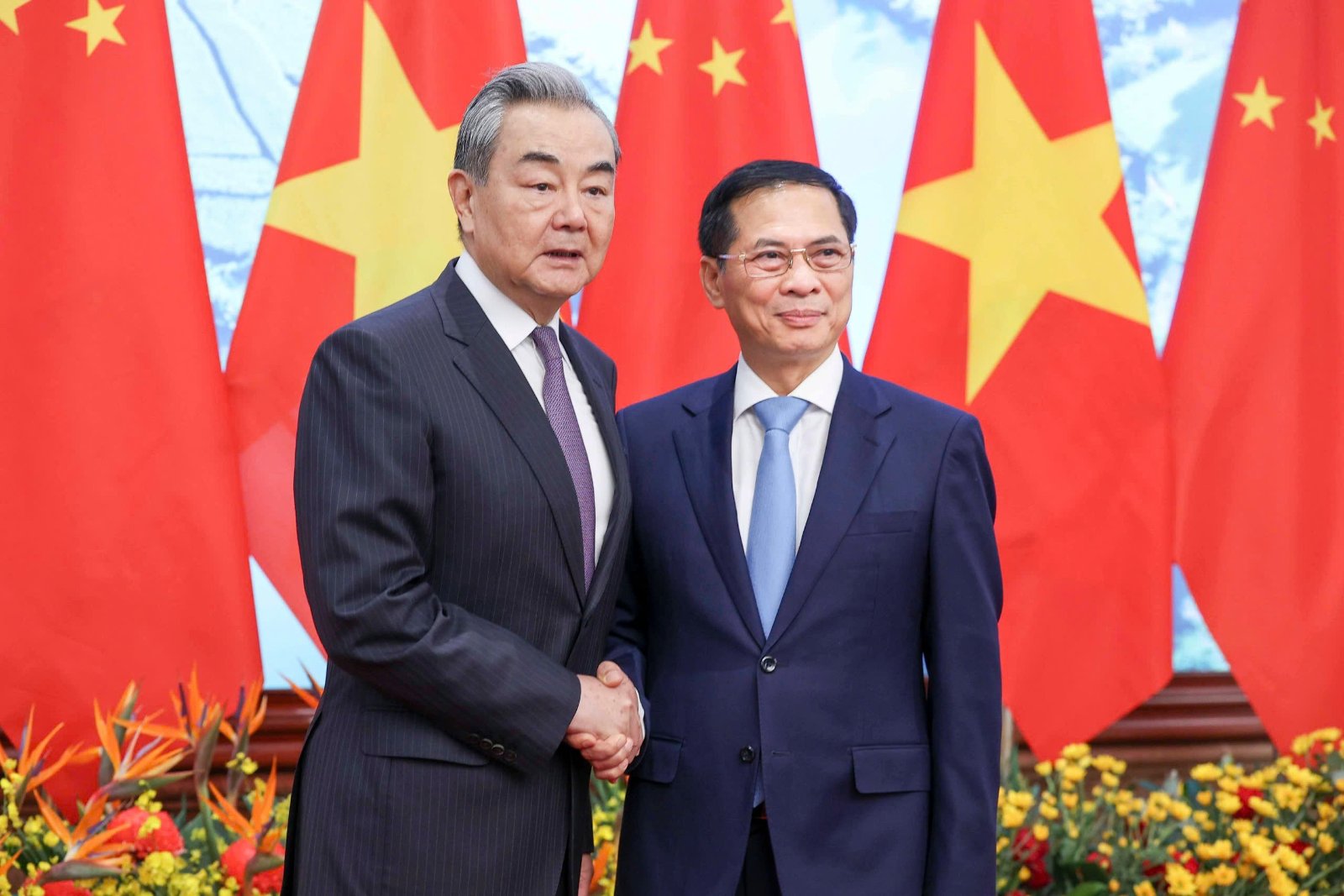 |
Deputy Prime Minister Bui Thanh Son (right) and Chinese Foreign Minister Wang Yi during their meeting on 17/3. *Photo: Ministry of Foreign Affairs* |
The Deputy Prime Minister also requested facilitating Vietnam to open more trade promotion offices in China. He called for continued market access for Vietnamese agricultural and aquatic products, such as: wild-caught seafood and pomelos. He further urged for the early re-importation of Vietnamese spiny lobster, along with enhanced cooperation on standards.
The Deputy Prime Minister expressed Vietnam's desire for both sides to promote high-quality, high-tech investment from China into Vietnam. He also urged accelerating the resolution of challenges in some aid projects.
He further addressed strengthening energy and border gate infrastructure, including increasing the capacity and output of electricity imported from China, ensuring fuel supply, expanding the smart border gate model, and implementing the construction of cross-border economic cooperation zones.
Wang Yi affirmed that China values promoting mutually beneficial cooperation with Vietnam. He stated China's readiness to share development opportunities, support Vietnam in building an independent and self-reliant economy, and expand imports of high-quality goods, especially agricultural products, to foster balanced trade.
According to Wang, China will actively advance the progress of the three railway lines and cooperate on capital, technology, and railway personnel training. He also encouraged Chinese enterprises to expand their investment in Vietnam.
He also proposed that both sides strengthen cooperation in emerging fields such as: high-tech, innovation, and clean energy. Wang expressed a desire for both nations to promote people-to-people exchanges, cultural, health, and education cooperation, affirming that China would provide more diverse scholarships for Vietnamese students.
China was the first country to establish diplomatic relations with Vietnam on 18/1/1950. The two countries established a Comprehensive Strategic Cooperative Partnership in 2008.
In 2023, the two countries issued a joint statement elevating their Comprehensive Strategic Cooperative Partnership, promoting the building of a strategically significant shared future community. In terms of trade, Vietnam is China's largest trade partner in ASEAN, with trade turnover reaching 252 billion USD in 2025.
Ngoc Anh