Two unprecedented consecutive phone calls on 4/2 between Chinese President Xi Jinping and US President Donald Trump, and Russian President Vladimir Putin, offered new insights into how these three major powers interact on the global political stage.
Shi Yinhong, a professor of international relations at Renmin University of Beijing, noted that two high-level dialogues occurring on the same day is "rare," despite Xi's separate calls with Trump and Putin in the past. This happened as China endeavors to balance global power dynamics on major issues, such as energy security and strategic stability, particularly as all three nations face internal challenges.
Professor Shi stated that the common theme President Xi addressed in both discussions with the Russian and US leaders was "energy economics," a primary concern for major powers today.
The Chinese leader's separate calls with the Russian and US leaders on the same day also highlight Beijing's effort to balance its relationships between the world's two leading powers. Analysts, however, remain skeptical about China's ability to act as an "arbiter" in the current era of intense great power competition.
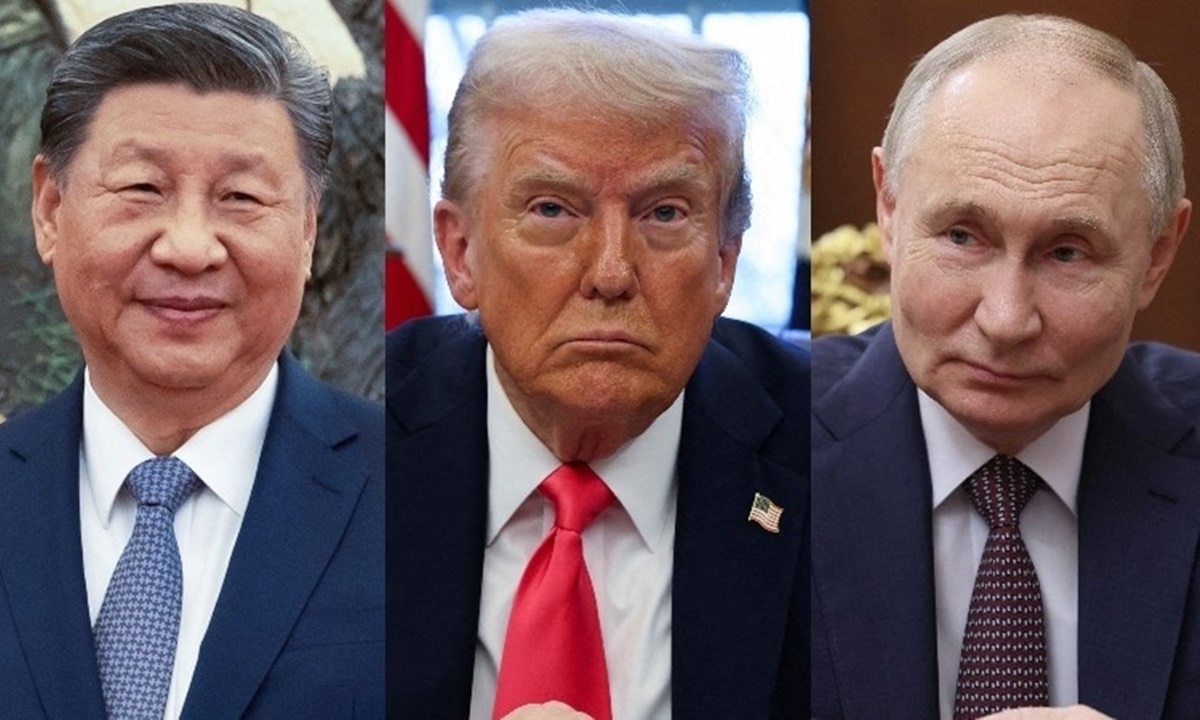 |
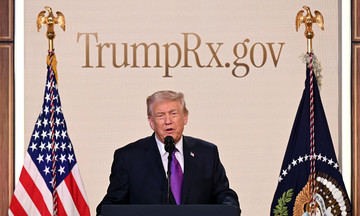
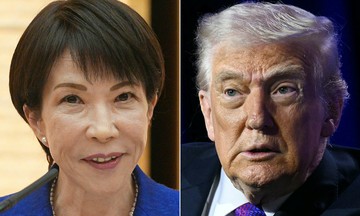
From left: Chinese President Xi Jinping, US President Donald Trump, and Russian President Vladimir Putin. *Photo: Reuters*
During his video call with Xi, Putin emphasized that Russia is a "leading energy supplier" to China, affirming that the "energy partnership between the two sides is mutually beneficial and truly strategic."
Two days prior, Trump announced that under a new trade agreement between the US and India, New Delhi had agreed to stop buying oil from Moscow. This was a significant revenue source for Russia, as its economy faced unprecedented sanctions from Western nations. The Kremlin later denied that India had agreed to cease Russian oil purchases.
President Trump also posted on social media on 4/2 that he and Xi had discussed "China purchasing oil and gas from the US" during their phone call, which took place just hours after the Chinese President's conversation with President Putin.
Xi's phone calls with Trump and Putin also conveyed messages about global strategic stability. They occurred just one day before the US-Russia New START nuclear arms reduction treaty expired. Trump had refused to extend New START, seeking to negotiate a new nuclear arms control treaty that would include China.
Chinese Foreign Ministry spokesperson Lin Jian stated on 5/2 that Beijing considered the termination of New START "regrettable." He urged the US to "re-engage in dialogue with Russia on strategic stability." However, he did not comment on whether Beijing included this issue in its discussions with Trump and Putin.
According to Beijing, President Xi affirmed to President Putin that the US and Russia need to work together to maintain global "strategic stability." This is a Cold War-era term referring to a state where neither side has an incentive to launch a preemptive nuclear attack.
President Trump said his discussions with President Xi included military aspects, though he did not elaborate. He added that the "long and thorough" phone call also addressed the Russia-Ukraine conflict and the "current situation with Iran."
Debate has grown over whether Trump envisions a world where the US, China, and Russia each maintain their own spheres of influence.
Before a summit last October with Xi in Busan, South Korea, Trump proposed the idea of the US and China forming a G2 group. However, Beijing was not enthusiastic about the US President's suggestion.
China's mediating role
Experts suggest that connecting simultaneously with both superpowers demonstrates Beijing's desire to present itself as a key player capable of engaging with both Washington and Moscow. This reinforces China's image as a stable and balancing "pole" in a volatile multipolar world.
"Xi's contact with both Trump and Putin on the same day indicates Beijing appears to be positioning itself at the center, a key point in the great power triangle," noted Artyom Lukin, a professor at Russia's Far Eastern Federal University in Vladivostok.
China's central position has recently strengthened as several Western nations, close allies of the US, seek to bolster relations with Beijing.
In recent months, leaders from France, Ireland, Finland, and the UK have visited Beijing. German Chancellor Friedrich Merz and Spanish Prime Minister Pedro Sanchez are also scheduled for similar visits.
"Most US allies disagree with the China policy Trump pursued, believing it lacked principle and was not firm enough," wrote Jia Qingguo, a professor of international relations at Peking University, in a report published on 4/2 by the Institute for Global Cooperation and Understanding at Peking University. Despite this, he expressed hope that a second Trump term could create "a rare opportunity" to stabilize China-US relations.
President Trump stated that he also discussed with President Xi the possibility of visiting China in April, a trip he "looks forward to."
However, the Trump administration also announced on 4/2 that it intends to establish a critical mineral trade bloc with partners and allies, using tariffs to maintain minimum prices to counter China's impact on these key materials. This move indicates Washington's continued interest in curbing Beijing's influence in areas it considers national security priorities.
Additionally, experts believe that the leaders' choice of 4/2, the start of spring according to the East Asian calendar, for their phone calls conveyed a message of "new beginnings." By speaking with both the Russian and US leaders at this special moment, Xi appeared to wish to convey hope for a less confrontational and more constructive phase in international relations among major powers.
Vu Hoang (According to SCMP, AFP, Reuters)