


In his daily address on the evening of 20/1, Ukrainian President Volodymyr Zelensky announced that Russian Geran-series suicide unmanned aerial vehicles (UAVs) had again struck energy infrastructure in Kiev province, which is currently undergoing repairs.
"The Air Force has not met the required combat effectiveness in countering Shahed-type UAVs. We possess interception weapons and have deployed many forces, including mobile air defense units and F-16 fighter jets," he said, calling for the Ukrainian Air Force to reorganize its combat strategy.
President Zelensky reported that he had reviewed this issue separately with Defense Minister Mykhailo Fedorov before reaching a conclusion.
 |
President Zelensky speaking on 19/1. Photo: Office of the President of Ukraine |
Earlier, the Ukrainian Air Force Command stated that Russia attacked Ukraine in the early hours of 20/1 with one 3M22 Zircon hypersonic missile, 18 Iskander-M tactical ballistic missiles, and modified S-300 air defense missiles for ground strikes, 15 Kh-101 long-range cruise missiles, and 339 various types of UAVs, with Kiev as the main target.
"Air defense units shot down 14 Iskander-M and S-300 missiles, 13 Kh-101 missiles, and 315 UAVs. The remaining five missiles and 24 UAVs hit 11 areas, with debris falling in 12 locations. We are clarifying information about the two remaining missiles," the agency reported, without specifying which weapons were not intercepted.
Kiev Mayor Vitali Klitschko noted the attack disrupted heating supplies for 5.635 apartment buildings and caused water outages in the city's areas on the Dnieper River's eastern bank. One person in Kiev city was injured, and one person in Kiev province was killed.
Beyond the capital Kiev and its surrounding province, Russia also damaged energy infrastructure and other facilities in Vinnytsia, Dnipro, Odessa, Poltava, Sumy, and the Ukrainian-controlled area of Zaporizhzhia province. Two people were also injured when a production facility in Dnipropetrovsk province was hit, according to local officials.
Ukraine's Defense Intelligence Directorate (GUR) stated earlier this week that Russia has deployed a new Geran series, designated Geran-5. It features a traditional fixed-wing aircraft design, replacing the previous delta-wing design, and is equipped with an upgraded jet engine to achieve a maximum speed of about 600 km/h.
The Geran-5 is believed to have a range of about 960 km and carries a 90 kg warhead. The GUR assesses that Russia intends to deploy this suicide aircraft from Su-25 attack aircraft, rather than solely launching from ground platforms as before, to extend its operational range.
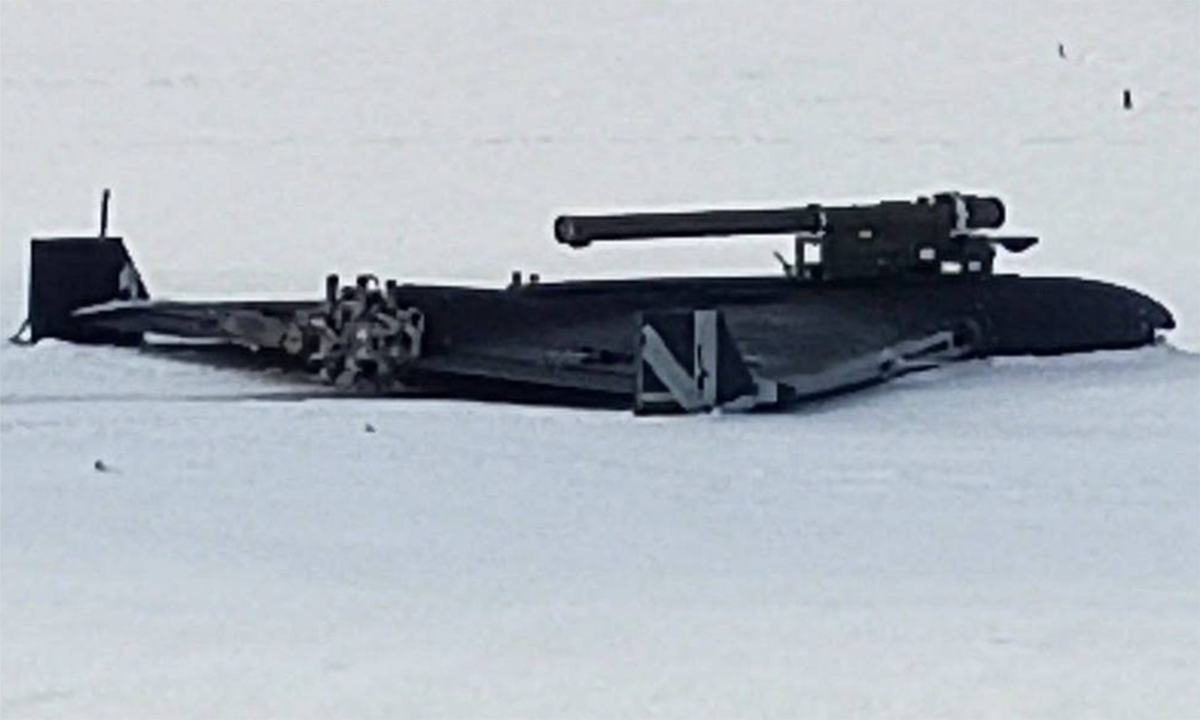 |
Russian Geran UAV carrying a shoulder-fired missile in a photo posted on 4/1. Photo: Ukrainska Pravda |
The Geran is a Russian-produced suicide UAV based on Iran's Shahed-136 series, which first saw combat in Ukraine in the autumn of 2022.
Russia regularly improves the Geran series, increasing the warhead mass, installing jet engines for higher and faster flight, and equipping them with sensors, cameras, and remote control systems. Some recent Geran-2 UAVs carry R-60 short-range air-to-air missiles or Verba shoulder-fired missiles, capable of shooting down targets at distances of 6-8 km.
Russian forces also constantly change their attack tactics with Geran UAVs, including using them to clear a path for missiles, attacking in swarms to overwhelm Ukrainian air defenses, and even employing variants with cameras to hunt down enemy mobile air defense units and designate targets for allied UAVs.
Pham Giang (According to AFP, Ukrainska Pravda, Business Insider)


