Vietnam is piloting dedicated passing lanes on three expressways: Ha Noi - Hai Phong, Cau Gie - Cao Bo, and Vinh Hao - Phan Thiet. Under the proposed plan, the lane adjacent to the median is for passing, and vehicles must return to the right lane when conditions allow after overtaking.
This organizational method raises concerns among many drivers, especially when applied to expressways with only two lanes of travel in each direction, such as Vinh Hao - Phan Thiet. If one lane is exclusively for passing, only one lane remains for continuous driving, potentially increasing traffic congestion.
Traffic studies indicate that the answer depends on traffic volume. When roads are clear, this rule can help differentiate slower vehicles from those needing to pass, thereby improving traffic flow. However, during heavy traffic, continuous lane changes for passing and then returning can make traffic flow less efficient.
Dedicated passing lanes can create traffic accumulation during heavy vehicle flow
A study titled "Study on the Keep-Right-Except-To-Pass Rule", published in 2014 by a team of authors at Hebei United University, China, in the Journal of Chemical and Pharmaceutical Research, simulated the "keep-right-except-to-pass" rule. This rule dictates that vehicles must drive in the right lane, only moving to the left lane to overtake, and then returning to the original lane.
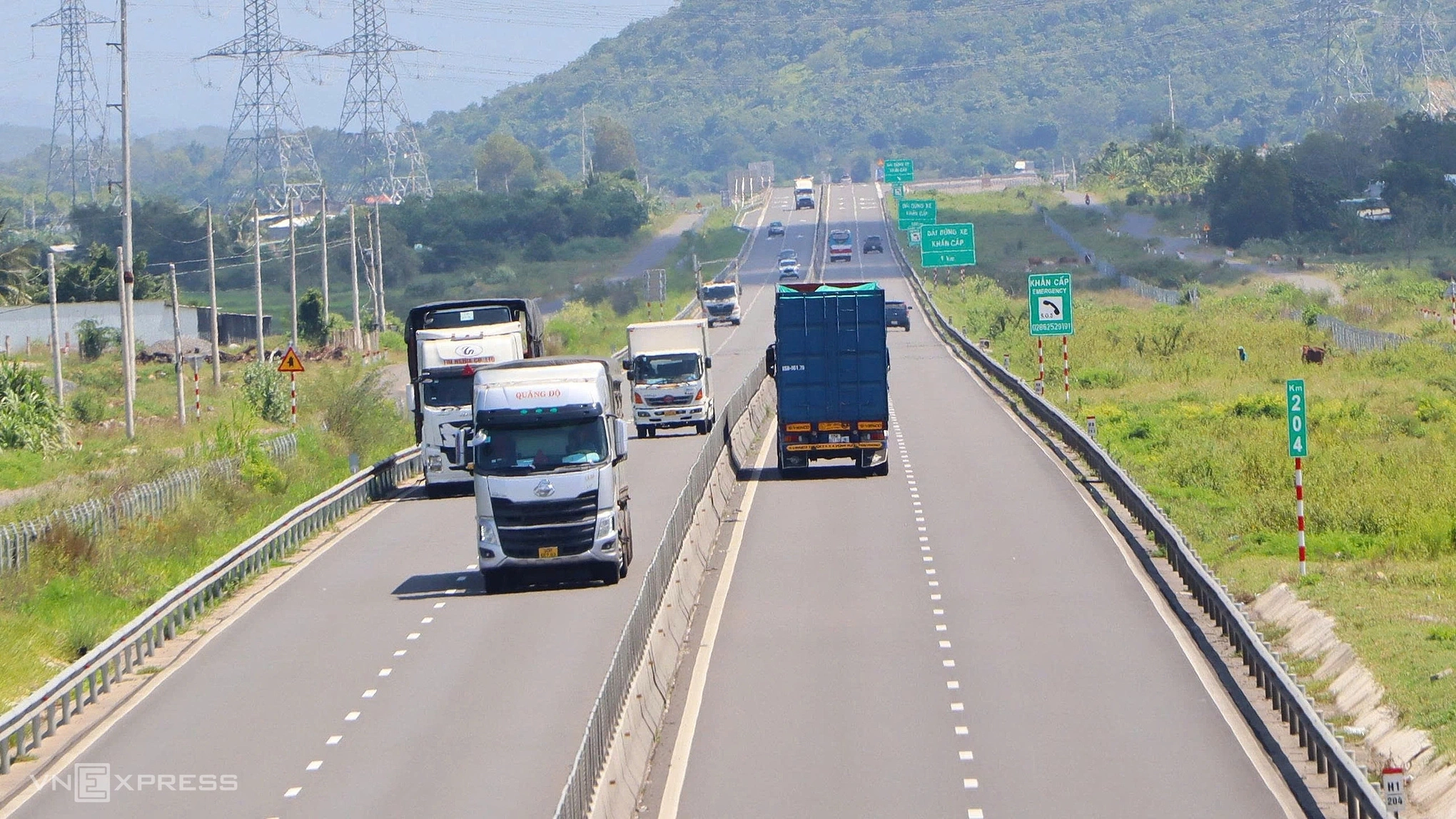 |
The Vinh Hao - Phan Thiet expressway with two lanes in each direction. Photo: Viet Quoc |
The study examined four factors: traffic flow, safety, number of lane changes, and speed limits. Results indicated that this rule could improve traffic flow during light traffic but was not as effective when traffic volume gradually increased. During heavy traffic, the rule of keeping right and being required to return to the lane after passing no longer helped improve vehicle flow density.
To illustrate, when traffic is light, a slow-moving vehicle in the right lane can easily yield to a vehicle behind it wishing to pass. Once the pass is complete, the vehicle returns to the right lane, and other vehicles maintain their speed. However, as traffic volume increases, the gaps between vehicles shrink. A vehicle wanting to pass must find a gap in the left lane. If that lane is already occupied by a passing vehicle, the trailing vehicle must wait. After completing a pass, the driver must again find an opening to merge back into the right lane. Many vehicles performing this maneuver simultaneously can create queues. In such scenarios, the right lane bears the brunt of continuous traffic flow, while the left lane operates in intermittent passing bursts.
Another study, "Performance Evaluation of the Keep-Right-Except-to-Pass Rule", by a Chinese research team, presented at the 17th International Conference of Transportation Professionals in Shanghai in 2017 and published in the 2018 proceedings, also focused on this rule. The research team developed a two-lane model, analyzing the passing process and the number of lane changes. Data showed that the number of lane changes varied with traffic volume, exhibiting a parabolic curve as volume increased. When the number of lane changes rose, the safety index of the traffic flow decreased. Therefore, the research team suggested that under heavy traffic conditions, the principle should shift to slower vehicles keeping right, allowing passing vehicles to continue in the left lane instead of immediately being forced to return.
Will this cause congestion?
The aforementioned studies do not definitively state that applying dedicated passing lanes on two-lane expressways will cause congestion; the effectiveness of this organizational method largely depends on traffic volume. When traffic volume is low, this traffic management approach can operate normally because there is sufficient space between vehicles. However, when vehicle numbers increase significantly, the gaps for merging and exiting lanes decrease, requiring vehicles wishing to pass to wait longer, while traffic in the right lane may accumulate.
Therefore, there is no basis to definitively state that dedicating one lane for passing will cause congestion, nor can it be asserted that this method will make two-lane expressways flow more smoothly under all conditions. For the expressways designated for piloting this scheme, it is necessary to monitor hourly traffic volume, average speed, number of lane changes, queue length, and travel times both before and after implementing the dedicated passing lanes.
Hai Dang