Recently, I have been reading many opinions debating traffic safety, especially the mandatory use of child safety seats in cars. In Western countries, people drive more disciplined and experience fewer accidents. However, when accidents do occur, they are often severe due to very high speeds, sometimes exceeding 200 km/h. This is why they mandate children use dedicated safety seats. In Vietnam, accidents are more frequent, but most are minor collisions within urban areas.
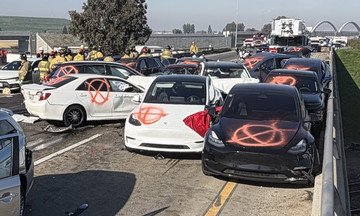
Reflecting on the reality of traffic in Vietnam, this observation aligns with daily experience. Inner-city roads in major cities are consistently congested, with cars often crawling at only 20–30 km/h, or even slower. In this context, most accidents are minor bumps and scrapes. Motorcyclists are most susceptible to serious injury, while car occupants are generally less likely to sustain severe injuries thanks to the vehicle frame, airbags, and seat belts, unlike high-speed accidents on expressways abroad.
From this reality, many conclude: "If we drive slowly, why bother with child safety seats? Just hold children in your lap or let them share a seat, there's nothing to worry about." I believe this line of thinking is partly true but also harbors many dangers. It is true that at low speeds, in constantly congested conditions, the likelihood of a serious accident is lower. However, the danger lies in the fact that even on an open road, with a sudden acceleration or an unexpected emergency brake, an unsecured child can still be thrown forward, hitting the front seat, windows, or other surfaces, causing injuries. Furthermore, the habit of "holding a child" in the front or back seat worsens the situation, as adults cannot adequately restrain a child's body against significant inertial forces.
I am not under the illusion that Vietnam will immediately adopt and strictly enforce regulations like those in Europe or North America, where children are legally required to use safety seats according to specific standards for age and weight, with heavy penalties for non-compliance. Our road conditions, income levels, public awareness, and cultural habits are significantly different. However, I believe we can take a more practical, step-by-step approach. For instance, we could begin with a simple regulation prohibiting the transport of children without safety seats when the vehicle travels at speeds above 60 km/h. Why 60 km/h? Because at this threshold, vehicles typically leave congested urban areas and enter major arteries, national highways, expressways, or at least stretches of road where speeds can be relatively fast and clear. A collision at 20-30 km/h is vastly different from one at 70-80 km/h. At higher speeds, seat belts and child safety seats are no longer recommendations; they are the boundary between minor injuries and severe trauma, or even fatalities.
A speed-based regulation offers another advantage: it is more readily accepted by the public. Within urban areas, where vehicles often crawl, regulations could be temporarily relaxed (though child seats are still advisable for safety). However, when drivers enter roads permitting faster speeds, the regulation would become stricter. This transitional and flexible approach avoids the feeling of an abrupt, "top-down" mandate.
Of course, regulations on paper are not enough. Strong parallel efforts are needed, such as public awareness campaigns to educate parents about the risks of high-speed accidents, explaining why child safety seats are crucial—not to "imitate Western practices" but to protect their own children. Incentives for taxi and ride-hailing drivers could include support policies, promotions, or pilot programs for vehicles equipped with child seats, providing parents with safer options for longer journeys. Considering tax incentives or discounts for certified safety equipment could make child seats less of a "luxury item" for many families.
Ultimately, I believe that child protection is an area where every society should be a bit "stricter." We can debate many aspects: fine amounts, enforcement methods, implementation timelines, but few would oppose the common goal of minimizing child casualties in traffic. Therefore, from the very real difference between "Westerners drive fast, have fewer but more severe accidents" and "Vietnamese drive slowly, have more but minor accidents," I hope we can derive a practical direction: begin to tighten the use of child safety seats on roads and at speeds where a single moment of carelessness can lead to an unbearable cost.
Sometimes, just a small seat and a seemingly troublesome regulation can secure an entire future.
Reader Ami
| Vietnam Mobility Show 2025 – Vietnam transportation exhibition will take place from 26-28/12 at the F1 racetrack area, My Dinh, Ha Noi. Car, motorcycle, bicycle, accessory, entertainment, and food brands are invited to register for booths here. |