 |
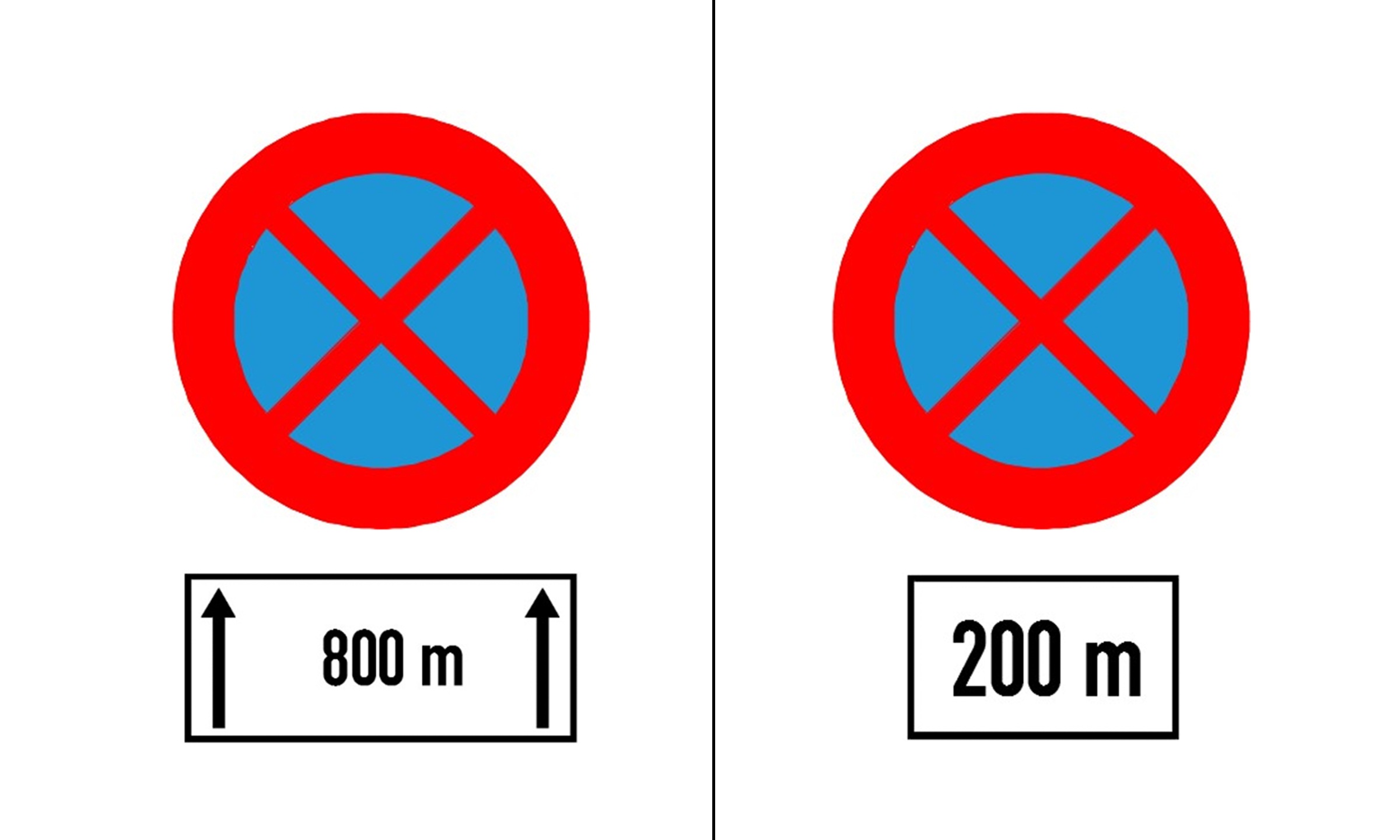
Supplementary signs: 800m S.501 and 200m S.502. |
Two specific supplementary signs, S.501 and S.502, frequently appear on Vietnamese roads, causing confusion among drivers regarding their precise meaning. While both prohibit stopping and parking based on distance, their definitions are distinct.
Sign S.501, labeled "scope of the sign's effect", indicates the length of the road section where a prohibition or restriction applies. According to National Technical Regulation QCVN 41:2019/BGTVT, this sign informs drivers of the distance over which a dangerous, prohibited, mandatory, or restricted condition extends, recorded in meters and rounded to the nearest ten. For example, an "800 m" supplementary sign S.501 means that stopping and parking are prohibited for 800 m from the sign's location.
Conversely, Sign S.502, titled "distance to the sign's object", informs drivers about the distance to a specific traffic condition or restriction ahead. This sign is placed below hazard, prohibition, mandatory, and informational signs when their placement deviates from general regulations. It communicates the actual distance from the sign's location to the object being signaled. The number on the sign is also recorded in meters, rounded to the nearest ten. Therefore, a "200 m" supplementary sign S.502 indicates that the prohibited stopping and parking section will begin 200 m further down the road.
To quickly differentiate between these two signs, drivers can look for an arrow symbol. If the supplementary sign includes an arrow, it signifies that the prohibition applies for the specified distance in the direction of the arrow (S.501). If there is no arrow, the number indicates the distance until the prohibited section begins (S.502).
Understanding these road signs is crucial for safe driving and avoiding traffic penalties. When encountering a supplementary sign below a main sign, drivers should take a moment to read and analyze its meaning. Correctly interpreting these signs allows drivers to navigate situations properly and move more safely on the road.
Nguyen Vu