Hyundai's electric vehicle models, such as the Ioniq 5, are among the fastest-charging electric vehicles, yet the company believes this is still not fast enough. Built on the E-GMP platform, both the Ioniq 5 and Ioniq 6 can charge from 10% to 80% in just 18 minutes using a 350 kW DC fast charger and an 800-volt system.
While this represents a leading charging speed, Hyundai is striving for even quicker times. According to Tyrone Johnson, director of Hyundai Europe Engineering Center, drivers are expecting electric vehicle charging times of around three minutes.
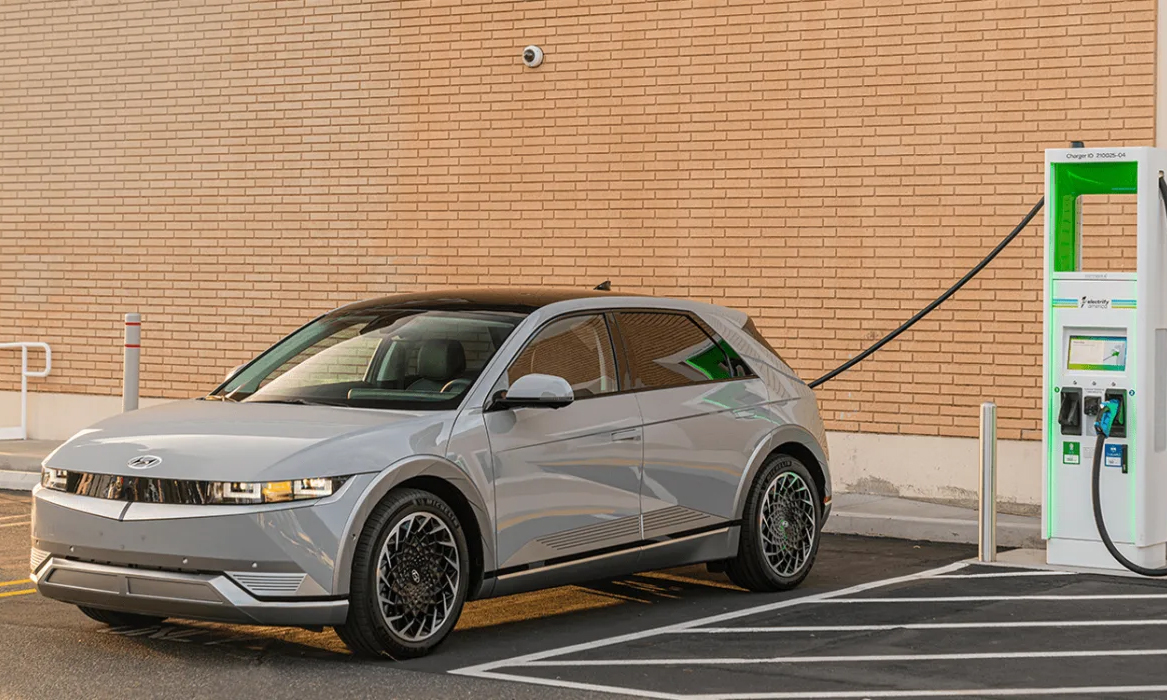 |
A Hyundai Ioniq 5 electric vehicle at a charging station in the US. Photo: Hyundai |
Drivers unable to charge at home need to know how quickly they can charge at public fast-charging stations. The primary challenge lies in delivering faster charging speeds without requiring larger batteries.
To achieve a three-minute charging time, Hyundai is working to bring 400 kW charging technology to market. By doing so, the company aims not only to shorten electric vehicle charging times to match gasoline refueling, but also to provide a longer driving range without the need for larger, more expensive batteries.
While Hyundai advertises 350 kW charging, actual speeds often hover around 250 kW, depending on factors such as battery temperature and charging station speed.
The Porsche Taycan is currently the fastest-charging electric vehicle, with capacities up to 320 kW. Several new electric vehicles, including the Lucid Gravity and the new Porsche Cayenne Electric, are achieving maximum charging capacities of 400 kW.
In Trung Quoc, BYD currently offers fast charging in five minutes, but this requires a dedicated 1,000 kW (equivalent to 1 MW) charging station and an electric vehicle capable of receiving that power. The upgraded Zeekr 001 model is capable of charging at over 1.3 MW, taking less than seven minutes to charge from 10% to 80%.
My Anh (via Auto Express)