The British luxury automaker recently inaugurated the Eric Platford Testway at its headquarters in Goodwood, Chichester, West Sussex, England. The company states that this facility will advance its pursuit of perfection and reinforce its stringent standards for product quality and refinement. The center is named after Eric Platford, chief engineer and head of the early testing team for Sir Henry Royce.
Platford is considered one of the most influential figures in Rolls-Royce's early history, instrumental in establishing the brand's engineering reputation. Beyond being a talented engineer, he demonstrated exceptional driving skills by securing third place at the Spanish Grand Prix in 1913.
The new facility allows engineers to test vehicles under various impacts on the chassis, suspension system, body structure, and interior components within a strictly controlled environment. The center comprises 4 parallel lanes, each 90 m long, covered with different surfaces to simulate a diverse range of operating conditions. Each vehicle will traverse these surfaces two times at a fixed speed.
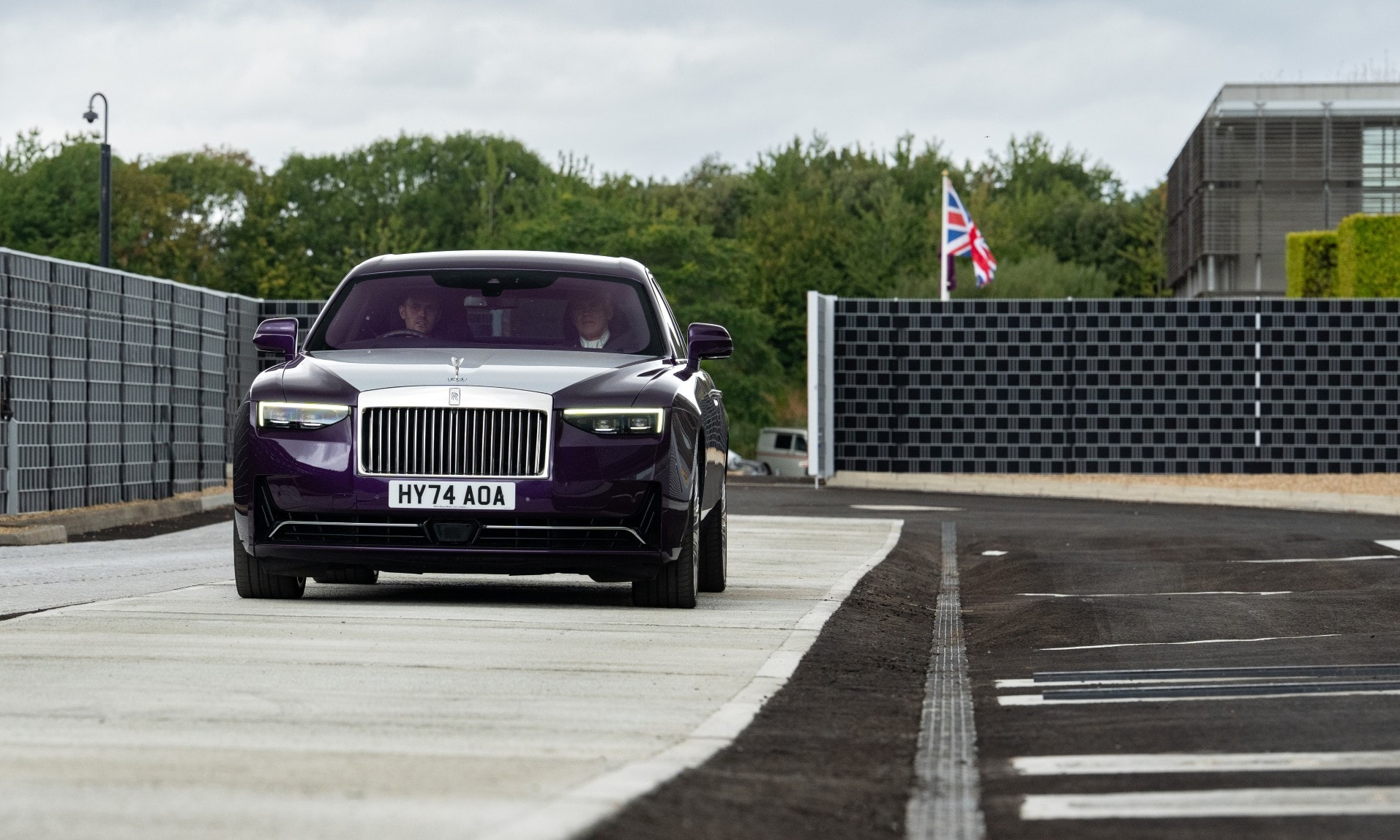 |
A Rolls-Royce model on the new test track at the company's headquarters. *Photo: Rolls-Royce*
The gravel surfaces (small and large) are used to detect minor vibrations within the cabin and assess overall ride comfort. Random concrete waves (with expansion joints every 2,4 m) create vertical variations. Twisted angle ramps are designed to generate torsional loads through counter-rotational axle movements.
Twin tracks create continuous impact forces on the front and rear axles. Offset iron manhole covers are positioned to evaluate the vehicle's asymmetrical response. Sine wave surfaces (1,27 cm amplitude, 30 cm distance) induce high-frequency resonance.
Before entering the Eric Platford Testway, vehicle models must undergo testing in an aerodynamic-acoustic chamber to assess sound insulation against wind noise. This test chamber employs high-pressure air nozzles, with adjustable speeds, mounted on a flexible sliding frame system. The equipment can simulate operating conditions at speeds exceeding the 112 km/h limit regulated in England.
Rolls-Royce continues to conduct random evaluations of some vehicle lines on a 13 km real-world route surrounding the Goodwood area. This combination is central to the testing process because public roads introduce a complex series of operational variables that only a real environment can provide. Meanwhile, the internal test track serves to isolate individual impacts and allows for unlimited repetition of tests.
By My Anh (according to Autoblog)