In East Asian culture, the horse (Ngo) is the seventh animal in the 12-animal zodiac. Ngo represents the true South when the sun is at its highest (midday). Because of this characteristic, the horse embodies the element of Fire, symbolizing energy, warmth, and progress.
Before the advent of the automobile, horses were intimately connected with humans, not only in work but also in fulfilling the desire for speed. In Western culture, a wanderer riding horseback under the afternoon sun across a vast plateau is one of the most distinctive metaphors for human ideals of freedom and liberation.
The horse evokes movement. For car manufacturers, simply being fast is not enough. A car must be exceptionally quick in a straight line, agile in corners, and resilient over long races. In Stuttgart, Germany, there is such a 'horse' named Porsche.
Porsche: Power from the stud farm
 |
The 2025 Porsche 911 in Quang Ninh. Photo: Minh Quan |
Porsche's logo is based on the coat of arms of Wurttemberg, a region in southwestern Germany. The Wurttemberg shield is divided into four sections. The upper left and lower right corners depict three traditional deer antlers, a symbol dating back to ancient times. The remaining sections feature the familiar red and black stripes of the German national flag. Above the shield, the word Porsche is outlined.
At the center of the Porsche logo is the emblem of Stuttgart. According to language experts, Stuttgart is a shortened form of the original word "Stutengarten," which translates to "stud farm" in English. The emblem and the name Stutengarten reflect Stuttgart's heritage, a region with fertile stud farms along the Neckar River.
Sleek and agile on the outside, yet powerful and swift within, Porsche is like a horse few would bet on at the start of a race, only to watch it finish first, leaving rivals far behind. Enthusiasts admire Porsche not for aggressive, muscular designs, which are often associated with masculine traits. Instead, they are captivated by Porsche's stability and mechanical precision, which are benchmarks in the contemporary automotive industry.
For petrolheads, Porsche's 911 is a pinnacle machine for conquering speed. The Porsche 911 might not be faster than its rivals in a straight line, but it excels in corners.
Porsche's philosophy of prioritizing the driving experience has cultivated a large, loyal customer base willing to spend significant sums on their dream cars. The German automaker began with low-slung sports cars like the 911 and 718. As demands for profitability and stricter emission regulations increased, Porsche introduced higher-riding models such as the Cayenne and Macan. While many viewed making high-riding vehicles as a weakness for a sports car brand, Porsche saw it differently.
The Cayenne's success saved Porsche from the brink of bankruptcy, guiding the German brand back to prosperity. The Porsche horse galloped again, paving the way for the later Macan and the Taycan in the era of electrification.
With a distinctive design preserved for nearly a century and high standards for mechanical performance, Porsche is one of the few pure sports car brands with excellent brand recognition in the automotive industry. Alongside Maserati, Porsche defines a premium segment that rivals extreme sports supercars.
Ferrari: The super horse from Italy
When discussing supercars, enthusiasts often seek out the horse bred and born exclusively in one place: Maranello, in Italy's Emilia-Romagna region, under the Ferrari brand. The story of the prancing horse logo began in 1923. After winning a race at the Savio circuit in Ravenna, Enzo Ferrari, the company's founder, met Countess Paolina, mother of Italy's World War I air hero, Francesco Baracca. She suggested Ferrari use the image of the prancing horse painted on the side of Baracca's fighter plane, believing it would bring Ferrari good fortune.
With Ferrari, there is no question of a purebred horse being tamed by a stranger in some tropical land across the globe. Ferrari also uses curves as a primary design element, like Porsche, but with a more muscular appearance. Its vehicles resemble the toned, sculpted muscles of warhorses trained and proven in numerous battles.
For Ferrari, a car must be fast not only in corners but also exceptionally quick in a straight line. The acceleration from speed machines like the 849 Testarossa, 296 GTB, and Purosangue is not for novices or the faint of heart. In Formula 1 racing, the most prestigious competition in four-wheeled motorsport, Ferrari stands as the most successful name.
 |
The Purosangue model launched in Ho Chi Minh City in 2023. Photo: Thanh Nhan |
The exceptional mechanical foundation and the superb sound from naturally aspirated V8 and V12 engines are an addictive stimulant for speed enthusiasts. At Ferrari, every design detail on the car aims for maximum aerodynamic efficiency. With each new generation, the company strives to improve engines or reduce weight using premium materials. The main goal is to shave off a few percentage points of a second during acceleration or corner exit, making the car even faster.
Porsche, Rolls-Royce, and other ultra-luxury brands offer customization programs to meet every customer's requirement, and Ferrari is no different. The Italian brand also cultivates its unique appeal with racing cars, costing hundreds of thousands of USD, for customers who wish to embody professional racers. Each year, in specific regions, the prancing horse brand organizes the Ferrari Club Challenge series, allowing clients to experience cars not available on public roads.
Ferrari's annual sales are around 10,000 vehicles, which is less than a fraction of mainstream brands like Toyota or Ford. However, Ferrari's profit margin per vehicle sold is among the highest in the automotive industry. The brand strength index of this Italian 'warhorse' is equally impressive.
Maintaining distinctiveness and choosing its own path is the philosophy that makes Ferrari stand out from its rivals. When the SUV trend dominated the automotive industry, Lamborghini quickly launched the Urus to get ahead. In contrast, Ferrari took a slower approach, nurturing the Purosangue project with an unconventional design that defied expectations. As a result, the Purosangue resembles a raised sports supercar, vaguely similar to an SUV. Its spirit of speed and unique, unmistakable interior and exterior design offer a distinct image for Ferrari's only high-riding model.
Ford Mustang: The wild horse of America
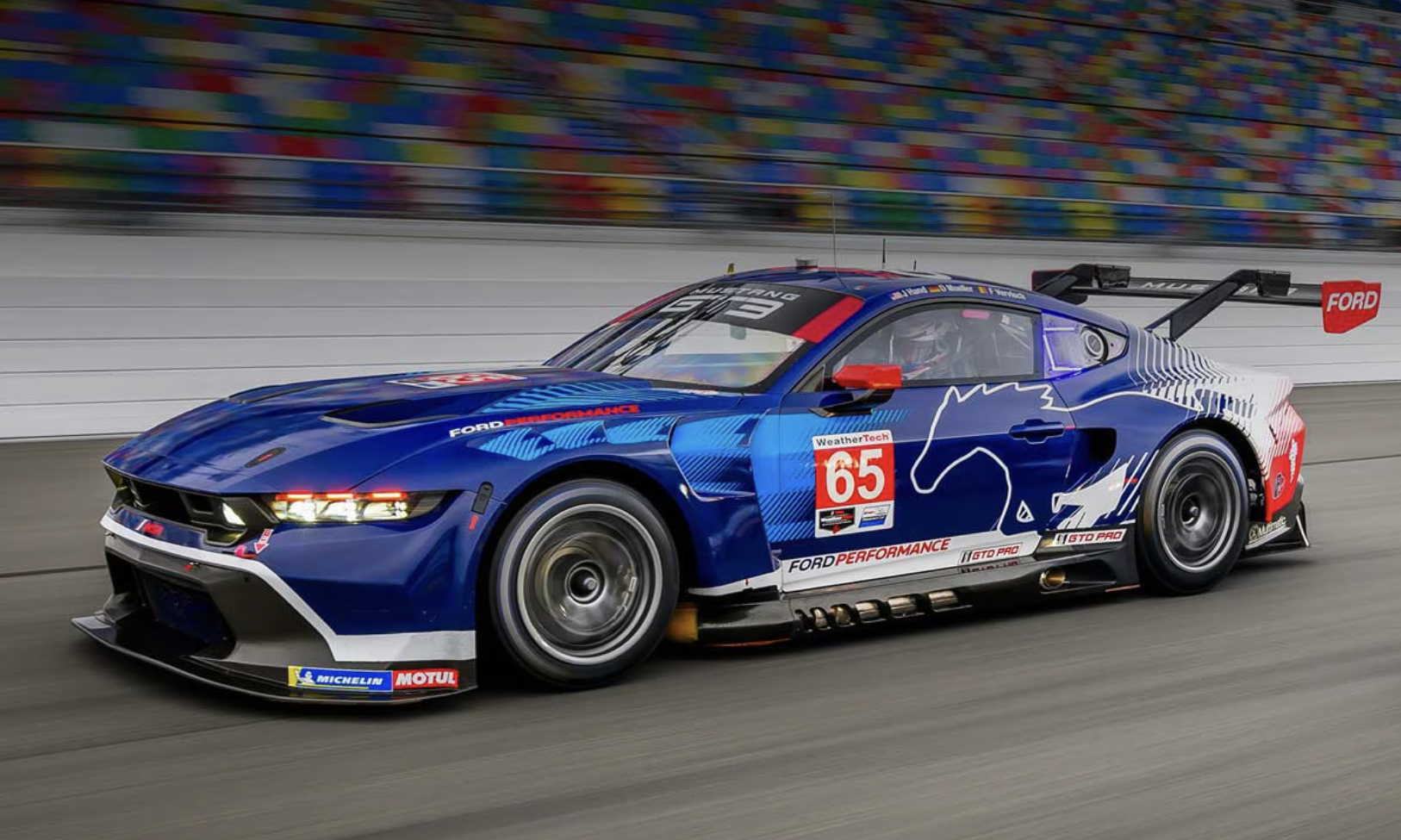 |
A Mustang GT3 on the racetrack. Photo: Ford |
If one speaks of a spirit of freedom and boundary-breaking, it would be incomplete without mentioning the wild mustang of the American West, the Ford Mustang. This name laid the foundation for one of the land of the free's most iconic segments: the pony car, which later brought forth the Chevrolet Camaro and Dodge Challenger.
The galloping Mustang horse is one of the most recognizable symbols for sports car enthusiasts. It features a long, tapering hood, a short rear deck, and muscular, sculpted lines, making it agile in the city and powerful at high speeds.
In Hollywood action films, the Mustang's appearance in chase scenes has become a signature element. The Mustang is a source of pride for Ford and for America as a whole. For many years, the Mustang has been one of the world's best-selling sports cars.
In America, beyond its purely commercial versions, Ford also produces variants exclusively for the racetrack, such as the Dark Horse R, GT3, and GT4, powered by naturally aspirated V8 engines with capacities ranging from 5 to 5,4 liters. These engines produce over 500 horsepower and approximately 650 Nm of torque.
As the electrification trend gains momentum, Ford has also created a Mustang that no longer emits a thundering roar. The Mustang Mach E, in an SUV body and purely electric, has sparked mixed reactions regarding one of the most prominent horse icons in the global automotive industry.
Thanh Nhan