The market features many types of escape hammers, differing in design, mechanism, and price, ranging from tens to hundreds of thousands of VND. Understanding the characteristics of each type helps users select the appropriate device for their needs, rather than relying solely on price or the number of features.
Traditional glass-breaking hammers
This is the most common type. These hammers feature hardened steel or hard alloy heads, typically designed with one or two sharp points to concentrate force on tempered glass. Most models also integrate a seatbelt cutter, recessed within the hammer body.
To use, hold the hammer and strike forcefully at a lower or upper corner of a side window. The sharp point creates a stress concentration, causing the tempered glass to crack and shatter into small pieces.
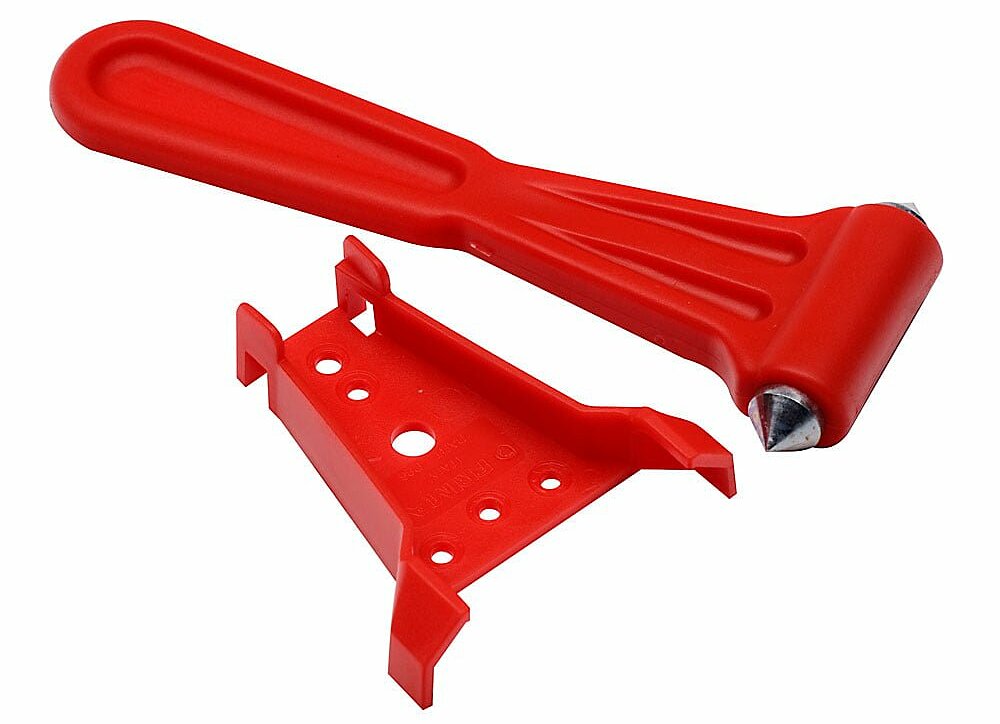 |
Traditional escape hammer with a holder. Photo: Stedall |
Its advantages include affordability, wide availability, and durability. Prices typically range from 50,000-200,000 VND. However, effectiveness depends on user strength. If a user is injured or the car's interior is deformed after a collision, using the hammer can be difficult due to limited space for a forceful swing. Therefore, this type is often more suitable for larger vehicles like passenger coaches and buses.
Spring-loaded glass-breaking hammers
This hammer operates using a spring-loaded mechanism. Users simply place the hammer head perpendicular to the glass and press firmly. When the applied pressure reaches a threshold, the spring-loaded pin automatically deploys, delivering a strong impact to the glass without needing a swinging motion.
Advantages of spring-loaded hammers include simple operation, reduced reliance on user strength, and usability in confined spaces. Drawbacks include a higher price than traditional hammers and the potential for the spring mechanism to lose effectiveness over time if the product is of poor quality or improperly maintained. Prices generally range from 200,000-600,000 VND. Additionally, spring-loaded hammers come in both traditional handheld versions and mini versions, no larger than a lighter or keychain, making them convenient to store in door compartments, handbags, or attached directly to a key ring.
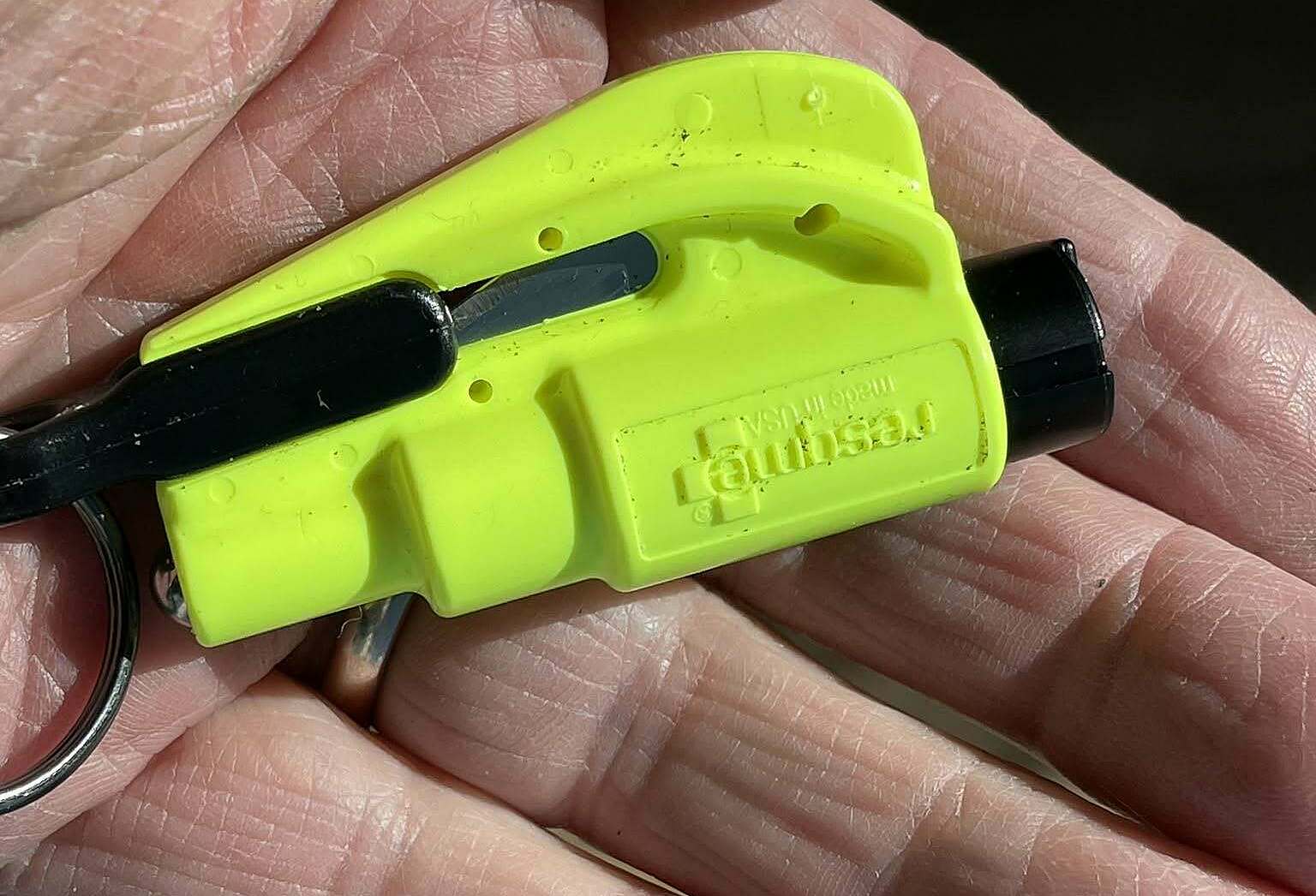 |
Mini glass-breaking device, using a spring-loaded mechanism. Photo: David Webster |
This type is suitable for most passenger cars, allowing seniors, women, or those seeking minimal force requirements to use it effectively. However, occupants must be instructed on the correct operation of this hammer.
Multi-functional escape hammers
Beyond glass-breaking, many products integrate rescue features such as: a seatbelt cutter, led flashlight, emergency warning light, alarm, magnet, or power bank.
The advantage of multi-functional tools is their support for various emergency situations, especially if a vehicle breaks down at night or on deserted roads. However, integrating more functions often increases product size, and some inexpensive products prioritize auxiliary features while their glass-breaking head fails to meet advertised quality.
This type suits individuals who frequently travel long distances, go on road trips, or drive inter-provincially. When choosing, users should prioritize glass-breaking capability and seatbelt cutting over additional features.
Tips for choosing and using an escape hammer
Regardless of the type chosen, car owners should prioritize products with a hardened steel or tungsten alloy glass-breaking head, an integrated seatbelt cutter, and a holder to secure it within the driver's reach.
An escape hammer is only effective if it can be retrieved and used within seconds. Suitable locations include the driver's door compartment, next to the driver's seat, or on the side of the front passenger seat. For vehicles with multiple rows of seats, equipping an additional hammer in the rear ensures passengers can also access it when needed. Avoid storing the hammer in the trunk, as the luggage compartment may not open after a collision.
Furthermore, not all types of car glass can be broken with an escape hammer. Typically, these hammers are designed to break tempered glass in side windows or the rear window. In contrast, windshields are usually laminated multiple layers to maintain structural integrity upon impact, making it very difficult to create an escape route with ordinary hammers.
Ho Tan