Most countries that designate the left highway lane for passing also prohibit vehicles from continuously occupying it. The definition of "continuous driving" varies, with some nations using absolute time limits and others applying exceptions.
Germany, for instance, adheres to the Rechtsfahrgebot principle (keep right), requiring vehicles to drive in the right lane when conditions permit. The left lane is primarily for passing. The law does not mandate immediate return to the right lane after passing, recognizing that constant lane changes can heighten collision risk.
To clarify this exception, German courts and the German Automobile Association (ADAC) employ the "20-second rule" as a practical guideline. This rule states that if a driver cannot remain in the right lane for at least 20 seconds before needing to overtake another vehicle, they may stay in the left lane. Conversely, if the right lane is clear for more than 20 seconds before the next overtaking opportunity, the driver must return to the right lane. Essentially, drivers should only remain in the left lane if actively preparing for another overtake; otherwise, they must move right.
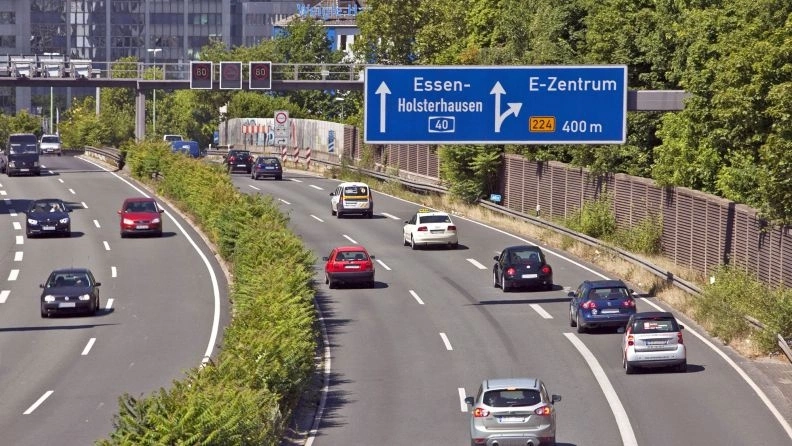 |
The Autobahn in Germany. Photo: dpa |
This guideline aims to reduce unnecessary lane changes while preventing drivers from occupying the passing lane without a valid reason. The 20-second benchmark is not explicitly stated in German road traffic law. Instead, it emerged from court rulings and is widely adopted by ADAC in driving guides to interpret the keep-right principle.
While Germany uses a specific time-based rule, most other countries do not specify how long drivers can use the passing lane. For nations like the US, Singapore, Australia, Malaysia, and the Philippines, which also use dedicated passing lanes, there are no regulations dictating duration or distance for left-lane usage. Instead, regulatory bodies and enforcement agencies evaluate based on the purpose of lane use and a vehicle's impact on traffic flow.
In the US, many states employ the concept of "impeding traffic." Washington state, for example, prohibits drivers from continuously operating in the left lane in a manner that obstructs vehicles behind them. This does not mean drivers must immediately return to the right lane after passing. If multiple slow-moving vehicles are ahead, and the driver plans to overtake again, they may remain in the left lane. However, if there is no further need to pass, but the driver continues in the left lane, preventing following vehicles from legally passing, this conduct may be deemed "impeding traffic," leading to a fine.
Other nations apply similar principles, requiring drivers to use the passing lane only when necessary. Upon completing an overtake, drivers must return to the normal lane when safe. Remaining in the passing lane without an overtaking purpose, particularly if it impedes vehicles behind, can be considered lane occupation or impeding traffic, depending on local terminology.
A common consensus among most countries is that the passing lane is not a regular travel lane. Drivers should not continuously occupy it, even when traveling at the maximum speed. Exceptions include heavy traffic where lanes move at similar speeds, or specific cases like avoiding obstacles, yielding to merging vehicles, or preparing to turn, as regulated by individual countries.
Pham Hai