Indian oil refiners are preparing to resume purchases of Iranian crude following the relaxation of US sanctions on Tehran, Reuters reported on 21/3, citing sources close to the matter. These refiners are awaiting government guidance and further details from Washington, particularly regarding payment terms.
This development follows a rush by Indian refiners to acquire Russian crude after the US permitted seaborne purchases from Russia until 11/4. India's crude oil reserves are considerably lower compared to other major Asian oil importers.
Beyond India, numerous oil refiners across other Asian countries are also assessing the feasibility of purchasing Iranian oil.
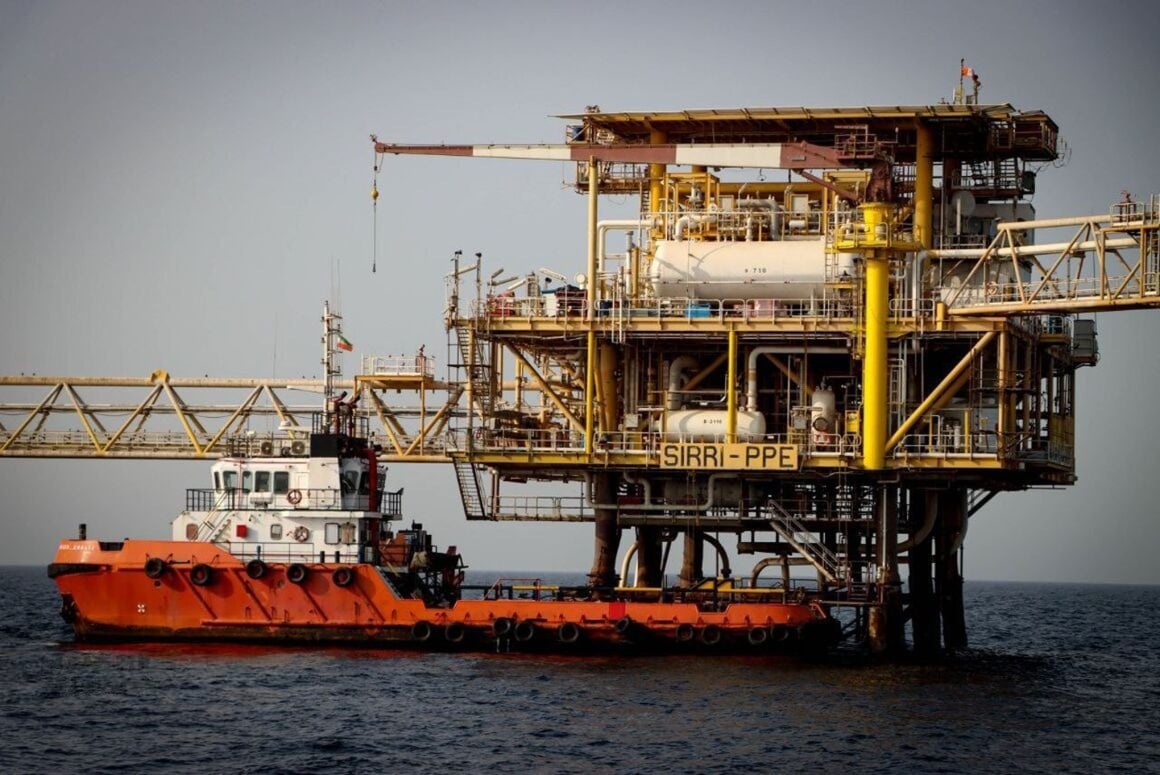 |
A vessel docked next to an offshore oil rig near Iran's Ilam city in the Persian Gulf, 9/2025. Photo: Iranintl |
Last weekend, US Treasury Secretary Scott Bessent announced a temporary 30-day waiver of sanctions on Iranian oil transported by sea. This waiver applies to oil loaded onto vessels on or before 20/3 and is effective until 19/4. This marks the third instance the US has lifted crude oil sanctions since the onset of the Middle East conflict.
Emmanuel Belostrino, a senior director at data firm Kpler, stated that approximately 170 million barrels of Iranian oil are currently on ships in the Gulf and near China. Earlier, on 19/3, consulting firm Energy Aspects estimated 130-140 million barrels of Iranian oil were floating at sea.
Asia currently relies on the Middle East for about 60% of its crude oil supply. The near closure of the Strait of Hormuz this month has compelled refiners across the region to reduce operating capacity and limit fuel exports.
In 2018, US President Donald Trump reimposed sanctions on Iran over its nuclear program. Since then, China has become the primary buyer of inexpensive Iranian oil, importing around 1,38 million barrels per day last year, according to Kpler data.
However, oil traders anticipate several challenges in resuming Iranian oil purchases, ranging from payment methods to the fact that much of the oil is transported by an aging fleet. Furthermore, some previous Iranian oil customers were required to buy directly from the National Iranian Oil Company, but since the US reimposed sanctions, most of the country's oil has been sold via third parties.
"It will take time to sort out compliance issues, administrative procedures, or banking. But I think everyone will try to implement it as soon as possible," a Singapore-based trader commented.
Prior to the reimposition of sanctions, Iran's major oil customers included India, South Korea, Japan, Italy, Greece, Taiwan, and Turkey, in addition to China.
Iran possesses one of the world's largest oil reserves. Data from the US Energy Information Administration (EIA) indicates that by late 2023, the country accounted for 24% of the Middle East's oil reserves and 12% globally. Despite this, its production has been constrained by years of international sanctions and insufficient investment.
The nation produces 3,3 million barrels of crude oil daily, along with approximately 1,3 million barrels of condensate and other liquid fuels. Iranian oil refineries have a combined capacity of 2,6 million barrels per day, according to consulting firm FGE.
In a 6/2025 report, the International Energy Agency (IEA) estimated that Iran exports about 1,7 million barrels of crude oil and condensate daily. The country is also a significant exporter of oil products, shipping nearly 820,000 barrels of fuel per day, according to Kpler data, a slight increase from 2024. Approximately 90% of its crude oil exports pass through Kharg Island for transit via the Strait of Hormuz.
Currently, this Gulf nation is the 3rd largest crude oil producer within the Organization of the Petroleum Exporting Countries (OPEC), contributing 4,5% of the global supply.
Ha Thu (according to Reuters)