At the dialogue forum between the Ministry of Agriculture and Environment and businesses on the morning of 18/6, Ms. Le Thi Hong Nhi, representing the European Chamber of Commerce in Vietnam (EuroCham), stated that one of the biggest current obstacles is procedures related to environmental protection fees for emissions.
According to business feedback, the declaration form for these fees is currently long and complicated, while guidance from regulatory agencies is not clear. Businesses spend much time completing dossiers but "are still unsure if they have done it correctly".
 |
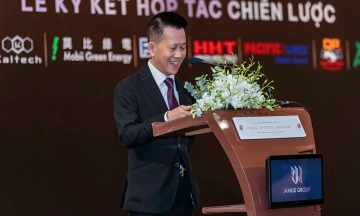
Ms. Le Thi Hong Nhi speaks at the forum on the morning of 18/6. *Photo: G.C* |
In addition to declaration procedures, the method for calculating environmental protection fees is cumbersome. Ms. Hong Nhi noted that businesses must process many technical parameters and perform complex spreadsheets to determine the amount payable. In some cases, businesses spend up to two weeks just to complete the calculation.
EuroCham recommended that regulatory agencies simplify the fee calculation formula and develop an online tool for businesses to input data and receive automatic results. Authorities also need to add visual guides on the public service portal to reduce the time businesses spend on procedures.
Another issue raised by businesses is the procedure for granting environmental permits and environmental impact assessments (EIA). According to the EuroCham representative, when implementing new projects, businesses still have to seek opinions from various agencies and revise their dossiers multiple times before obtaining permits. Some regulations also do not clarify the relationship between the EIA approval decision and the environmental registration procedure, confusing businesses when taking subsequent project steps.
European businesses also believe that regulations on adjusting environmental permits do not truly encourage technological innovation. In many cases, they must redo administrative procedures even if technological changes help reduce environmental impact and emissions.
 |
The public administrative service center in TP HCM. *Photo: Dinh Van* |
Not only foreign businesses, but domestic entities also face difficulties in preparing dossiers and procedures. A representative from the Vietnam Chamber of Commerce and Industry (VCCI) stated that among more than 870 recommendations from businesses sent to regulatory agencies since the beginning of this year, many relate to the agriculture and environment sectors.
VCCI argues that some regulations are unclear and inconsistent across legal documents, leading to different interpretations by localities. Many businesses report difficulties in mortgaging mineral exploitation rights, handling secured assets, or carrying out procedures related to land, quarantine, and raw material imports.
For instance, petroleum businesses are required to have an environmental protection professional certificate, while the regulations guiding training and issuance of such certificates expired many years ago.
Many entities propose replacing the environmental protection deposit requirement when importing scrap with bank guarantees or risk-based management to reduce capital costs.
Deputy Minister of Agriculture and Environment Nguyen Hoang Hiep acknowledged that regulatory agencies need to review regulations and implementation methods when businesses continuously report the same group of issues. "A procedure that requires two weeks just to calculate how much money to pay clearly has a problem," Mr. Hiep said.
 |
Deputy Minister of Agriculture and Environment Nguyen Hoang Hiep speaks at the forum. *Photo: G.C* |
According to the Deputy Minister, the goal of regulatory agencies is to design procedures in a way that businesses can easily perform them, clearly understand their obligations, and complete them in a short time instead of having to dedicate too many resources to administrative tasks.
He stated that the Ministry will continue to review regulations to simplify dossiers, procedures, and reduce unnecessary requirements in the environmental sector.
Compared to 2024, the Ministry of Agriculture and Environment has reduced nearly 9,000 days for procedure resolution, saving businesses over 5,300 billion VND. Specifically, for the 2025-2026 period, the Ministry has abolished 108 procedures, simplified 88, and decentralized 58 other procedures, reducing the total number of current administrative procedures to 555.
Gia Chinh