Janus Group announced that these senior personnel adjustments are part of its roadmap to strengthen the leadership structure. The aim is to clearly delineate the strategic governance role of the Board of Directors from the direct operational execution capabilities of the Executive Board, supporting the company's restructuring strategy into a Holdings model (parent company - subsidiary).
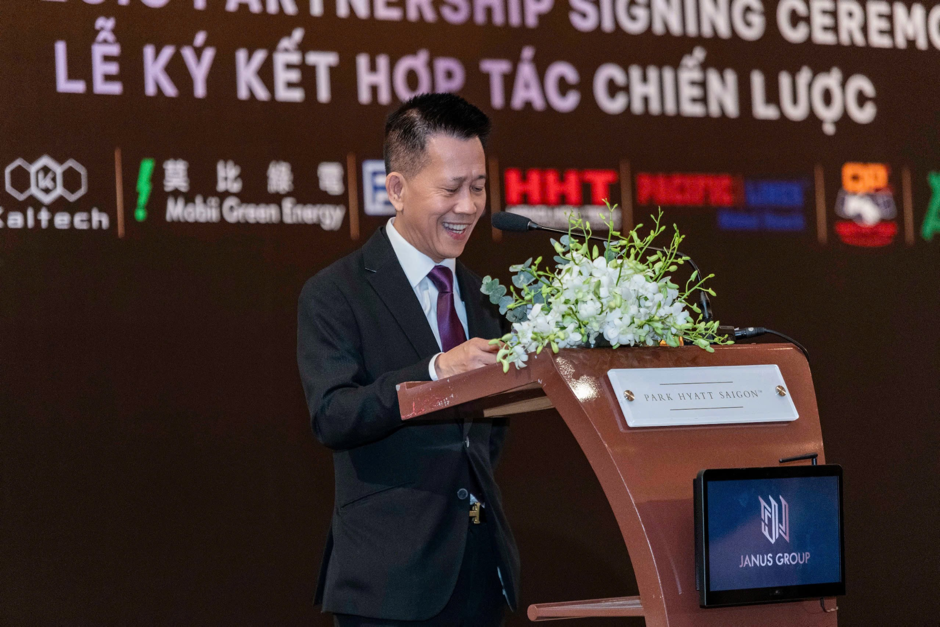 |
Ching Heng Hoe speaks at Janus Group's strategic cooperation signing ceremony. Photo: Janus Group
The new Chairman, Ching Heng Hoe, transitioned from his role as General Director to assume this new position. A Malaysian national, he brings over 40 years of experience in master planning, sustainable urban development, and applying environmental, social, and governance (ESG) standards across Asia. In Vietnam, he directly contributed to developing a social housing project of 1,500 units in Da Nang and spearheaded major constructions such as Melinh Point, Vietcombank Tower, and Hilton Saigon. The leadership anticipates that his deep understanding of international standards will enable the company to unlock a portfolio of large-scale infrastructure, green real estate, and renewable energy projects in the future.
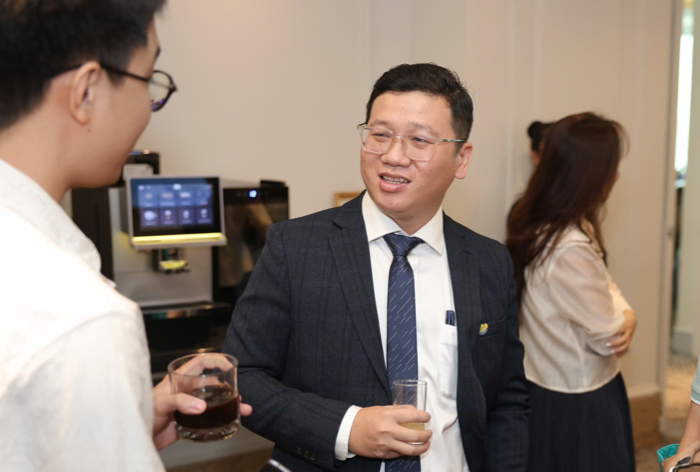 |
Nguyen The An exchanges with shareholders at the annual General Meeting of Shareholders. Photo: Janus
Replacing Ching Heng Hoe as the company's operational head is Nguyen The An, who has served as the company's Chief Accountant since 2023. The new General Director possesses strong expertise in financial management and agricultural supply chain operations. Before joining Janus Group, he held management positions at several companies in the food and agriculture sectors.
This leadership reorganization coincides with the company's rebranding to Janus Group and its operational model transformation. Under the new structure, the parent company focuses on capital management, strategy development, and investment direction. Member entities will autonomously operate their respective core business segments. The company's ecosystem now spans agriculture, logistics, real estate, energy, and infrastructure.
Currently, agriculture and real estate contribute the majority of Janus Group's revenue structure. For the first nine months of fiscal year 2026 (from 1/10/2025 to 30/6/2026), the rice production segment accounted for 83% of total revenue. Real estate comprised 12%, with logistics contributing the remaining 5%.
To boost its real estate segment, the company plans to participate in a 4,000 billion dong commercial, service, and accommodation complex project in Da Nang, with a committed minimum ownership of 70%. In the agricultural sector, the parent company recently reduced its ownership stake in its subsidiary, TCO Agi, to approximately 51%. This move aims to directly share benefits with the operational team at the production facility, while continuing to maintain rice production as a primary business pillar.
At the close of the first nine months of fiscal year 2026, Janus Group reported a profit after tax of 32 billion dong, achieving 62% of its full-year plan. The company's leadership targets completing its profit plan in the final quarter of the fiscal year, driven by the peak summer-autumn rice harvest season and increased operational capacity across its factory system.
Janus Group was formerly Duyen Hai Transport Co. Ltd., established in 1997. Originating from logistics and multimodal transport operations, the company officially listed its shares on HoSE (stock code TCO) in 2012. Over nearly 30 years of development, the company was previously known as TCO Holdings before its current rebranding to Janus Group. This name change aligns with a comprehensive strategic shift towards a Holdings model. Currently, the group's ecosystem has expanded from its core logistics sector into rice production, real estate, energy, and urban infrastructure segments.
By Thanh Thu